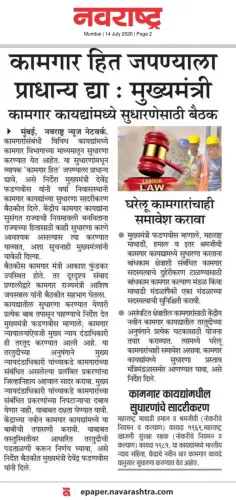
CM Fadnavis Chairs Meet on Labour Welfare Act Amendments
Synopsis
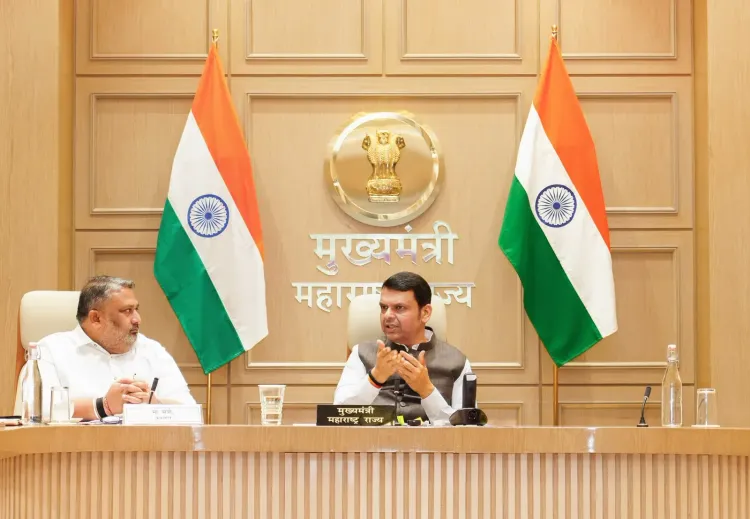
Chief Minister Devendra Fadnavis chaired a meeting at Varsha Bungalow on 13 July 2026 to deliberate on amendments to Maharashtra's two key labour welfare statutes covering manual workers and private security guards. Ministers Akash Fundkar and Adv. Ashish Jaiswal attended alongside senior officials.
Key Takeaways
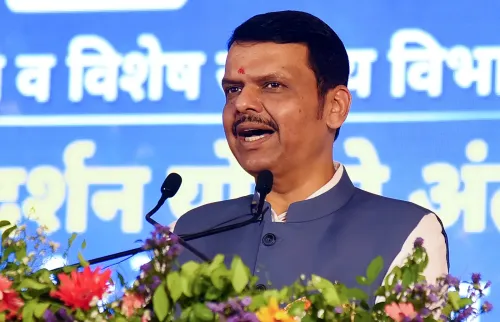
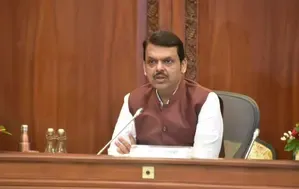
CM Devendra Fadnavis chaired the meeting at Varsha Bungalow, Mumbai on 13 July 2026 at 12 noon .
The meeting focused on amendments to the Maharashtra Mathadi, Hamal and Other Manual Workers Act, 1969 .
Proposed changes to the Maharashtra Private Security Guards Act, 1981 were also on the agenda.
Minister Akash Fundkar and MoS Adv.
Ashish Jaiswal were present alongside senior officials.
The specific content of the proposed amendments has not yet been disclosed by the government.
Both statutes cover some of Maharashtra's most economically vulnerable informal-sector workers.
The Chief Minister's Office of Maharashtra announced on Monday, 13 July 2026, that Chief Minister Devendra Fadnavis chaired a high-level meeting at Varsha Bungalow, Mumbai, to deliberate on proposed amendments to two foundational labour welfare statutes — the Maharashtra Mathadi, Hamal and Other Manual Workers (Regulation of Employment and Welfare) Act, 1969, and the Maharashtra Private Security Guards (Regulation of Employment and Welfare) Act, 1981. The meeting, held at 12 noon, was attended by Minister Akash Fundkar, Minister of State Adv. Ashish Jaiswal, and senior government officials.
Context
The Maharashtra Mathadi, Hamal and Other Manual Workers Act was enacted in 1969 to regulate employment conditions and administer welfare funds for headloaders, hamalis, and other manual labourers working in the unorganised sector. The Maharashtra Private Security Guards Act followed in 1981 to address the rapidly expanding private security workforce, covering registration norms, wages, and welfare entitlements. Both statutes have governed large sections of Maharashtra's informal and semi-formal labour force for decades.
Policy Backdrop
Maharashtra has periodically revisited its older labour welfare laws to align them with evolving employment patterns in the informal sector. These targeted revisions reflect a broader state-level approach to updating occupational protections that were originally designed for specific worker categories. Nationally, the implementation of four consolidated labour codes has remained partial, making state-level amendments to existing statutes particularly significant for workers not yet covered under the new framework.
The two acts under review collectively cover some of the most economically vulnerable occupational groups — mathadi (headloaders) and hamal (manual carriers) workers, along with private security personnel — who depend on state-administered welfare boards for benefits such as housing, medical aid, and provident fund contributions.
Stakeholders and Impact
The primary beneficiaries of any amendment would be mathadi and hamal workers, manual labourers, and private security guards across Maharashtra — all of whom are registered under the respective welfare boards. Any revision to contribution structures, benefit entitlements, or registration procedures under these acts would directly affect their livelihoods and social security access. Industry bodies employing contract labour and private security agencies would also be subject to revised compliance obligations.
The presence of both Minister Akash Fundkar and Minister of State Adv. Ashish Jaiswal alongside senior officials signals that the review carries cabinet-level priority. The specific content of the proposed amendments was not disclosed by the Chief Minister's Office at this stage.
What's Next
The next steps are expected to include formal drafting of amendment bills for introduction in the Maharashtra Legislative Assembly, potentially followed by consultations with trade unions representing mathadi and hamal workers, private security associations, and relevant industry stakeholders. The outcome of this review could reshape welfare board operations and employer compliance requirements that have remained largely unchanged for several decades.
Point of View
State-level amendments to occupational welfare acts carry outsized significance for workers outside the formal economy. The cabinet-level attendance at what is ostensibly a review meeting suggests the amendments may be substantive rather than cosmetic. How the government balances employer compliance costs against expanded worker benefits will be the defining political test of this exercise.
NationPress
12 Oct 2026
Frequently Asked Questions
What acts did CM Devendra Fadnavis review at the 13 July 2026 meeting?
CM Fadnavis chaired a meeting to deliberate on amendments to the Maharashtra Mathadi, Hamal and Other Manual Workers (Regulation of Employment and Welfare) Act, 1969, and the Maharashtra Private Security Guards (Regulation of Employment and Welfare) Act, 1981.
Where was the Maharashtra labour welfare amendment meeting held?
The meeting was held at Varsha Bungalow in Mumbai on 13 July 2026 at 12 noon.
Who attended the labour welfare meeting chaired by CM Fadnavis?
Minister Akash Fundkar, Minister of State Adv. Ashish Jaiswal, and senior government officials attended the meeting alongside Chief Minister Devendra Fadnavis.
What is the Maharashtra Mathadi Hamal Act 1969?
The Maharashtra Mathadi, Hamal and Other Manual Workers (Regulation of Employment and Welfare) Act, 1969 is a state law that regulates employment conditions and administers welfare funds for headloaders, hamalis, and other manual labourers in the unorganised sector.
What changes are proposed to Maharashtra's labour welfare acts?
The specific content of the proposed amendments has not been disclosed by the Chief Minister's Office; the 13 July 2026 meeting was a review-stage deliberation, with formal amendment bills expected to be drafted subsequently.