CM Fadnavis: Maharashtra mangrove cover up 12.39 sq km since 2021
Synopsis
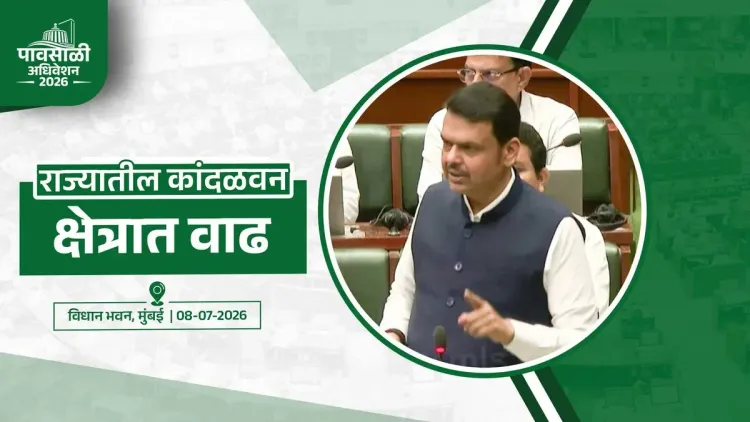
Chief Minister Devendra Fadnavis told the Maharashtra legislature on 8 July 2026 that mangrove cover in the state has expanded by 12.39 square kilometres since 2021, framing the gains as critical protection for Mumbai and the coastline during the Monsoon Session 2026.
Key Takeaways
Maharashtra Chief Minister Devendra Fadnavis announced a 12.39 sq km increase in state mangrove cover since 2021 .
The statement was made at the Maharashtra Vidhan Sabha during the Monsoon Session 2026 on 8 July 2026 .
Mangroves were described as essential natural protection for Mumbai and the broader Maharashtra coastline against flooding and erosion.
The Union government's MISHTI scheme , launched in the 2023 Union Budget , supports mangrove expansion across coastal states including Maharashtra.
The Maharashtra Forest Department oversees mangrove mapping, plantation drives, and CRZ enforcement underpinning these gains.
Independent verification is expected through the next State of Forest Report by the Forest Survey of India .
Maharashtra Chief Minister Devendra Fadnavis announced on Wednesday, 8 July 2026, that the state's mangrove cover has grown by 12.39 square kilometres since 2021, citing the ecological role of mangroves in protecting Mumbai and the broader coastline. The statement was made from the Maharashtra Vidhan Sabha in Mumbai during the ongoing Monsoon Session 2026.
Context
Addressing the legislature, CM Fadnavis stated: 'Mangrove conservation is extremely important, as it helps protect Mumbai and the coastline.' In Marathi, he added — कांदळवन संवर्धन अत्यंत महत्त्वाचे असून, कांदळवनांमुळे मुंबई व किनारपट्टी सुरक्षित राहते [Mangrove conservation is extremely important, and mangroves keep Mumbai and the coastline safe]. The bilingual address signalled the government's intent to frame mangrove protection as a mainstream policy priority rather than a niche environmental concern.
The 12.39 sq km increase, recorded between 2021 and the present, represents incremental but measurable progress in a coastal ecosystem that has faced sustained pressure from urban expansion, land reclamation, and infrastructure development along Mumbai's suburban shoreline.
Policy Backdrop
Maharashtra's mangrove push sits within a broader national framework. The Union government launched the MISHTI (Mangrove Initiative for Shoreline Habitats and Tangible Incomes) scheme in the 2023 Union Budget to expand mangrove cover across coastal states, with Maharashtra among the key beneficiaries. The scheme ties ecological restoration to livelihood support for fishing communities, aligning conservation with economic incentives.
At the state level, the Maharashtra Forest Department has been responsible for mangrove mapping, plantation drives, and enforcement of Coastal Regulation Zone (CRZ) rules that restrict construction near sensitive coastal habitats. Successive state administrations have reported gradual gains in mangrove area, though urban development pressures — particularly in Mumbai's flood-prone western and northern suburbs — have historically offset restoration efforts.
Mangroves are increasingly recognised as natural infrastructure: their dense root systems buffer storm surges, reduce coastal erosion, and absorb floodwaters — functions that carry direct relevance for a megacity like Mumbai, which faces recurring monsoon flooding and long-term sea-level rise projections.
Stakeholders and Impact
The communities most directly affected by mangrove health include Mumbai's coastal fishing villages (koliwadas), residents of flood-vulnerable suburbs such as Vikhroli, Bhandup, and Thane, and the broader urban population that depends on mangroves as a first line of defence against cyclonic weather. Environmental groups have long argued that robust mangrove cover can reduce the economic cost of monsoon damage to road, rail, and housing infrastructure.
Fishermen along the Konkan coast also benefit from healthy mangrove ecosystems, which serve as nurseries for commercially important fish and crustacean species. Any sustained increase in cover is therefore both an ecological and an economic signal for these communities.
What's Next
Attention will now turn to the forthcoming State of Forest Report by the Forest Survey of India, which independently maps and verifies forest and mangrove cover across all states. That report will either corroborate or contextualise the 12.39 sq km figure cited by CM Fadnavis. Observers will also watch whether the Monsoon Session 2026 produces supplementary budget allocations for mangrove restoration, which would translate the Chief Minister's floor statement into funded policy action. As climate risk for coastal cities intensifies, Maharashtra's ability to sustain and accelerate mangrove gains will be a key indicator of its coastal resilience preparedness.
Point of View
Raising the political stakes of the figure. The bilingual delivery in both English and Marathi signals an attempt to reach both a national policy audience and Maharashtra's vernacular electorate simultaneously. More broadly, the statement positions mangrove conservation not as a peripheral green agenda but as core urban risk management — a framing that aligns with India's wider push to treat natural ecosystems as climate infrastructure.
NationPress
7 Oct 2026
Frequently Asked Questions
How much has Maharashtra's mangrove cover increased?
According to Chief Minister Devendra Fadnavis, Maharashtra's mangrove cover has increased by 12.39 square kilometres since 2021, as stated in the Vidhan Sabha on 8 July 2026.
Why are mangroves important for Mumbai?
Mangroves act as a natural buffer against storm surges, coastal erosion, and monsoon flooding. For Mumbai, a low-lying coastal megacity, mangrove belts along its suburban shoreline help reduce flood damage to residential and infrastructure zones.
What is the MISHTI scheme?
MISHTI stands for Mangrove Initiative for Shoreline Habitats and Tangible Incomes. It was launched in India's 2023 Union Budget to expand and restore mangrove cover across coastal states, including Maharashtra, while also supporting livelihoods of coastal fishing communities.
Who monitors mangrove cover in Maharashtra?
The Maharashtra Forest Department is the primary state agency responsible for mangrove mapping, plantation drives, and enforcement of Coastal Regulation Zone rules. National-level verification is conducted by the Forest Survey of India through its periodic State of Forest Reports.
What was discussed in Maharashtra Monsoon Session 2026?
The Maharashtra Vidhan Sabha's Monsoon Session 2026 began in July 2026. Among the issues raised was mangrove conservation, with CM Fadnavis citing a 12.39 sq km increase in state mangrove cover since 2021 as evidence of the government's coastal protection efforts.