Chhattisgarh Cabinet Clears Rent Control Amendment Bill 2026
Synopsis
The Chhattisgarh cabinet has cleared the draft Rent Control Amendment Bill 2026, bringing the state's 2011 tenancy law in line with India's Model Tenancy Act, 2021. The bill defines landlord and tenant rights, introduces property-manager provisions, and sets up faster dispute resolution through rent tribunals.
Key Takeaways
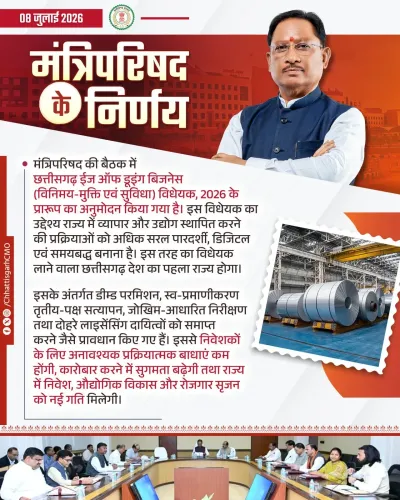
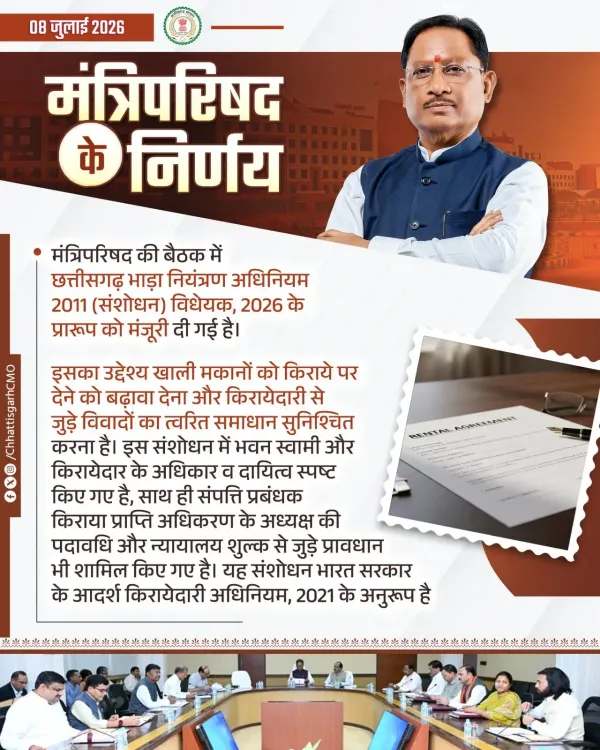
The Chhattisgarh cabinet approved the draft Chhattisgarh Rent Control Act, 2011 (Amendment) Bill, 2026 on 8 July 2026 .
The amendment aims to encourage owners of vacant properties to lease them out by providing a clearer legal framework.
It explicitly defines the rights and obligations of both landlords and tenants under Chhattisgarh law.
New provisions cover property managers, rent receipts, tenure of the rent tribunal chairperson, and court fees .
The bill aligns with the Government of India's Model Tenancy Act, 2021 , following a national pattern of rent-law reform.
The bill must next be introduced and passed in the Chhattisgarh Vidhan Sabha before it becomes law.
The Chief Minister's Office of Chhattisgarh announced on 8 July 2026 that the state cabinet has approved the draft of the Chhattisgarh Bhadha Niyantran Adhiniyam (Rent Control Act), 2011 (Amendment) Bill, 2026, a move aimed at encouraging landlords to lease vacant properties and ensuring faster resolution of tenancy disputes.
The official post stated: 'Mantriparishad ki baithak mein Chhattisgarh Bhada Niyantran Adhiniyam, 2011 (Sanshodhan) Vidheyak, 2026 ke praroop ko manjuri di gayi hai' — 'The draft of the Chhattisgarh Rent Control Act, 2011 (Amendment) Bill, 2026 has been approved in the cabinet meeting.' The amendment explicitly defines the rights and obligations of both building owners and tenants, and introduces provisions relating to property managers, rent receipts, the tenure of the rent tribunal chairperson, and court fees.
Context
Chhattisgarh's existing rent control framework dates to 2011, a statute that critics have long argued favours protracted litigation over swift dispute resolution. Urban housing surveys across central Indian states have repeatedly flagged large numbers of vacant dwellings whose owners are reluctant to let them out, fearing difficulty in eviction and delayed court proceedings. The cabinet's approval of the amendment bill is a direct response to those structural concerns.
The bill aligns explicitly with the Government of India's Model Tenancy Act, 2021, a template circulated by the Ministry of Housing and Urban Affairs to nudge states away from colonial-era rent-control regimes. The CMO's post confirmed: 'Yeh sanshodhan Bharat Sarkar ke Aadarsh Kirayedari Adhiniyam, 2021 ke anurup hai' — 'This amendment is in conformity with the Central Government's Model Tenancy Act, 2021.'
Policy Backdrop
The Model Tenancy Act, 2021 was designed to replace pre-independence and post-independence rent-control statutes that had effectively frozen rental markets by capping rents at levels that made leasing financially unattractive. The central model introduces time-bound written agreements, property-manager provisions, and dedicated rent authorities and tribunals to adjudicate disputes outside overloaded civil courts.
Several states have moved to adopt or align with the model since 2021, seeking to unlock idle urban housing stock. Chhattisgarh's amendment follows this national pattern, adding clarity on landlord and tenant obligations — a gap that had historically been the root cause of most tenancy litigation in the state.
Stakeholders and Impact
Landlords stand to benefit from clearer eviction pathways and defined rent-receipt obligations, reducing the risk that has historically kept residential units off the rental market. Tenants, particularly migrant workers and lower-income urban residents in cities such as Raipur and Bilaspur, are expected to gain from standardised agreements that protect against arbitrary eviction and opaque fee structures.
The inclusion of provisions governing property managers — intermediaries who manage rental assets on behalf of owners — is a notable addition that reflects the growing professionalisation of urban rental markets. Separately, the clarification of court-fee structures and the tenure of the rent tribunal chairperson is expected to lend institutional stability to the dispute-resolution mechanism.
What's Next
Cabinet approval of the draft bill is the first step; the legislation must now be introduced and passed in the Chhattisgarh Vidhan Sabha before it can be notified as law. Following legislative passage, the state government will need to frame rules and constitute the rent tribunal envisaged under the amended act.
If enacted, the reform could meaningfully expand the supply of formally rented housing in Chhattisgarh, contributing to the broader national goal of 'Housing for All' by bringing currently idle units into the market through a more predictable legal framework.
Point of View
The state insulates itself from charges of bias and gains a ready policy justification. The emphasis on a dedicated rent tribunal is particularly significant: it acknowledges that overloaded civil courts have been the single biggest deterrent to landlords entering the formal rental market. If the Vidhan Sabha passes the bill swiftly, Chhattisgarh could become a benchmark for other central and eastern Indian states still sitting on colonial-era rent statutes.
NationPress
7 Oct 2026
Frequently Asked Questions
What is the Chhattisgarh Rent Control Amendment Bill 2026?
It is a draft amendment to the Chhattisgarh Bhadha Niyantran Adhiniyam (Rent Control Act), 2011, approved by the state cabinet on 8 July 2026. The bill seeks to encourage renting of vacant homes, clarify landlord and tenant rights, and speed up dispute resolution through dedicated rent tribunals.
How does the Chhattisgarh amendment relate to the Model Tenancy Act 2021?
The amendment is explicitly designed to align Chhattisgarh's 2011 rent law with the Government of India's Model Tenancy Act, 2021, which the Ministry of Housing and Urban Affairs circulated as a template for states to modernise outdated rent-control statutes.
What new provisions does the Chhattisgarh Rent Control Amendment Bill 2026 include?
The bill includes provisions on property managers, rent receipts, the tenure of the rent tribunal chairperson, and court fees, in addition to clearly defining the rights and obligations of both building owners and tenants.
Will the bill immediately become law after cabinet approval?
No. Cabinet approval clears the draft for introduction in the Chhattisgarh Vidhan Sabha. The bill must be debated and passed by the state legislature before it can be notified as law and rules framed.
How will the amendment benefit tenants and landlords in Chhattisgarh?
Landlords are expected to feel more confident leasing vacant properties due to clearer eviction and rent-receipt rules, while tenants gain standardised agreements and access to a dedicated tribunal for faster, cheaper dispute resolution outside overloaded civil courts.