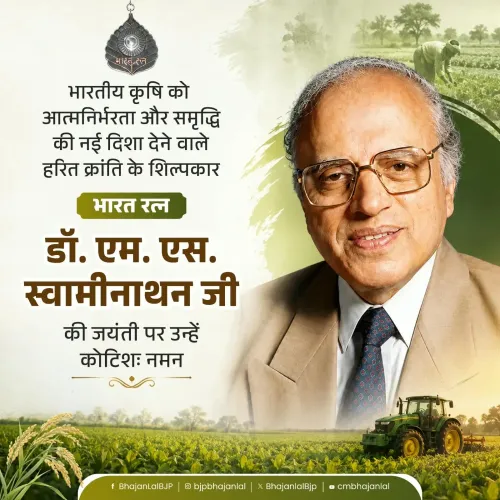
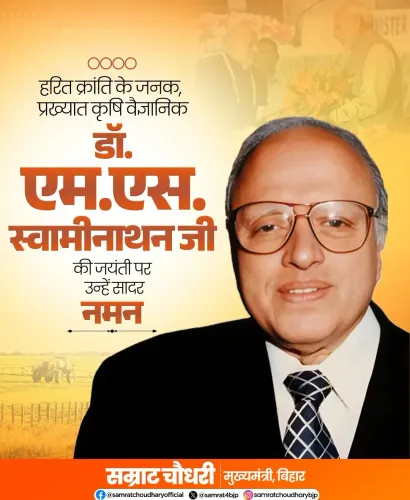
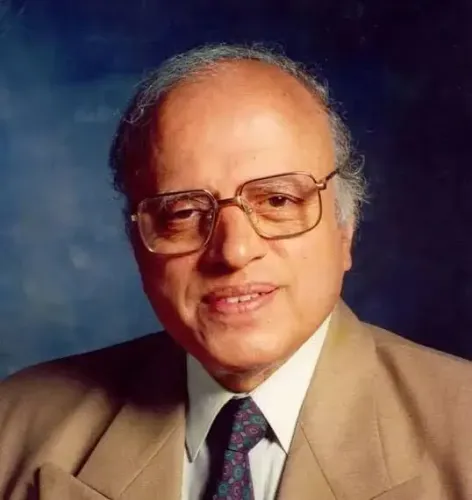
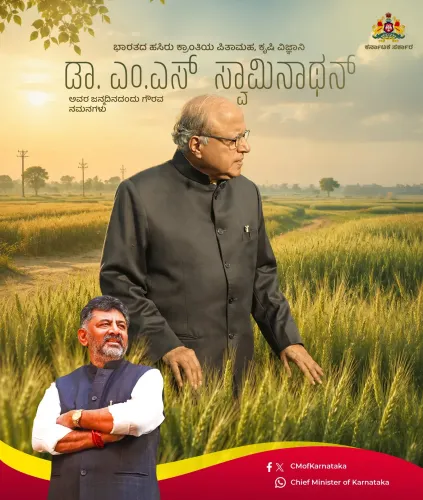
CM Fadnavis marks Swaminathan birth anniversary as Sustainable Agriculture Day

Synopsis
Maharashtra CM Devendra Fadnavis marked Dr. M. S. Swaminathan's birth anniversary on 7 August 2026 as 'Shashwat Sheti Din', calling for climate-friendly, tech-driven farming — positioning the occasion as Maharashtra's commitment to post-Green Revolution sustainability.
Key Takeaways
CM Devendra Fadnavis observed 7 August 2026 as Shashwat Sheti Din (Sustainable Agriculture Day) to mark Dr.
Swaminathan's birth anniversary.
Swaminathan is credited as the father of India's Green Revolution, which transformed the country's food security in the 1960s–70s .
Fadnavis called for advancing 'climate-friendly, tech-driven, and sustainable farming practices' in Maharashtra.
India launched the National Mission for Sustainable Agriculture in 2011 to promote climate-resilient farming under its National Action Plan on Climate Change.
Whether 'Shashwat Sheti Din' has been formally notified as an official state observance has not been confirmed in public records.
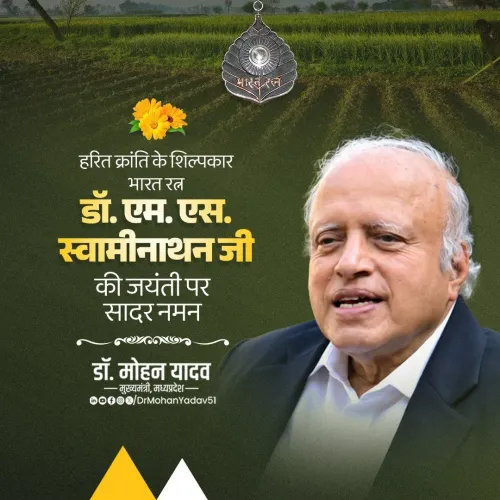
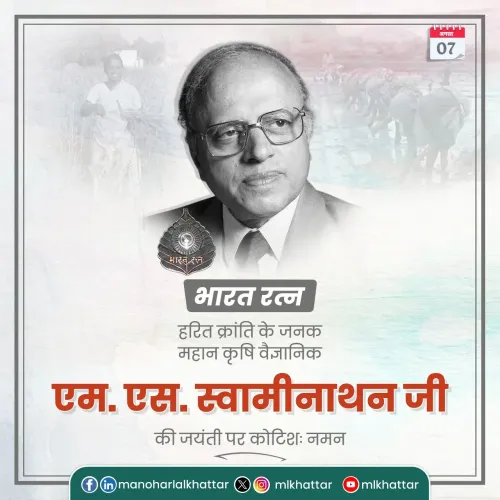
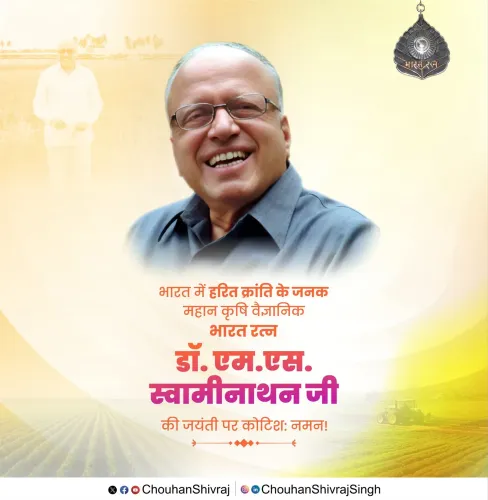
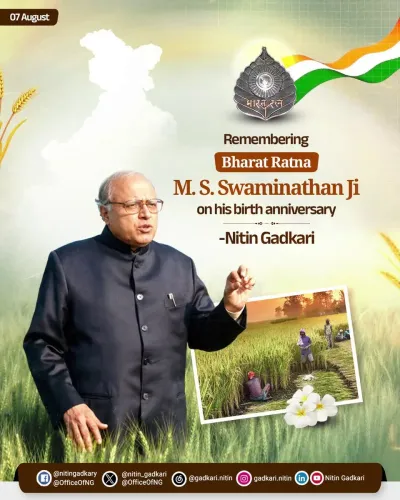
Half a century after Dr. M. S. Swaminathan helped pull India back from the brink of famine, Maharashtra Chief Minister Devendra Fadnavis invoked his legacy on Friday, 7 August 2026 — calling on the state to honour the father of India's Green Revolution by committing to the next agricultural frontier: sustainability.
Fadnavis marked the birth anniversary of Bharat Ratna Dr. M. S. Swaminathan by framing the occasion as 'Shashwat Sheti Din' (Sustainable Agriculture Day), urging farmers and policymakers alike to weave together new technology and nature. 'Let's commit to advancing climate-friendly, tech-driven, and sustainable farming practices,' he wrote, posting in both English and Marathi.
From Green Revolution to green reckoning
Swaminathan's work in the 1960s and 1970s introduced high-yielding crop varieties that transformed India from a food-deficit nation into a grain-surplus one — a shift that fed hundreds of millions. But the revolution's chemical-intensive playbook left a long shadow: soil degradation, groundwater depletion, and shrinking biodiversity have steadily eroded the gains.
India's policy response began taking shape in 2011 with the launch of the National Mission for Sustainable Agriculture, part of the country's National Action Plan on Climate Change. The mission sought to pivot farming toward climate-resilient, water-efficient practices — acknowledging that the Green Revolution's model needed a successor, not just a sequel.
Maharashtra's alignment with a national shift
Fadnavis's call is not ceremonial in isolation. Maharashtra, one of India's largest agricultural states, has pursued modernisation through successive administrations, and the CM's post fits squarely into a broader national trajectory: balancing output with environmental safeguards. Several states have introduced dedicated observances and missions to accelerate technology adoption in farming, and Maharashtra's framing of Swaminathan's birthday as a day of sustainable-agriculture commitment follows that pattern.
The watch now shifts to whether the state follows the symbolic moment with concrete policy — specific schemes, pilot projects, or budgetary allocations in the next Maharashtra agriculture policy review that would give 'Shashwat Sheti Din' institutional weight.
Swaminathan himself spent his later decades arguing that the Green Revolution's unfinished business was precisely this: marrying productivity with ecological responsibility. On what would have been his birth anniversary, India's most populous agrarian state named that argument its headline for the day.
Point of View
Fadnavis is doing something politically deft: borrowing the moral authority of the Green Revolution to frame a post-Green Revolution agenda — one that demands difficult trade-offs between yield and ecology. The move aligns Maharashtra with a national policy arc that has been building since the 2011 sustainability mission, but the gap between symbolic observance and funded, notified state policy remains real. For a state where agrarian distress has repeatedly shaped electoral outcomes, converting this rhetoric into measurable scheme delivery will be the true test of the commitment Fadnavis is publicly staking today.
NationPress
21 Sept 2026
Frequently Asked Questions
Who was Dr. M. S. Swaminathan and why is he called the father of India's Green Revolution?
Dr. M. S. Swaminathan was an agricultural scientist who played a central role in introducing high-yielding crop varieties in India during the 1960s and 1970s, dramatically boosting foodgrain production and averting widespread famine. He was awarded the Bharat Ratna, India's highest civilian honour, for this contribution.
What is Shashwat Sheti Din?
'Shashwat Sheti Din' means Sustainable Agriculture Day in Marathi. Maharashtra CM Devendra Fadnavis observed Dr. Swaminathan's birth anniversary — 7 August 2026 — under this name, calling for a commitment to climate-friendly and technology-driven farming. Whether it has been formally notified as an official state observance has not been confirmed.
What is India's National Mission for Sustainable Agriculture?
Launched in 2011 as part of India's National Action Plan on Climate Change, the National Mission for Sustainable Agriculture aims to make Indian farming more climate-resilient by promoting water conservation, reduced chemical inputs, and sustainable land management.
What did CM Fadnavis say about sustainable farming on 7 August 2026?
CM Fadnavis posted on X urging farmers and policymakers to advance 'climate-friendly, tech-driven, and sustainable farming practices', framing Dr. Swaminathan's birth anniversary as an occasion to recommit to balancing agricultural productivity with environmental responsibility.
What is the connection between the Green Revolution and current sustainability concerns in India?
While the Green Revolution of the 1960s–70s secured India's food supply, its reliance on chemical inputs and intensive irrigation has since contributed to soil degradation, groundwater depletion, and biodiversity loss. Post-Green Revolution Indian policy, including Maharashtra's push, seeks to address these consequences through sustainable, technology-assisted farming.