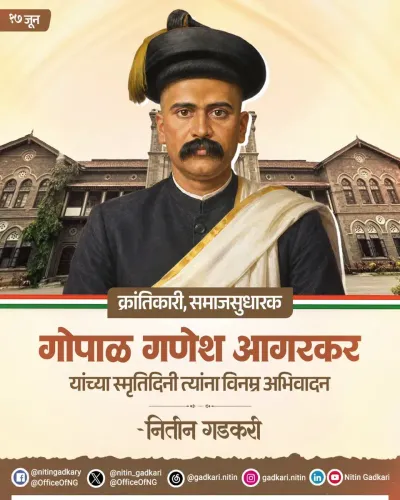
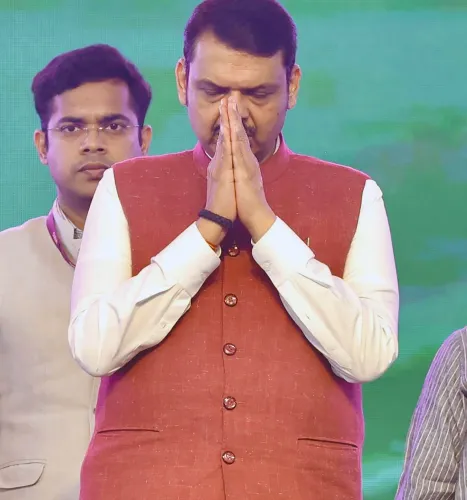
CM Fadnavis Pays Tribute to Reformer Gopal Ganesh Agarkar
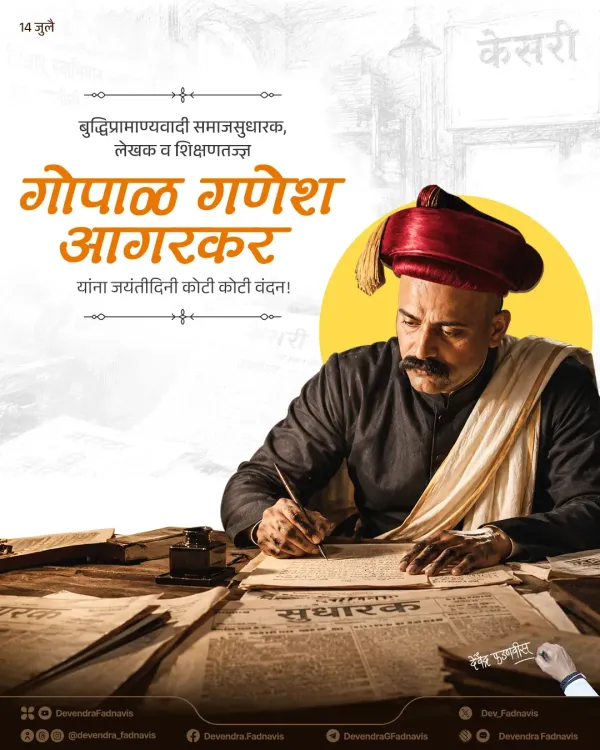
Synopsis
Maharashtra Chief Minister Devendra Fadnavis on 14 July 2026 paid tribute to 19th-century rationalist reformer and educationist Gopal Ganesh Agarkar on his birth anniversary, honouring his legacy of social reform, women's education, and scientific temper that continues to shape Maharashtra's public discourse.
Key Takeaways
Maharashtra CM Devendra Fadnavis paid tribute to Gopal Ganesh Agarkar on his birth anniversary on 14 July 2026 .
Agarkar ( 1856–1895 ) was a rationalist social reformer who championed women's education, widow remarriage, and scientific reasoning in colonial-era Maharashtra.
He co-founded the Deccan Education Society with Tilak and later launched the Marathi journal Sudharak to advance his reformist agenda.
Fadnavis described Agarkar in Marathi as a 'rationalist social reformer, great thinker, writer and education expert.' Maharashtra's political leaders across parties regularly mark such anniversaries, invoking the state's 19th-century reform legacy in contemporary public discourse.
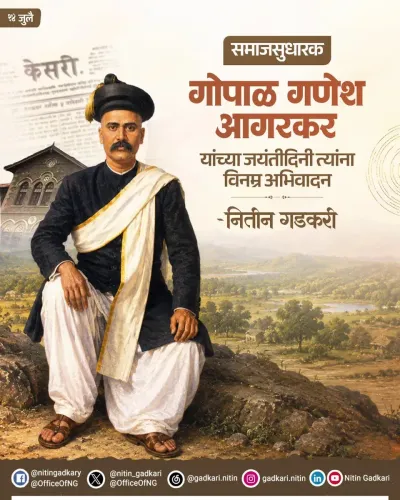
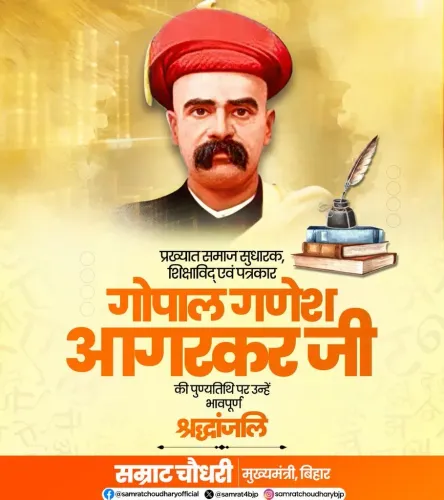
Maharashtra Chief Minister Devendra Fadnavis on Tuesday, 14 July 2026, paid tribute to 19th-century social reformer and educationist Gopal Ganesh Agarkar on his birth anniversary, honouring him as a rationalist thinker and champion of education and social reform.
Context
In his post, Fadnavis offered what he called 'humble tributes' to Agarkar, describing him in Marathi as a buddhi-pramanyavadi samaj-sudhaarak, thor vicharvant, lekhak va shikshan-tajnya — meaning 'a rationalist social reformer, great thinker, writer and education expert.' The Chief Minister extended 'crores of salutations' (koti koti vandan) to Agarkar's memory on the occasion of his birth anniversary.
Such commemorations by Maharashtra's top political leadership are a regular feature of the state's public calendar, reflecting the deep imprint that 19th-century reformers have left on its political and intellectual identity.
Who Was Gopal Ganesh Agarkar
Gopal Ganesh Agarkar (1856–1895) was one of Maharashtra's most influential rationalist voices of the colonial era. He co-founded the Deccan Education Society alongside Bal Gangadhar Tilak and was among the early editors of the Kesari newspaper before parting ways with Tilak over ideological differences.
Agarkar went on to launch his own Marathi journal, Sudharak, through which he advocated women's education, widow remarriage, and the application of scientific reasoning to social questions. His insistence on social reform as a prerequisite for political freedom set him apart from many contemporaries and earned him a lasting place in Maharashtra's reformist tradition alongside Jyotirao Phule and others.
Policy Backdrop
Maharashtra's political class — across party lines — has long drawn on the legacy of 19th-century reformers to frame contemporary social and educational policy. Agarkar's emphasis on rational inquiry and universal education resonates with ongoing state debates around curriculum reform, girls' education, and the promotion of scientific temper as enshrined in the Indian Constitution.
The state government has periodically referenced reformers of this era in the context of educational initiatives and awareness campaigns. Birth and death anniversaries of figures such as Agarkar, Phule, and Tilak serve as occasions for both commemoration and policy signalling.
Stakeholders and Impact
Agarkar's legacy is particularly significant for students, educators, and civil society organisations working on women's rights and rationalist thought in Maharashtra. His writings on education and social equality continue to be referenced in academic syllabi and public discourse.
Tributes from the Chief Minister's office lend institutional weight to these commemorations and can prompt renewed public interest in Agarkar's original works and the reform movements he helped shape.
What's Next
State-level events, academic seminars, and school programmes marking Agarkar's birth anniversary are expected across Maharashtra on 14 July 2026. His writings on rationalism and education are likely to be cited in any forthcoming government discourse around curriculum updates or social welfare schemes, keeping his intellectual legacy alive in the public sphere.
Point of View
Honouring a rationalist and social reformer like Agarkar — who prioritised social change over religious nationalism — carries a degree of ideological nuance, signalling the party's effort to broaden its cultural appeal in a state with a strong reformist tradition. Such commemorations also serve a soft-power function, reinforcing the government's association with education and social welfare ahead of any policy announcements in those domains. Agarkar's enduring relevance to debates on women's education and scientific temper ensures these tributes carry weight beyond mere ceremony.
NationPress
12 Oct 2026
Frequently Asked Questions
Who was Gopal Ganesh Agarkar?
Gopal Ganesh Agarkar (1856–1895) was a Maharashtrian social reformer, rationalist thinker, and educationist who advocated women's education, widow remarriage, and scientific reasoning. He co-founded the Deccan Education Society and launched the Marathi journal Sudharak.
Why did Devendra Fadnavis pay tribute to Agarkar?
Devendra Fadnavis paid tribute to Gopal Ganesh Agarkar on his birth anniversary on 14 July 2026, honouring his contributions as a rationalist social reformer and educationist who shaped Maharashtra's progressive intellectual tradition.
What is the significance of Agarkar's birth anniversary in Maharashtra?
Agarkar's birth anniversary is observed as an occasion to recall Maharashtra's 19th-century reform legacy. Political leaders, educators, and civil society groups use the day to highlight his contributions to women's rights, education, and rational thought.
What was the Sudharak newspaper founded by Agarkar?
Sudharak was a Marathi-language journal founded by Gopal Ganesh Agarkar after he parted ways with Bal Gangadhar Tilak. Through it, Agarkar promoted social reforms including women's education, widow remarriage, and the application of scientific reasoning to social issues.
How is Agarkar different from Bal Gangadhar Tilak?
While both Agarkar and Tilak were contemporaries who co-founded the Deccan Education Society, they diverged ideologically. Agarkar believed social reform must precede political freedom, whereas Tilak prioritised political independence first. This difference led Agarkar to launch his own journal, Sudharak.