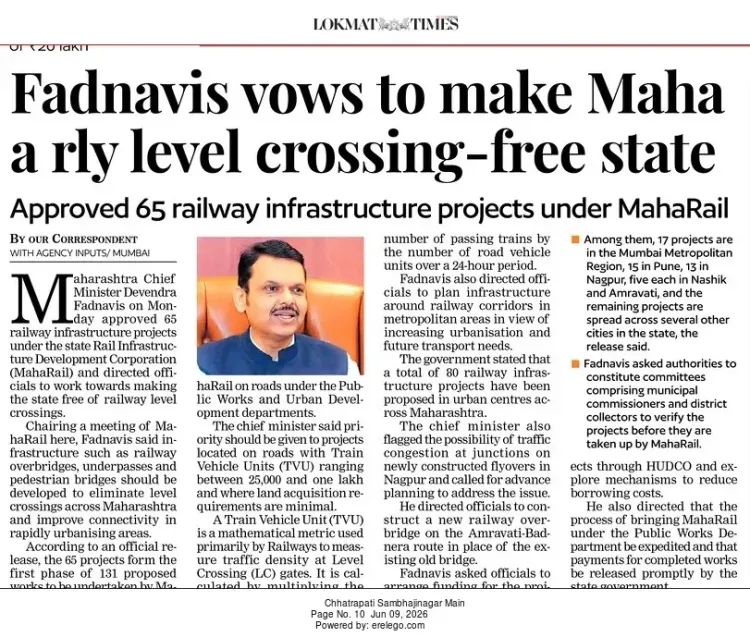
CM Fadnavis vows to make Maharashtra level crossing-free
Synopsis
Chief Minister Devendra Fadnavis has vowed to make Maharashtra free of all railway level crossings, committing the state to a sweeping grade-separation drive that aligns with national rail safety policy and affects millions of daily road and rail commuters across one of India's busiest transport networks.
Key Takeaways
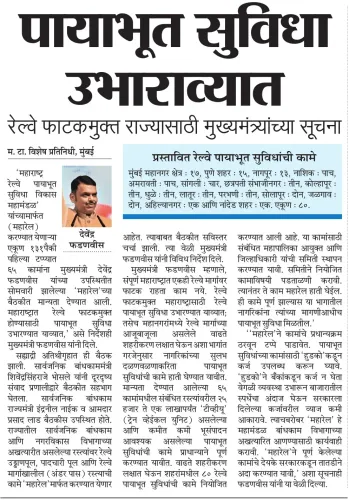
CM Devendra Fadnavis pledged on 9 June 2026 to make Maharashtra a railway level crossing-free state.
Level crossings are a leading cause of road-rail accidents; their removal via ROBs and RUBs is a central and state policy priority.
The commitment aligns with the central government's Setu Bharatam scheme launched in 2016 to eliminate level crossings on national highways.
Maharashtra operates one of India's densest combined rail and road networks, making grade separation especially critical.
Implementation will require cost-sharing coordination between the Maharashtra government and the Ministry of Railways .
Rollout timelines and specific project lists are awaited and are expected to feature in upcoming state and railway budget announcements.
The Chief Minister's Office of Maharashtra announced on Tuesday, 9 June 2026 that Chief Minister Devendra Fadnavis has pledged to eliminate all railway level crossings across the state, positioning Maharashtra as a leader in rail safety and infrastructure modernisation.
Context
CM Fadnavis has vowed to make Maharashtra a railway level crossing-free state, a commitment that places the state at the forefront of grade-separation infrastructure in India. Level crossings — points where roads and rail tracks intersect at the same grade — are among the most persistent sources of road and rail accidents across the country. Their elimination through road-over-bridges (ROBs) and road-under-bridges (RUBs) is widely regarded as a critical safety imperative.
Maharashtra operates one of India's densest combined rail and road networks, making the presence of unmanned and manned level crossings a chronic hazard for both road users and railway commuters. The state's urban and peri-urban corridors, in particular, carry heavy mixed traffic that amplifies risks at such crossings.
Policy Backdrop
The pledge aligns with a long-standing national policy direction. The central government's Setu Bharatam scheme, launched in 2016, specifically targeted the removal of level crossings on national highways through the construction of ROBs and RUBs. Indian Railways, as the national operator, has progressively worked with state governments to fund and execute grade-separation projects as part of successive national budget cycles.
Multiple Indian states have aligned with central railway modernisation drives that prioritise grade separation to reduce accidents and ease traffic congestion. Maharashtra's announcement fits a visible pattern of state-central coordination on rail infrastructure funding and project execution. CM Fadnavis, who has overseen the state across prior terms, has consistently flagged large-scale infrastructure as a governance priority.
Stakeholders and Impact
The primary beneficiaries of a level crossing-free Maharashtra would be the state's millions of daily road users and railway commuters. Eliminating crossings reduces the risk of collisions between vehicles and trains, cuts delays caused by closed crossing gates, and improves the overall flow of freight and passenger movement.
Local bodies, highway authorities, and Indian Railways zonal divisions operating in Maharashtra — including the Central Railway and Western Railway zones — would be key implementing partners. Funding structures for ROB and RUB projects typically involve cost-sharing between the state government and the railway ministry, making budgetary coordination a central execution variable.
What's Next
The immediate focus will be on whether the state government follows the announcement with a detailed project list, phased timelines, and a formal funding framework — potentially through a memorandum of understanding with the Ministry of Railways. Observers will watch the next state budget and railway budget for allocations that operationalise the commitment.
If executed at scale, a level crossing-free Maharashtra would represent one of the most comprehensive grade-separation programmes undertaken by any Indian state, setting a benchmark that other densely networked states may be pressed to match.
Point of View
Suggesting a deliberate alignment between the state and the railway ministry that could unlock co-funding. The real test, however, lies in converting a high-profile vow into a time-bound, budgeted project pipeline; Maharashtra's infrastructure record shows ambition, but large-scale ROB and RUB programmes have historically faced land acquisition and coordination delays. If the state tables a concrete execution framework soon, it could set a replicable template that pressures other densely networked states to follow.
NationPress
23 Oct 2026
Frequently Asked Questions
What does it mean for Maharashtra to become a railway level crossing-free state?
It means all points where roads and railway tracks currently intersect at the same grade will be replaced by road-over-bridges or road-under-bridges, eliminating the risk of vehicle-train collisions and reducing traffic delays caused by closed crossing gates.
Why are railway level crossings dangerous?
Level crossings require vehicles to cross active rail tracks, creating the risk of collisions if gates fail, are ignored, or crossings are unmanned. They are a significant source of fatal accidents on India's rail and road network.
What is the Setu Bharatam scheme and how does it relate to this pledge?
Setu Bharatam is a central government scheme launched in 2016 to remove level crossings on national highways through ROBs and RUBs. Maharashtra's state-level commitment extends this logic to all crossings within the state, not just those on national highways.
Who funds road-over-bridge projects in Maharashtra?
ROB and RUB projects in India are typically funded through cost-sharing between the state government and the central Ministry of Railways , with allocations announced in state and railway budgets.
When will Maharashtra's level crossings actually be removed?
Specific timelines have not yet been announced. Observers expect detailed project lists and phased schedules to emerge in upcoming state and railway budget sessions following CM Fadnavis 's pledge.