Farooq Abdullah: Terrorism will never succeed in Kashmir, Pakistan must stop terror
Synopsis
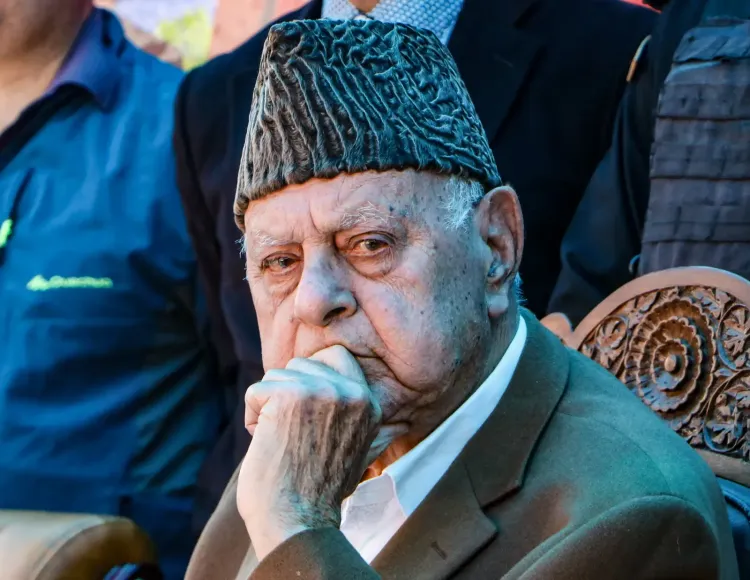
Just hours after twin terror attacks killed two SPOs in Kishtwar and injured three CRPF troopers in Kulgam, National Conference president Farooq Abdullah delivered a pointed double message: terrorism will never win in Kashmir, and Pakistan must abandon militancy in favour of dialogue. His remarks also directly challenged Delhi's narrative of complete post-Article 370 normalcy.
Key Takeaways
Dr Farooq Abdullah declared on 12 November that terrorism will never succeed in Kashmir , following attacks in Kulgam and Kishtwar .
In the Kishtwar attack, two SPOs were killed and their weapons stolen; in Kulgam , three CRPF troopers were injured.
Both attacks occurred within a 24-hour window , prompting a territory-wide security alert and checkpost deployments.
Abdullah challenged claims of complete normalcy after Article 370 's abrogation, stating terrorism still exists and must be countered.
He called on Pakistan to pursue dialogue over conflict, referencing the Tribal Invasion of 1947 and global conflicts as cautionary examples.
Abdullah advocated revival of SAARC as a framework for regional dispute resolution.
National Conference (NC) president and former Jammu and Kashmir Chief Minister Dr Farooq Abdullah on Thursday, 12 November declared that terrorism will never succeed in the union territory, and directly urged Pakistan to abandon its support for militancy. His remarks came in Srinagar in the immediate aftermath of two separate terror attacks — one in Kulgam and another in Kishtwar — that occurred within a 24-hour window.
Abdullah's Warning After Back-to-Back Attacks
Speaking to reporters, Abdullah was unequivocal: 'Terrorism will never succeed in Kashmir and those thinking they can grab Kashmir through terror are mistaken.' He also took aim at political voices in Delhi who claim terrorism has been fully extinguished, saying they must be reminded that the threat persists and that credible steps to end it are still needed.
Reacting specifically to the Kishtwar attack, in which two Special Police Officers (SPOs) were killed and their weapons stolen, Abdullah said such incidents continue to occur with unpredictable frequency. 'No one knows where the next attack will happen,' he said, underscoring the volatile security environment.
On the Post-Article 370 Claims of Normalcy
Abdullah pushed back against the narrative of complete normalcy following the abrogation of Article 370, acknowledging that terrorism still exists even as he urged residents not to live in fear. He was firm, however, that Jammu and Kashmir remains an inseparable part of India. 'Kashmir was, is, and will remain a part of India. They can do whatever they have to do,' he said.
He invoked the Tribal Invasion of 1947, recounting atrocities committed during that period — including the killing of a doctor, his wife, and a nurse at a Christian-run hospital — to remind Pakistan of the historical consequences of sponsoring violence.
Abdullah's Call for Dialogue Over Conflict
Drawing on global conflicts, the veteran leader pointed to the Iran-US and Ukraine-Russia wars as examples of how armed hostility ultimately leads to negotiated settlements. 'I always tell Pakistan to stop terrorism. Nothing will come out of this. Adopt the path of dialogue, through which a way out can be found. We were both parts of one country once,' he said.
He also referenced post-World War II Europe — noting how a continent devastated under Hitler rebuilt itself into an integrated bloc with a single currency and shared vision — as a model for regional reconciliation. Abdullah called for the revival of SAARC, which he credited to Indira Gandhi, so that South Asian nations could collectively address disputes. 'But bullets and talks cannot go together,' he added.
Security Situation on the Ground
The two attacks that prompted Abdullah's remarks have triggered a widespread security response across Jammu and Kashmir. In the Kulgam district attack, three CRPF troopers were injured; in Kishtwar, two SPOs were killed and their weapons seized. A general security alert has been sounded across the union territory, with special checkposts and barricades erected for vehicle searches and personnel checks. Massive search operations are ongoing in Kulgam to track down the two terrorists responsible for the Wednesday attack.
The twin incidents raise pointed questions about ground-level security coordination, particularly ahead of the winter months when high-altitude routes become operational challenges. All eyes are now on how security agencies respond — and whether Abdullah's call for dialogue gains any traction in New Delhi or Islamabad.
Point of View
But for what they say to Delhi. By explicitly challenging the post-Article 370 normalcy narrative, he is using two fresh attacks to reopen a political debate the ruling establishment has tried to close. His call to revive SAARC and pursue dialogue is well-worn ground, but its timing — delivered hours after SPOs were killed — gives it sharper political weight. The deeper question mainstream coverage glosses over is this: if security conditions remain fragile enough to produce twin attacks in 24 hours, the metrics being used to declare success in Jammu and Kashmir deserve scrutiny, and Abdullah knows it.
NationPress
12 Nov 2026
Frequently Asked Questions
What did Farooq Abdullah say about terrorism in Kashmir on 12 November?
Dr Farooq Abdullah said terrorism will never succeed in Kashmir and that those who believe they can seize the territory through violence are mistaken. He also urged Pakistan to abandon support for militancy and instead adopt the path of dialogue.
What happened in the Kishtwar and Kulgam terror attacks?
Two attacks occurred within 24 hours in Jammu and Kashmir. In Kishtwar, two Special Police Officers (SPOs) were killed and their weapons stolen by terrorists. In Kulgam, three CRPF troopers were injured in a separate attack.
What did Abdullah say about Article 370 and claims of normalcy in Kashmir?
Abdullah pushed back against assertions that terrorism has ended following the abrogation of Article 370 in 2019. He acknowledged terrorism still exists and said those in Delhi claiming it has fully ended must be reminded of the continuing threat.
Why did Abdullah invoke SAARC and historical conflicts?
Abdullah cited the Ukraine-Russia and Iran-US conflicts to argue that wars ultimately end at the dialogue table. He called for the revival of SAARC to enable South Asian nations to resolve disputes collectively, while warning that talks and bullets cannot proceed simultaneously.
What is the current security situation in Jammu and Kashmir after the attacks?
A general security alert has been issued across the union territory. Special checkposts and barricades have been set up for vehicle searches, and massive search operations are ongoing in Kulgam district to track down the two terrorists responsible for Wednesday's attack.