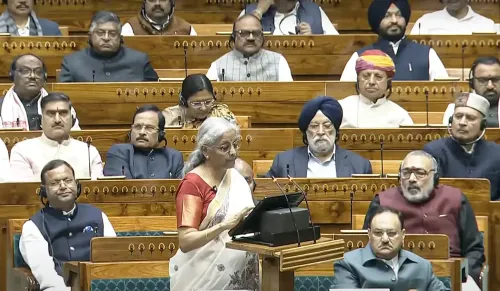
Finance Minister Nirmala Sitharaman Unveils Finance Bill 2026 in Lok Sabha

Synopsis
On March 23, Finance Minister Nirmala Sitharaman introduced the Finance Bill 2026 in Lok Sabha, which aims to implement crucial changes in tax regulations and corporate laws, enhancing the ease of doing business in India.
Key Takeaways
The Finance Bill 2026 was introduced in Lok Sabha by Finance Minister Nirmala Sitharaman.
It aims to implement changes in income tax and corporate laws.
The bill is part of the Union Budget for 2026-27.
It has faced opposition regarding its impact on Corporate Social Responsibility.
The amendments follow recommendations from the Company Law Committee established in 2019.
New Delhi, March 23 (NationPress) On Monday, Finance Minister Nirmala Sitharaman presented the Finance Bill for 2026 in the Lok Sabha, a significant legislative move aimed at providing legal support to the proposals outlined in the Union Budget for 2026-27.
Upon approval, this Finance Bill will implement modifications to income tax rates as well as adjustments to customs and excise duties as detailed in the Budget announcements.
Additionally, the Finance Minister introduced the Corporate Laws (Amendment) Bill, 2026, which received the Lok Sabha's endorsement for referral to the Joint Parliamentary Committee (JPC) for in-depth examination.
The purpose of this bill is to modify the Limited Liability Partnership Act, 2008 and the Companies Act, 2013 to enhance the ease of doing business, decriminalize lesser offences, substitute certain criminal sanctions with civil penalties, and lessen compliance challenges for small enterprises, startups, and agricultural companies.
Previously, opposition members, including Congress representative Manish Tewari, Trinamool Congress's Sougata Ray, and DMK's Dr. T. Sumathy, expressed disapproval regarding the bill's introduction.
They claimed that the proposed legislation undermines the principles of Corporate Social Responsibility. In response to these concerns, the Finance Minister asserted that the amendments would not only draw more investments but also enhance corporate governance.
FM Sitharaman emphasized that this legislation was developed following two years of comprehensive discussions. She noted that input from representatives of industry associations, professional bodies, legal and accounting experts, and the public was incorporated prior to the Bill's introduction in the House.
The legal amendments are based on recommendations from the Company Law Committee (CLC), established by the government to promote an improved business environment.
Formed in September 2019, the 11-member CLC included notable figures such as former Lok Sabha Secretary General T.K. Viswanathan, Uday Kotak, Executive Chairman of Shardul Amarchand Mangaldas & Co, G. Ramaswamy, and Sidharth Birla, Chairman of Xpro India. The CLC submitted its final report to the government on March 21, 2022.
The CLC's recommendations were discussed by various stakeholders and reviewed by the High-Level Committee on Non-Financial Regulatory Reforms (HLC-NFRR), which is chaired by former Cabinet Secretary and NITI Aayog member Rajiv Gauba.
In her budget address for 2025-26, the Finance Minister had announced the formation of the committee: “A High-Level Committee for Regulatory Reforms will be established to review all non-financial sector regulations, certifications, licenses, and permissions,” she remarked on February 1 of the previous year.
The second phase of the Budget Session resumed on Monday at 11 a.m. following holidays for Ugadi and Eid celebrations on Thursday and Friday, respectively. Parliament is scheduled to convene again on March 28 and March 29 to make up for these holidays.
Point of View
The introduction of the Finance Bill 2026 represents a pivotal moment for India's economic landscape. With the proposed amendments aiming to streamline corporate regulations and attract investments, the government appears committed to fostering a more conducive business environment. However, the concerns raised by opposition members regarding potential dilution of corporate accountability underscore the ongoing debate surrounding corporate governance in India.
NationPress
24 Sept 2026
Frequently Asked Questions
What is the Finance Bill 2026?
The Finance Bill 2026 is a legislative proposal introduced by Finance Minister Nirmala Sitharaman in Lok Sabha to implement changes in tax rates and corporate laws as outlined in the Union Budget for 2026-27.
What changes does the Finance Bill propose?
The Finance Bill proposes changes in income tax rates, customs and excise duties, and amendments to the Limited Liability Partnership Act and Companies Act to facilitate ease of doing business.
What is the significance of the Corporate Laws (Amendment) Bill?
The Corporate Laws (Amendment) Bill aims to decriminalize minor offences, reduce compliance burdens, and improve corporate governance, thereby attracting more investments.
Who were the key figures involved in the Company Law Committee?
The Company Law Committee included prominent members such as T.K. Viswanathan, Uday Kotak, and Shardul S. Shroff, among others.
When will the Parliament reconvene to discuss the bill further?
Parliament will reconvene on March 28 and March 29 to continue discussions related to the Finance Bill 2026.