Finance Minister Sitharaman backs targeted welfare delivery

Synopsis
Finance Minister Nirmala Sitharaman says targeted interventions, beneficiary identification and sustained monitoring helped turn welfare policy into improvements in people's lives. Her post credits PM Narendra Modi with resolving implementation bottlenecks and encouraging technology to track delivery.
Key Takeaways
Nirmala Sitharaman shared an excerpt from her article on poverty reduction in India on 23 November 2026 .
She said interventions were targeted at people in need and focused on measurable outcomes.
She credited Narendra Modi with monitoring implementation and intervening at critical junctures.
The Direct Benefit Transfer architecture expanded from 2014 , linking welfare payments with Aadhaar and bank accounts.
NITI Aayog launched the National Multidimensional Poverty Index in 2021 .
Getting welfare to the last household takes more than announcing a scheme, Union Finance Minister Nirmala Sitharaman argued in a post on 23 November 2026, citing targeted interventions and close monitoring in an article on poverty reduction in India. She credited Prime Minister Narendra Modi with personally tracking implementation and intervening to resolve bottlenecks.
Sitharaman's case for targeted delivery
In the excerpt shared on X, Sitharaman said government interventions were targeted at those who needed them, focused on measurable outcomes and tailored to the deprivation they sought to remove. Each scheme, she said, required identifying beneficiaries, delivering effectively and following up until the last household was reached.
She said Modi had encouraged technology to track delivery and that sustained attention had helped translate policy into 'tangible improvements in people's lives'. The post did not provide a poverty figure or identify individual schemes.
DBT and the poverty measure
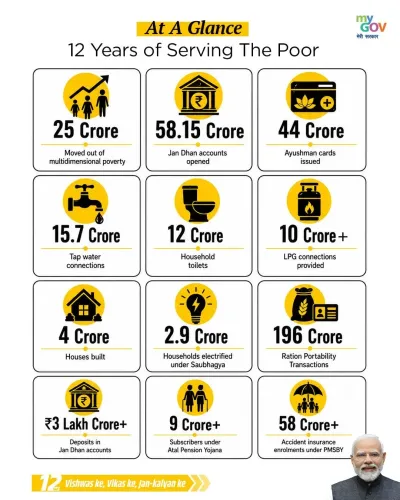
The argument sits alongside an expansion of the Direct Benefit Transfer architecture from 2014, linking welfare payments with Aadhaar and bank accounts. The government's emphasis on targeted, technology-tracked delivery has also appeared across programmes covering housing, sanitation and food security.
Measuring deprivation involves more than income alone. In 2021, NITI Aayog launched the National Multidimensional Poverty Index to track deprivation in health, education and living standards.
For households that depend on welfare, the test is whether identification and delivery reach those still missing out. Future poverty measurements will offer one way to assess that progress.
Point of View
Education and living standards.
NationPress
23 Nov 2026
Frequently Asked Questions
What did Nirmala Sitharaman say about poverty reduction?
She said targeted interventions, effective delivery and follow-up helped translate policy into improvements in people's lives. Her post shared an excerpt from an article she wrote on poverty reduction in India.
What did Sitharaman say about Modi's role in welfare schemes?
She credited Prime Minister Narendra Modi with personally monitoring implementation and intervening to resolve bottlenecks. She also said he encouraged the use of technology to track delivery.
What is Direct Benefit Transfer in India?
Direct Benefit Transfer is an architecture for delivering welfare payments to beneficiaries. Its expansion from 2014 linked payments with Aadhaar and bank accounts.
What does India's multidimensional poverty index measure?
The National Multidimensional Poverty Index tracks deprivation in health, education and living standards. NITI Aayog launched it in 2021.