UN chief Guterres calls for peace at BRICS Summit in New Delhi
Synopsis
With Iran, the UAE, Saudi Arabia, and Russia all in the room, UN Secretary-General Guterres used the BRICS Summit in New Delhi to demand peace across Gaza, Ukraine, and Sudan — while the bloc's own declaration quietly dropped any mention of the Ukraine war, a telling diplomatic retreat from the previous year's summit in Brazil.
Key Takeaways
UN Secretary-General Antonio Guterres called for peace at the BRICS Summit in New Delhi on 13 September 2026 , citing Gaza , the Middle East , Ukraine , and Sudan .
Leaders including Russia's President Vladimir Putin , Iran's President Masoud Pezeshkian , and senior officials from Saudi Arabia and the UAE attended simultaneously.
The BRICS joint declaration demanded a Gaza ceasefire , affirmed Palestinian rights, and called for an 'immediate, permanent ceasefire' in Sudan .
The declaration made no mention of the Ukraine war — a retreat from the fleeting reference included at last year's Brazil summit .
Disruption to shipping through the Strait of Hormuz has constrained roughly 20 per cent of global petroleum and gas supply, according to reports.
Iran , UAE , and Saudi Arabia — regional adversaries — all signed the joint declaration, marking a rare moment of BRICS-driven diplomatic alignment.
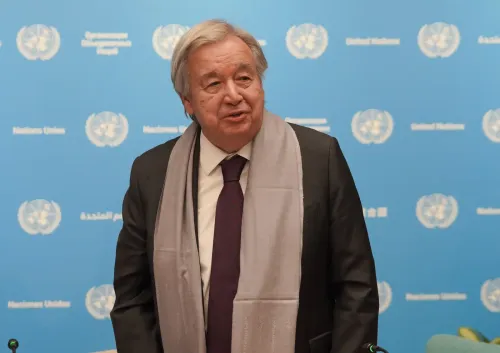
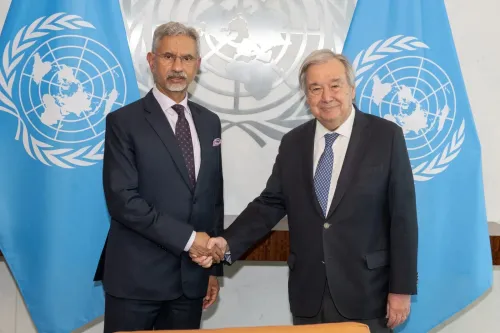
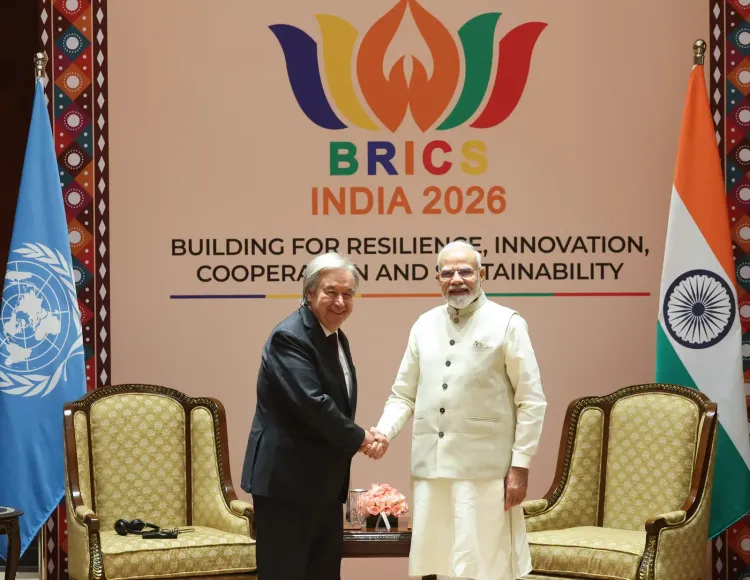
United Nations Secretary-General Antonio Guterres on Sunday, 13 September 2026, issued a sweeping call for peace at the BRICS Summit in New Delhi, as leaders from nations directly embroiled in active conflicts sat together at the same table. His appeal spanned Gaza, the broader Middle East, Ukraine, Sudan, and other flashpoints that have disproportionately devastated the Global South.
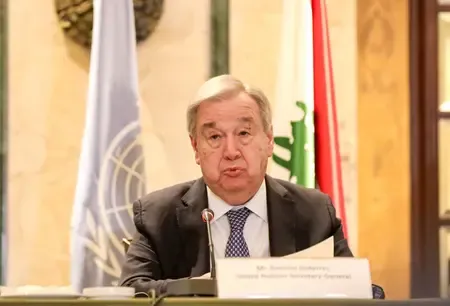
'From Gaza, to the broader crisis in the Middle East, to Ukraine, Sudan and beyond, our world needs peace,' Guterres said, framing peace as indispensable for achieving 'inclusive global growth.'
High-Stakes Diplomacy in the Room
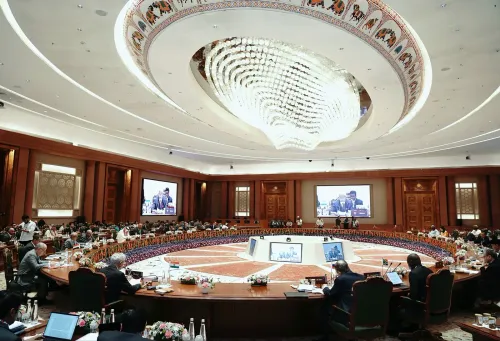
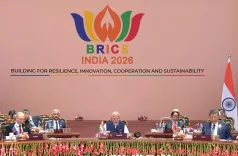
The summit brought together an unusually charged set of participants. Iran's President Masoud Pezeshkian, Crown Prince of Abu Dhabi Sheikh Khaled bin Mohamed bin Zayed Al Nahyan, and Saudi Foreign Minister Faisal bin Farhan Al Saud — all parties to the simmering West Asia conflict — were present simultaneously. Russia's President Vladimir Putin, whose 2022 invasion of Ukraine triggered a global crisis in foodgrains and fertilisers, also attended. The convergence of adversaries under one roof underscored both the breadth of BRICS membership and the complexity of building consensus across conflicting geopolitical loyalties.
Guterres on International Law
The UN chief urged all member states to honour their obligations under the UN Charter and international law. He specifically enumerated these as encompassing 'international navigational rights and freedoms; the principles of sovereign equality; respect for territorial integrity and political independence of States; peaceful settlement of disputes, and observance of international humanitarian law and international human rights law.' The remarks carried pointed relevance given that disruptions to shipping in the Strait of Hormuz — following the February attack on Iran by Israel and the United States — have choked off a significant share of the roughly 20 per cent of the world's petroleum and gas supply that transits the waterway.
Summit Theme and Modi's Framing
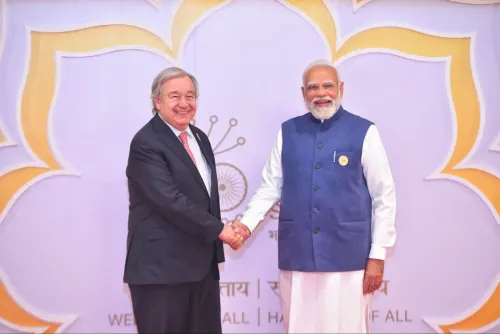
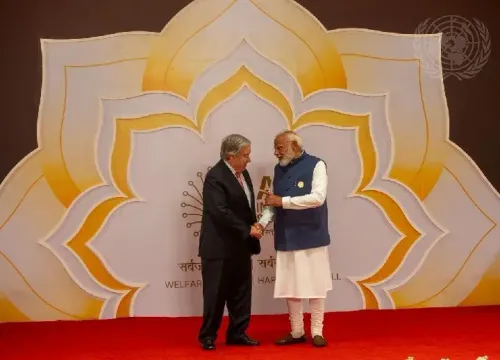
Guterres aligned his message with the summit's overarching theme set by Prime Minister Narendra Modi. 'As your Summit's theme rightly frames it, we must build for resilience, innovation, cooperation and sustainability,' he said, calling these values 'essential for shaping inclusive global growth.' Peace, he stressed, was a precondition for each of these aims — not a parallel aspiration but a foundational requirement.
What the BRICS Declaration Said
Guterres' appeal found partial echo in the BRICS joint declaration adopted on Saturday. The 11-member group expressed 'deep concern over the continued escalation of tensions in the Middle East/West Asia' and called for 'exercising maximum restraint, as well as avoiding actions that could further aggravate the situation.' On Gaza, the declaration urged all parties to maintain the ceasefire, affirmed Palestinians' 'inalienable rights,' and opposed their displacement. On Sudan, it voiced 'grave concern over the deteriorating situation' and demanded 'an immediate, permanent ceasefire.'
Notably, the Ukraine war was conspicuously absent from the declaration — a significant diplomatic retreat from last year's Brazil summit, where at least a brief reference acknowledging members' positions in international forums was included. Analysts suggest the omission reflects the difficulty of forging consensus inside an expanded BRICS that now includes both Russia and countries heavily aligned with Western positions. In a rare display of BRICS-driven diplomatic alignment, the leaders of Iran, the UAE, and Saudi Arabia all signed on to the joint declaration — a signal that the bloc's expanded architecture can, at minimum, produce formal convergence on select regional crises.
Whether the diplomatic language translates into tangible de-escalation across any of these theatres remains the defining question as BRICS nations return to their respective capitals.
Point of View
The bloc at least nodded at the war; this year it was erased entirely — a concession to Russia's growing leverage within an expanded BRICS. The presence of Iran, the UAE, and Saudi Arabia under the same roof is symbolically striking, but their collective signature on a declaration that demands 'maximum restraint' without naming any aggressor illustrates the ceiling of BRICS consensus-building. Guterres' invocation of territorial integrity and the UN Charter, delivered with Putin seated at the same summit, was diplomatically courageous — but the gap between multilateral language and ground-level accountability in Gaza, Sudan, and Ukraine has never been wider.
NationPress
13 Sept 2026
Frequently Asked Questions
What did UN Secretary-General Guterres say at the BRICS Summit in New Delhi?
Guterres called for global peace, urging that 'from Gaza, to the broader crisis in the Middle East, to Ukraine, Sudan and beyond, our world needs peace.' He also called on all states to respect the UN Charter, including principles of territorial integrity and international humanitarian law.
What did the BRICS 2026 joint declaration say about Gaza and Sudan?
The BRICS declaration expressed deep concern over Middle East tensions, called on all parties in Gaza to maintain the ceasefire and affirmed Palestinians' inalienable rights. On Sudan, it called for 'an immediate, permanent ceasefire' amid a worsening humanitarian crisis.
Why was Ukraine not mentioned in the BRICS 2026 declaration?
The BRICS 2026 New Delhi declaration made no mention of the Ukraine war, a significant omission given that last year's Brazil summit included at least a brief reference to members' positions in international forums. The exclusion reportedly reflects the difficulty of reaching consensus in a bloc that now includes Russia as well as nations aligned with Western positions.
Which world leaders attended the BRICS Summit 2026 in New Delhi?
The summit brought together Russia's President Vladimir Putin, Iran's President Masoud Pezeshkian, Crown Prince of Abu Dhabi Sheikh Khaled bin Mohamed bin Zayed Al Nahyan, and Saudi Foreign Minister Faisal bin Farhan Al Saud, among leaders from the 11-member BRICS grouping. Prime Minister Narendra Modi set the summit's theme around resilience, innovation, cooperation, and sustainability.
How has the Strait of Hormuz disruption affected global energy supply?
Following the February attack on Iran by Israel and the United States, disruptions to shipping in the Strait of Hormuz have constrained a significant portion of the roughly 20 per cent of the world's petroleum and gas supply that passes through the waterway, according to reports cited at the summit.