Gadkari: Cabinet clears 132nd Bill to raise Vidhan Sabha seats
Synopsis
Nitin Gadkari said the Union Cabinet had approved the 132nd Constitutional Amendment Bill to raise the state assembly seat cap from 500 to about 650. He argued more MLAs would bring governance closer to citizens and urged all parties to back the measure.
Key Takeaways
Union Road Transport and Highways Minister Nitin Gadkari on 28 November 2026 said the Cabinet had approved the 132nd Constitutional Amendment Bill .
He said the bill would amend Article 170(1) to raise the maximum seats in a state assembly from 500 to around 650 .
Gadkari credited Prime Minister Narendra Modi 's leadership and called the decision historic and people-oriented.
He urged all political parties to welcome and support the bill with an open mind.
The Constitution (Eighty-fourth Amendment) Act, 2001 extended the freeze on seat readjustment until after the first census after 2026 .
Union Road Transport and Highways Minister Nitin Gadkari on 28 November 2026 said the Union Cabinet had approved a 150-seat jump in the legal ceiling of state assemblies, from 500 to about 650. He called the 132nd Constitutional Amendment Bill a historic step under Prime Minister Narendra Modi to pull governance closer to citizens, and he asked every party to back it with an open mind. The post immediately reopens a question frozen since the 2001 amendment: how large India's Vidhan Sabhas should be after the census due after 2026.
Gadkari wrote that, under Prime Minister Modi's leadership, the central Cabinet had taken a historic decision by clearing the bill to make democracy stronger and more people-oriented. The proposed change, he said, would amend Article 170(1) so that the maximum number of seats in a state legislative assembly could rise from 500 to around 650.
In his telling, when the number of people's representatives grows, the voice of every region will reach the House more firmly. Plans would then track local problems, priorities and aspirations, and the pace of development would quicken. He closed with a direct appeal: all political parties should welcome and support this visionary and historic bill with an open mind.
Article 170(1) and the 500-seat ceiling
Article 170 of the Constitution governs the composition of state legislative assemblies. Clause (1) currently sets an upper limit of 500 members. Gadkari said the new bill would rewrite that ceiling to about 650.
That number matters because India's last nationwide freeze on the readjustment of Lok Sabha and assembly seats was locked in by the Constitution (Eighty-fourth Amendment) Act, 2001. That law extended the freeze until after the first census taken after 2026. Any lift in the statutory maximum is the legal doorway before a future delimitation can actually add members.
Gadkari's case for more MLAs
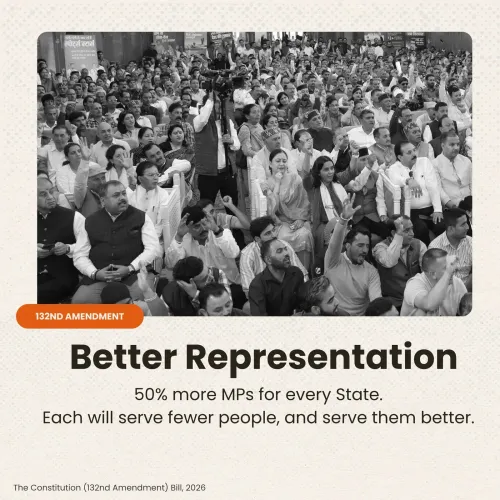
The minister argued that raising the headcount of legislators would pull the state closer to the citizen. More representatives, he said, would carry local grievances into the House with greater force and let schemes follow district-level needs rather than a thinner map of constituencies.
He tied the Cabinet decision to Prime Minister Modi's leadership and described the bill as both far-sighted and historic. The appeal to other parties is not incidental: a constitutional amendment needs a special majority in Parliament and, depending on the clause, ratification by states. Cross-party numbers will decide whether the text even reaches the statute book.
Parliament, the census and the next test
Gadkari's post does not give a date for introduction in either House. The next public test is whether the government tables the 132nd Constitutional Amendment Bill, how Article 170(1) is drafted in the official text, and how parties respond in debate.
Watchers will also look past Parliament to the census after 2026 and any subsequent delimitation commission. Raising the legal ceiling is one step; redrawing constituencies to fill extra seats is another, and that process has historically been among the most sensitive in Indian federal politics.
The minister has staked a simple claim: more MLAs, a stronger local voice, faster development. Parliament, and then the states, will now decide if that claim becomes law.
Point of View
Not the settlement. Special-majority arithmetic in Parliament, and the mood of states that fear losing relative weight, will matter more than the minister's appeal. If the official bill matches his 650 figure, India will have changed the hardware of state democracy before the next census-driven map is even drawn.
NationPress
28 Nov 2026
Frequently Asked Questions
What is the 132nd Constitutional Amendment Bill according to Nitin Gadkari?
Union Minister Nitin Gadkari said the bill would amend Article 170(1) to raise the maximum number of seats in a state legislative assembly from 500 to around 650. He described Cabinet approval under Prime Minister Narendra Modi as a historic step to make democracy more people-oriented.
What does Article 170 say about Vidhan Sabha seats?
Article 170 governs the composition of state legislative assemblies and currently provides for a maximum of 500 members. Gadkari said the proposed amendment would lift that ceiling to about 650.
Why have assembly and Lok Sabha seats been frozen?
The Constitution (Eighty-fourth Amendment) Act, 2001 extended the freeze on readjustment of Lok Sabha and assembly seats until after the first census conducted after 2026. That freeze has kept constituency maps tied to older population data even as states have grown.
Does increasing the assembly seat cap need Parliament's approval?
Yes. A constitutional amendment requires passage by a special majority in Parliament and, for certain provisions, ratification by state legislatures. Gadkari has appealed to all political parties to support the bill.
When could extra MLAs actually be elected?
Raising the legal maximum is only the first step. Actual additions would typically follow a census after 2026 and a delimitation exercise. Gadkari's post did not announce a timeline for either.