Gadkari pays tribute to nuclear pioneer Dr. Homi Bhabha on birth anniversary
Synopsis
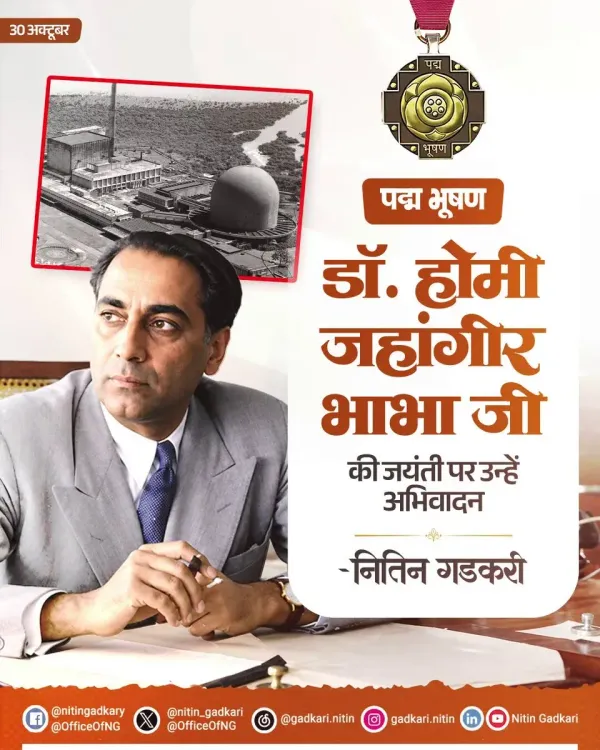
Union Minister Nitin Gadkari paid tribute to Padma Bhushan Dr. Homi Jehangir Bhabha on his birth anniversary, honouring the physicist who founded TIFR in 1945 and built the institutional base for India's nuclear energy programme.
Key Takeaways
Union Minister Nitin Gadkari paid tribute to Dr.
Homi Jehangir Bhabha on his birth anniversary on 30 October 2026 .
Bhabha is regarded as the founder of India's nuclear energy programme and was a recipient of the Padma Bhushan .
He established the Tata Institute of Fundamental Research (TIFR) in 1945 and the Atomic Energy Establishment Trombay , later renamed Bhabha Atomic Research Centre (BARC).
Gadkari described Bhabha as a 'great scientist' and the 'father of the Indian nuclear energy programme' in his post on X.
Indian leaders regularly mark birth anniversaries of pioneering scientists to reaffirm national pride in foundational contributions to India's capabilities.
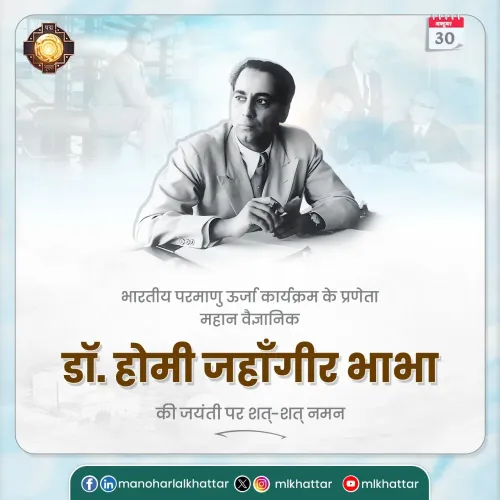
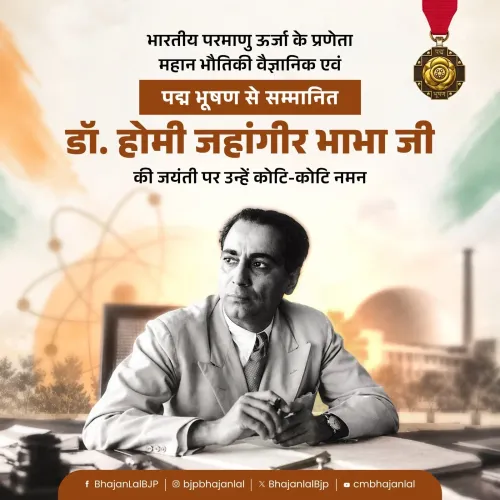
On the birth anniversary of the physicist who gave India its atomic ambitions, Union Road Transport and Highways Minister Nitin Gadkari paid solemn tribute to Padma Bhushan Dr. Homi Jehangir Bhabha, remembering him as the father of India's nuclear energy programme.
Gadkari's post — in Hindi — offered a respectful salute: 'सादर नमन' ('a respectful tribute') to the great scientist on his birth anniversary, using the hashtags #DrHomiJehangirBhabha and #डॉ_होमी_जहांगीर_भाभा.
The man who built India's atomic foundation
Dr. Homi Jehangir Bhabha was the visionary physicist who laid the institutional bedrock for India's nuclear programme in the 1940s and 1950s. He founded the Tata Institute of Fundamental Research (TIFR) in 1945 and established the Atomic Energy Establishment Trombay — later renamed in his honour as the Bhabha Atomic Research Centre (BARC). His work directly shaped the framework through which India pursued peaceful nuclear applications for decades to come.
Awarded the Padma Bhusson, India's third-highest civilian honour, Bhabha's legacy extends far beyond laboratories. He is widely credited with convincing the government of the era that atomic energy was essential to India's future — a conviction that eventually produced one of the world's most self-reliant nuclear programmes.
A tradition of remembering those who built India's science
Indian ministers and leaders have long used birth anniversaries of pioneering scientists as moments of public reaffirmation — a way of connecting the present government's ambitions to the foundational figures who made them possible. Gadkari's tribute follows this pattern, recognising a legacy that spans nuclear energy, fundamental research, and national capability-building. For a minister whose own portfolio reshapes India's physical infrastructure, the salute to the man who once shaped its atomic one carries a quiet resonance.
Point of View
Including BARC and the three-stage nuclear power programme. For the ruling dispensation, honouring such figures also reinforces a broader narrative of indigenous scientific achievement. The gesture is ceremonial, but the icon being invoked carries genuine weight in India's science-policy identity.
NationPress
30 Oct 2026
Frequently Asked Questions
Who was Dr. Homi Jehangir Bhabha?
Dr. Homi Jehangir Bhabha was an Indian physicist and Padma Bhushan recipient widely regarded as the father of India's nuclear energy programme. He founded the Tata Institute of Fundamental Research in 1945 and established the Atomic Energy Establishment Trombay, which was later renamed the Bhabha Atomic Research Centre (BARC) in his honour.
When is Homi Bhabha's birth anniversary?
Homi Jehangir Bhabha was born on 30 October. Indian leaders and the scientific community mark this date each year with public tributes recognising his foundational contributions to nuclear science in India.
What did Nitin Gadkari say about Homi Bhabha?
Minister Nitin Gadkari described Dr. Homi Jehangir Bhabha as the 'father of the Indian nuclear energy programme' and a 'great scientist,' offering him a respectful tribute on his birth anniversary via a post on X.
What is the Bhabha Atomic Research Centre?
The Bhabha Atomic Research Centre (BARC), located in Trombay, Mumbai, is India's premier nuclear research facility. It was originally established by Dr. Homi Bhabha as the Atomic Energy Establishment Trombay and was renamed BARC after his death in tribute to his legacy.
Why do Indian ministers pay tribute to scientists on their birth anniversaries?
It is a longstanding convention in Indian public life for ministers and leaders to issue tributes on the birth anniversaries of pioneering scientists and national figures, reaffirming pride in foundational contributions to India's capabilities and connecting the present to nation-building achievements of the past.