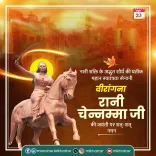
Gadkari pays tribute to Rani Chennamma on her Jayanti
Synopsis
Union Minister Nitin Gadkari marked the birth anniversary of Rani Chennamma of Kittur on 23 October 2026, saluting the 19th-century warrior queen who led one of India's earliest armed revolts against the British East India Company in 1824.
Key Takeaways
Union Minister Nitin Gadkari paid tribute to Rani Chennamma of Kittur on her Jayanti, 23 October 2026 .
Rani Chennamma led an armed revolt against the British East India Company in 1824 , making it one of the earliest organised uprisings against colonial rule in India.
Kittur was a princely state in what is now Belagavi district, Karnataka .
Chennamma resisted the British doctrine of lapse, which sought to deny rulers the right to adopt an heir and thereby annex their kingdoms.
Senior BJP leaders regularly observe birth and death anniversaries of regional anti-colonial figures as part of a broader cultural-history messaging practice.
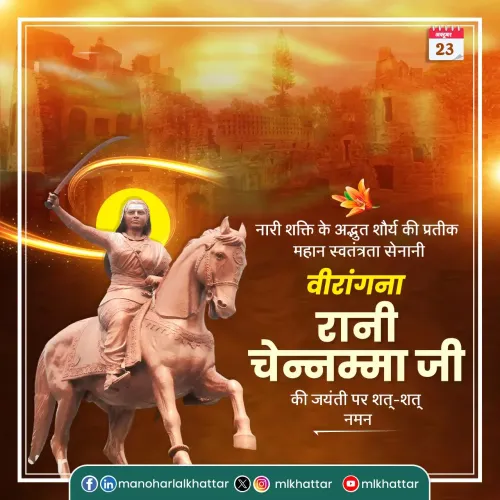
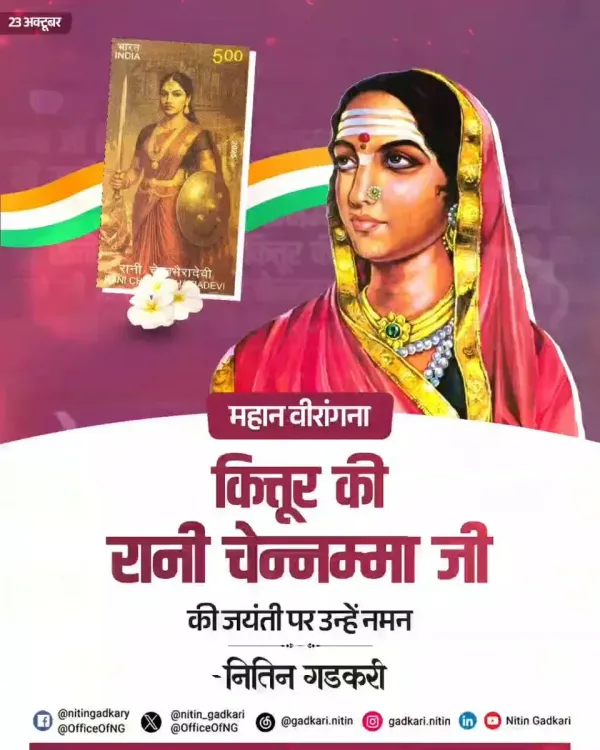
Nearly two centuries after Rani Chennamma of Kittur raised her sword against the British East India Company, her defiance still draws salutes from the highest offices of the republic. On her birth anniversary, Friday, 23 October 2026, Union Road Transport and Highways Minister Nitin Gadkari offered his respects to the warrior queen on social media.
Posting in Hindi, Gadkari wrote: 'मातृभूमि के गौरव एवं सम्मान की रक्षा हेतु अंग्रेजों से लड़ने वाली महान वीरांगना कित्तूर की रानी चेन्नम्मा जी की जयंती पर उन्हें सादर नमन।' — ['Respectful tribute on the birth anniversary of the great warrior Rani Chennamma of Kittur, who fought the British to protect the honour and pride of the motherland.']The queen who said no to annexation
Rani Chennamma was the ruler of Kittur, a princely state now located in the Belagavi district of Karnataka. In 1824, nearly three decades before the better-known revolt of 1857, she led an armed uprising against the British East India Company when colonial authorities moved to annex her kingdom under the doctrine of lapse — the policy that denied a ruler's right to adopt an heir. Her resistance is widely regarded as one of the earliest organised armed revolts against British expansion in the subcontinent. The rebellion was eventually suppressed, and Chennamma was captured and imprisoned, where she died in 1829. But her defiance left a lasting imprint on the anti-colonial imagination of the region.Why BJP ministers mark regional warrior queens
Gadkari's tribute follows a well-established pattern among senior BJP leaders of marking the birth and death anniversaries of regional anti-colonial figures on social media. The practice serves to anchor national pride in local histories — honouring rulers whose resistance to British power unfolded far from the more celebrated centres of the independence movement. For Karnataka in particular, Chennamma holds the stature of a folk hero and a proto-nationalist icon, celebrated each year with events in Belagavi.Point of View
A key electoral state. By foregrounding a woman warrior from the Deccan who fought the British nearly 33 years before 1857, the party signals that the freedom struggle was not a single-axis, north-centric story. The annual repetition of such tributes also serves a grassroots cultural function, reinforcing local pride among communities in Belagavi and beyond who regard Chennamma as a foundational hero.
NationPress
23 Oct 2026
Frequently Asked Questions
Who was Rani Chennamma of Kittur?
Rani Chennamma was the queen of Kittur, a princely state in present-day Belagavi district, Karnataka. She led an armed revolt against the British East India Company in 1824, one of the earliest instances of armed resistance by an Indian ruler against colonial annexation.
When is Rani Chennamma's Jayanti celebrated?
Rani Chennamma's birth anniversary, known as her Jayanti, is observed on 23 October each year.
What was the Kittur revolt of 1824?
The Kittur revolt of 1824 was an armed uprising led by Rani Chennamma against the British East India Company's attempt to annex the Kittur kingdom under the doctrine of lapse. The rebellion is considered one of the earliest organised anti-colonial revolts in Indian history.
Why did Nitin Gadkari pay tribute to Rani Chennamma?
Nitin Gadkari posted a tribute on her birth anniversary to honour her role as a freedom fighter who resisted British colonial expansion in the early 19th century. Senior BJP leaders regularly mark anniversaries of regional anti-colonial figures on social media.
Where is Kittur located today?
Kittur is located in the Belagavi district of Karnataka , in southern India. It was a princely state at the time of the 1824 revolt.