Gadkari pays tribute to V. Shantaram on his birth anniversary
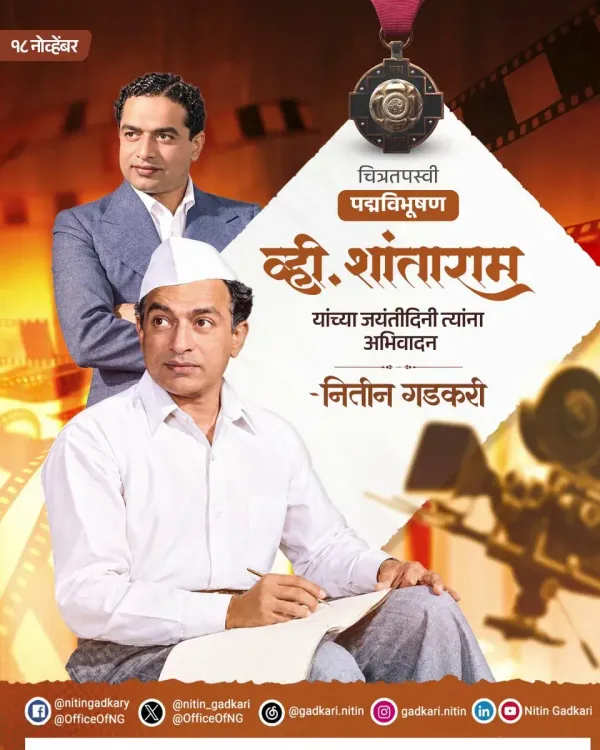
Synopsis
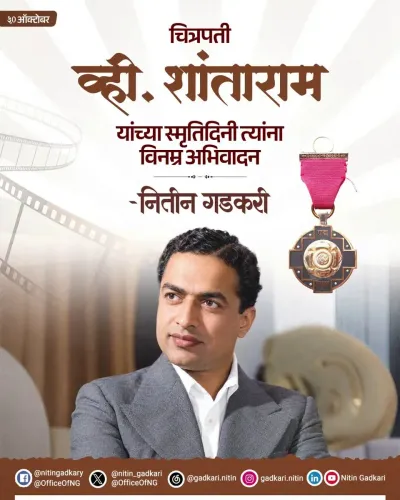
Union Minister Nitin Gadkari paid homage to iconic filmmaker Padma Vibhushan V. Shantaram on his 125th birth anniversary, calling him the 'patriarch of Indian cinema' and 'saint-ascetic of cinema' in a Marathi post on X.
Key Takeaways
Nitin Gadkari posted a tribute to V.
Shantaram on 18 November 2026 , marking his 125th birth anniversary .
Gadkari described Shantaram as the 'patriarch of Indian cinema' and used the Marathi honorific chitra-tapasvi (saint-ascetic of cinema).
Shantaram was born on 18 November 1901 in Kolhapur, Maharashtra .
He was awarded the Padma Vibhushan , India's second-highest civilian honour, for his contributions to Indian cinema.
His studio Rajkamal Kalamandir and films such as Sant Tukaram and Dr.
Kotnis Ki Amar Kahani remain milestones of early Indian cinema.
A legend who shaped the soul of Indian cinema turns 125 today — and Union Road Transport and Highways Minister Nitin Gadkari marked the occasion with a heartfelt salute to Padma Vibhushan V. Shantaram, the filmmaker revered as the patriarch of the Indian film industry, on his birth anniversary on 18 November 2026.
Posting on X in Marathi, Gadkari hailed Shantaramabapu as 'चित्रतपस्वी' — a 'saint-ascetic of cinema' — and offered his respects with the words: 'Humble salutations to Padma Vibhushan Shantaram Rajaram Vankudre, popularly known as V. Shantaram, the patriarch of Indian cinema, on his birth anniversary.'
From Kolhapur to the Conscience of Indian Cinema
Born on 18 November 1901 in Kolhapur, Maharashtra, V. Shantaram did not merely make films — he used the medium as a moral instrument at a time when Indian cinema was still finding its feet. His studio, Rajkamal Kalamandir, became a creative powerhouse that nurtured generations of talent. Films such as Sant Tukaram and Dr. Kotnis Ki Amar Kahani cemented his reputation as a director who fused social conscience with cinematic craft, earning him the nation's second-highest civilian honour, the Padma Vibhushan.Maharashtra's Cultural Figures and the Politics of Memory
For Maharashtra-origin Union ministers like Gadkari, marking the birth anniversaries of figures like V. Shantaram is both a cultural duty and a public statement of identity. Such tributes form a consistent thread in the commemorative calendar of senior political leaders — a recognition that the contributions of pioneers like Shantaram to Indian art, society, and national storytelling remain alive and relevant long after the credits have rolled. Shantaram's legacy endures not just in film archives but in the vocabulary of Indian cinema itself — a filmmaker whose name, more than a century after his birth, still commands reverence in the highest offices of the republic.Point of View
Reinforcing regional identity within national political discourse. V. Shantaram's legacy — rooted in social-reform cinema — also carries a soft ideological resonance, linking the BJP's cultural nationalism to pre-independence figures who shaped a distinctly Indian artistic tradition. While the post carries no policy weight, it underscores how commemorative diplomacy on social media functions as a parallel cultural register for senior ministers. The choice of Marathi and the honorific chitra-tapasvi signals an audience rooted firmly in Maharashtra.
NationPress
18 Nov 2026
Frequently Asked Questions
Who is V. Shantaram and why is he famous?
V. Shantaram (Shantaram Rajaram Vankudre) was a pioneering Indian filmmaker and producer born on 18 November 1901 in Kolhapur, Maharashtra . He is celebrated for socially conscious films such as Sant Tukaram and Dr. Kotnis Ki Amar Kahani , and was awarded the Padma Vibhushan , India's second-highest civilian honour.
Why did Nitin Gadkari post about V. Shantaram today?
18 November marks the birth anniversary of V. Shantaram , who was born on this day in 1901 . Gadkari posted a tribute on X to honour the filmmaker's 125th birth anniversary.
What is Rajkamal Kalamandir?
Rajkamal Kalamandir is the celebrated film studio founded by V. Shantaram in Mumbai, which became one of the most prominent production houses in early Indian cinema.
What does chitra-tapasvi mean?
Chitra-tapasvi is a Marathi honorific meaning 'saint-ascetic of cinema,' reflecting the idea that V. Shantaram dedicated his life to the art of filmmaking with the devotion of a spiritual ascetic.
What is the Padma Vibhushan awarded for?
The Padma Vibhushan is India's second-highest civilian award, conferred for exceptional and distinguished service to the nation. V. Shantaram received it for his outstanding contribution to Indian cinema.