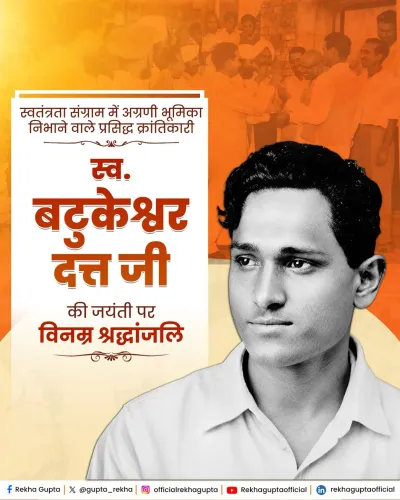
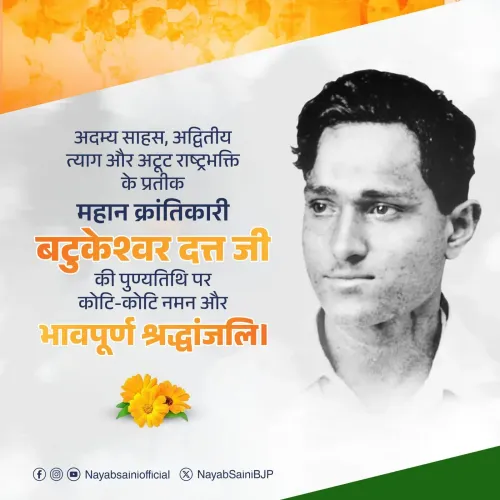
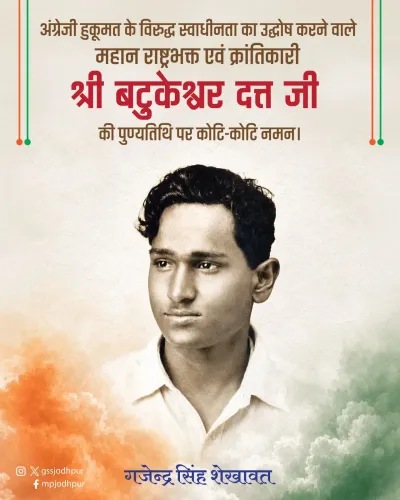
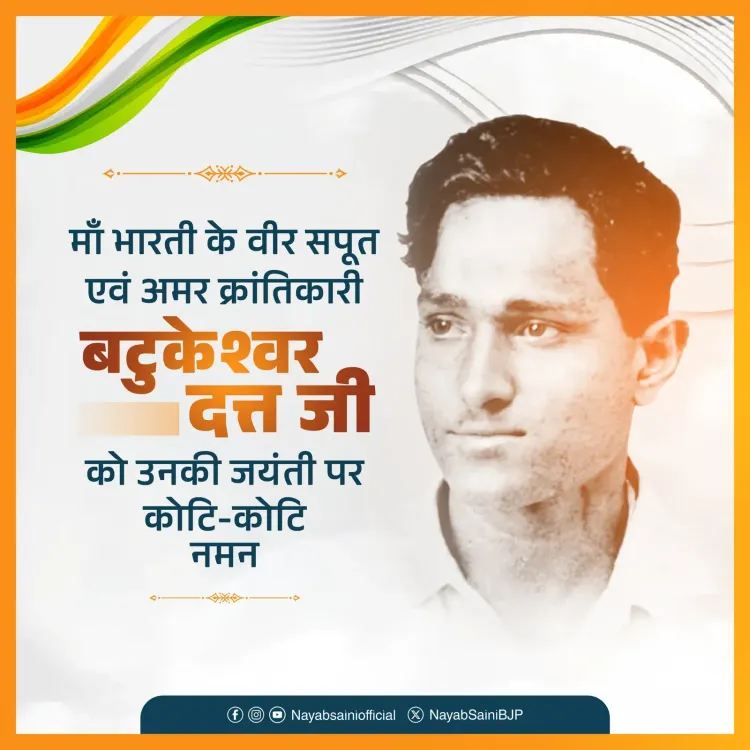
CM Nayab Saini pays tribute to revolutionary Batukeshwar Dutt on jayanti
Synopsis
Haryana Chief Minister Nayab Singh Saini paid tribute to revolutionary Batukeshwar Dutt on his birth anniversary, recalling the freedom fighter's iconic 1929 Central Legislative Assembly protest alongside Bhagat Singh and his years of imprisonment at Kala Pani.
Key Takeaways
Haryana CM Nayab Singh Saini paid tribute to revolutionary Batukeshwar Dutt on his birth anniversary, 18 November 2026 .
Dutt and Bhagat Singh threw smoke bombs in the Central Legislative Assembly on 8 April 1929 to protest the Public Safety Bill and Trade Disputes Bill .
The act was designed to send a political message, not cause casualties; both men courted arrest deliberately.
Dutt was subsequently imprisoned in the Cellular Jail, Andaman Islands — the feared 'Kala Pani'.
Saini described Dutt's legacy as a continuing inspiration for the resolve to put the 'nation first'.
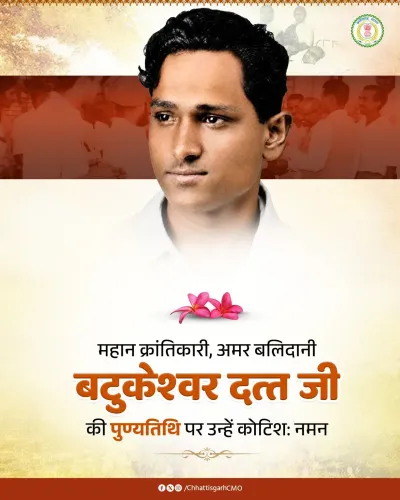
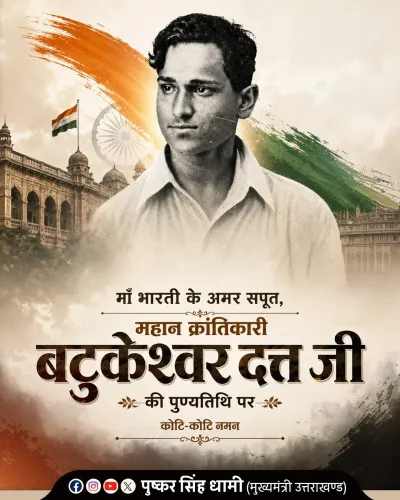
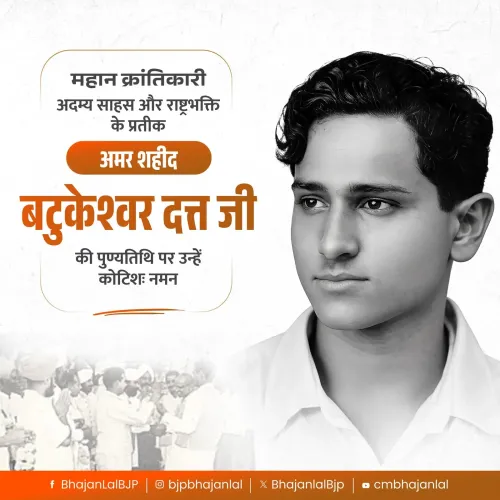
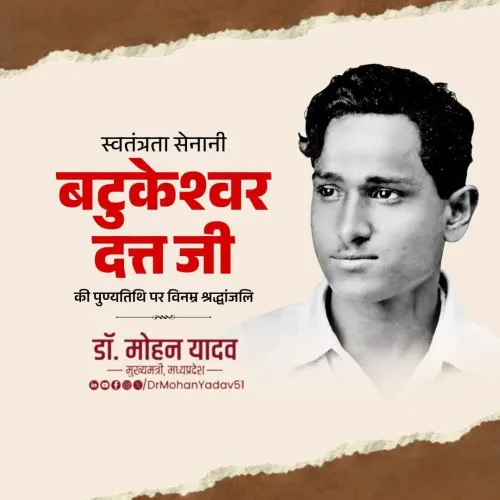
On the birth anniversary of one of India's most daring freedom fighters, Haryana Chief Minister Nayab Singh Saini paused to remember a man who once shook the British Empire from the inside — Batukeshwar Dutt, the revolutionary who stood shoulder to shoulder with Bhagat Singh in one of colonial India's most audacious acts of defiance.
Posting on Wednesday, 18 November 2026, CM Saini wrote in Hindi: 'Maa Bharti ke veer sapoot, mahan swadheenta senani evam amar krantikari Batukeshwar Dutt ji ko unki jayanti par koti-koti naman' — 'A thousand salutes to the brave son of Mother India, the great freedom fighter and immortal revolutionary Batukeshwar Dutt, on his birth anniversary.' He added that Dutt's life of sacrifice and valour would continue to inspire every Indian to remain resolute in the pledge to put the nation first.
The assembly bombing that echoed through history
On 8 April 1929, Batukeshwar Dutt and Bhagat Singh walked into the Central Legislative Assembly in Delhi and threw smoke bombs into the visitor's gallery — not to kill, but to be heard. The act was a calculated protest against the Public Safety Bill and the Trade Disputes Bill, legislation the British administration was pushing to suppress labour movements and stifle political dissent. The two men stayed put, raised slogans, and courted arrest — a dramatic assertion that the blast was a message, not a massacre.
Dutt was subsequently tried and transported to the Cellular Jail in the Andaman Islands, the dreaded 'Kala Pani', where he endured years of brutal imprisonment. His courage in the face of colonial punishment cemented his place alongside the front rank of India's revolutionary tradition — even as history's spotlight fell more heavily on Bhagat Singh.
A pattern of remembrance — and what it signals
CM Saini's tribute follows a well-established practice among Indian elected representatives: using the jayantis of independence-era revolutionaries to publicly reaffirm themes of sacrifice, nationalism, and civic duty. The gesture carries a particular resonance in Haryana, a state with deep historical ties to the freedom movement and a culture that prizes martial valour.
The message — 'nation first' — is both a historical citation and a living political idiom. In invoking Dutt on his birth anniversary, Saini places Haryana's government within a wider national conversation about whose sacrifices built modern India, and why they still matter.
Point of View
But the choice of Batukeshwar Dutt — a figure whose bravery is historically established yet often overshadowed — is notable. By anchoring his message in Dutt's specific story, CM Saini signals an intent to widen the pantheon of celebrated martyrs beyond the most familiar names. The 'nation first' framing also performs ideological work, aligning a colonial-era revolutionary's sacrifice with contemporary nationalist discourse. For the BJP in Haryana, such commemorations serve both a cultural and an electoral purpose: they reinforce a governing identity built on patriotic heritage.
NationPress
18 Nov 2026
Frequently Asked Questions
Who was Batukeshwar Dutt?
Batukeshwar Dutt was an Indian revolutionary who, alongside Bhagat Singh, threw smoke bombs in the Central Legislative Assembly on 8 April 1929 to protest the Public Safety Bill and Trade Disputes Bill. He was subsequently imprisoned in the Cellular Jail in the Andaman Islands.
Why did Batukeshwar Dutt throw bombs in the Central Legislative Assembly?
The act was a deliberate political protest — not intended to kill — against British legislation seen as suppressing labour movements and political dissent. Dutt and Bhagat Singh stayed to court arrest, turning the act into a public statement.
When is Batukeshwar Dutt's birth anniversary?
Batukeshwar Dutt's birth anniversary is widely observed on 18 November, the date on which CM Nayab Singh Saini posted his tribute in 2026.
What did CM Nayab Singh Saini say about Batukeshwar Dutt?
CM Saini called Dutt a 'brave son of Mother India' and an 'immortal revolutionary', saying his tale of sacrifice and valour would forever inspire Indians to remain firm in their pledge to put the nation first.
What was the Cellular Jail connection to Batukeshwar Dutt?
After the 1929 assembly protest, Batukeshwar Dutt was tried and sentenced to transportation to the Cellular Jail in the Andaman Islands — the British colonial prison known as 'Kala Pani' — where he endured years of harsh imprisonment.