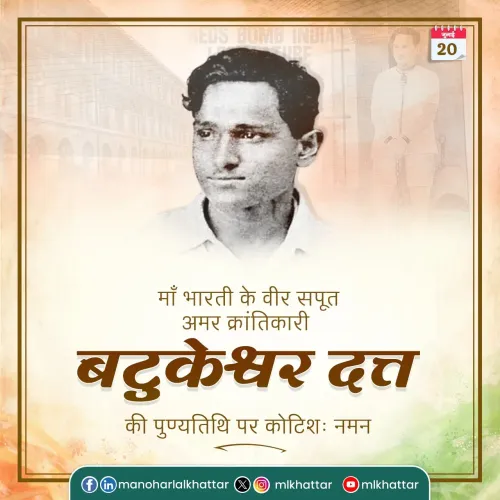
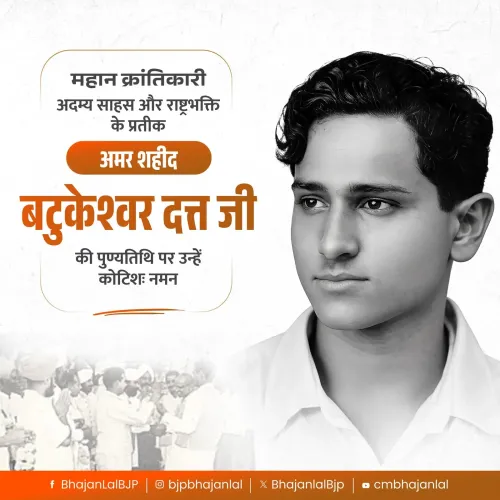
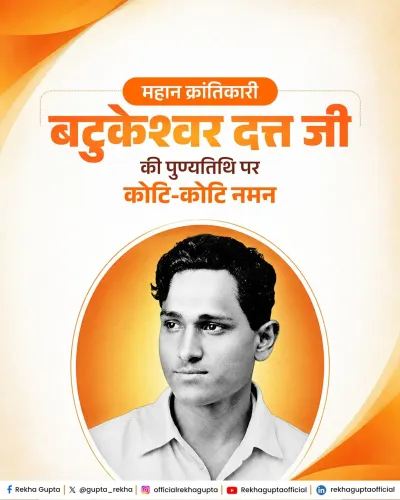
Gadkari pays tribute to revolutionary Batukeshwar Dutt on jayanti
Synopsis
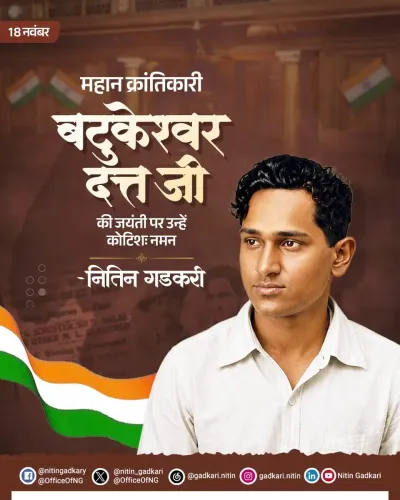
Union Minister Nitin Gadkari honoured revolutionary Batukeshwar Dutt on his birth anniversary, paying homage to the freedom fighter who famously bombed the Central Legislative Assembly alongside Bhagat Singh in 1929.
Key Takeaways
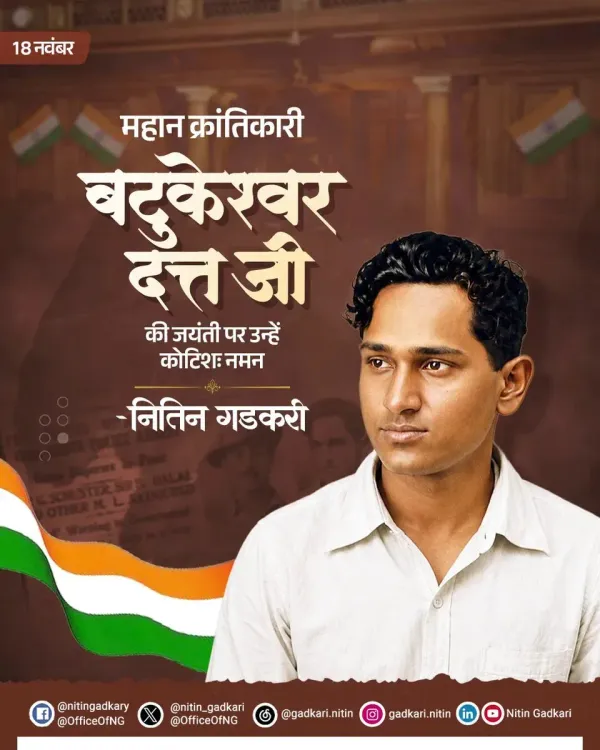
Nitin Gadkari posted a tribute to Batukeshwar Dutt on his birth anniversary on 18 November 2026 .
Dutt, alongside Bhagat Singh , threw smoke bombs in the Central Legislative Assembly on 8 April 1929 to protest the Public Safety Bill and Trade Disputes Bill.
The act was deliberate and non-lethal — intended as a political statement, not to cause casualties.
Dutt was convicted and imprisoned in the Cellular Jail, Andaman Islands , spending years in harsh conditions.
Unlike Bhagat Singh, who was hanged in 1931 , Dutt survived and remained a lesser-known figure in mainstream historical memory.
Indian political leaders regularly commemorate independence-era revolutionaries on their jayantis as part of national remembrance.
A freedom fighter who once shook the halls of colonial power with a defiant act of protest gets his due remembrance today — and Union Road Transport and Highways Minister Nitin Gadkari is among those honouring him.
On Wednesday, 18 November 2026, Gadkari took to X to offer his respects to Batukeshwar Dutt on the revolutionary's birth anniversary, writing 'कोटिशः नमन' — a salutation meaning 'a crore-fold reverence' — accompanied by the Indian tricolour emoji and folded-hands gesture.
The 1929 Assembly bombing that echoed through history
Batukeshwar Dutt occupies a singular place in India's independence movement. On 8 April 1929, he and Bhagat Singh threw smoke bombs into the Central Legislative Assembly in Delhi — not to cause casualties, but to ensure their message could not be ignored. The target was the colonial government's push for the Public Safety Bill and the Trade Disputes Bill, legislation the revolutionaries condemned as instruments of oppression against workers and political opponents. The slogan they hurled alongside the bombs — 'Inquilab Zindabad' — became a rallying cry that outlasted the British Empire itself. Dutt was arrested, tried, and convicted alongside Bhagat Singh. He survived where his celebrated comrade did not — Bhagat Singh was hanged in 1931 — and Dutt spent years in the Andaman's Cellular Jail, enduring its notoriously brutal conditions. His relative anonymity in mainstream historical memory, despite such sacrifice, makes tributes like today's especially pointed.A pattern of official remembrance across the aisle
Gadkari's post is part of a well-established tradition in Indian public life: ministers, chief ministers, and parliamentarians across party lines mark the birth and death anniversaries of independence-era figures with formal tributes on social media. These jayanti posts serve as compact exercises in national memory, keeping lesser-celebrated revolutionaries from fading into historical footnotes. For a figure like Batukeshwar Dutt — brave, consequential, yet long overshadowed by the towering legend of Bhagat Singh — each such commemoration nudges public awareness a little further in his direction. The measure of a nation's gratitude, after all, is not only in its monuments but in whether it remembers who stood in the shadows too.Point of View
Alongside the more canonically celebrated Gandhian tradition — a cultural-political choice that reflects the party's broader historical framing of nationalism. Batukeshwar Dutt's relative obscurity makes the gesture more meaningful than a routine Bhagat Singh post: it signals an effort to widen the pantheon. For the government, social-media jayanti tributes also function as low-cost, high-visibility acts of national memory maintenance. The cumulative effect, across hundreds of such posts by officials each year, is a living archive of the freedom struggle kept in public circulation.
NationPress
18 Nov 2026
Frequently Asked Questions
Who was Batukeshwar Dutt?
Batukeshwar Dutt was an Indian revolutionary who, alongside Bhagat Singh, threw smoke bombs in the Central Legislative Assembly in Delhi on 8 April 1929 to protest colonial legislation. He was subsequently convicted and imprisoned in the Cellular Jail in the Andaman Islands.
What did Batukeshwar Dutt do in 1929?
In 1929, Batukeshwar Dutt and Bhagat Singh bombed the Central Legislative Assembly in Delhi to protest the Public Safety Bill and the Trade Disputes Bill. The act was deliberately non-lethal — designed to deliver a political message rather than cause casualties.
Why is Batukeshwar Dutt less famous than Bhagat Singh?
While both were convicted for the 1929 assembly bombing, Bhagat Singh was executed in 1931 and became a martyr icon. Dutt survived imprisonment but faded from mainstream historical memory, overshadowed by his more celebrated comrade.
Why did Nitin Gadkari post about Batukeshwar Dutt?
18 November is Batukeshwar Dutt's birth anniversary. Gadkari's post is part of the Indian political tradition of paying public tribute to freedom fighters on their jayantis.
What does 'kotishaha naman' mean?
'Kotishaha naman' is a Hindi phrase meaning 'a crore-fold salutation' or 'reverence a hundred-million times over' — a form of deep, reverential tribute used in formal commemorations.