Giriraj Singh hails 496 mn poverty exit under Modi

Synopsis
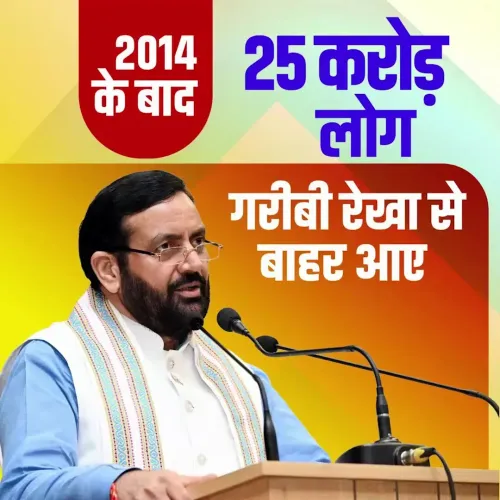
Textiles Minister Giriraj Singh on 11 November 2026 credited PM Modi's leadership for lifting 496 million Indians out of poverty, calling it a historic achievement rooted in a decade of direct-benefit welfare schemes and the government's MPI-aligned socio-economic push.
Key Takeaways
Giriraj Singh posted on 11 November 2026 crediting PM Modi's leadership with lifting 496 million people out of poverty.
The claim aligns with the government's use of NITI Aayog's Multidimensional Poverty Index , which measures deprivation across health, education, and living standards.
NITI Aayog's earlier MPI reports (covering 2015-16 to 2019-21 ) had already documented a significant fall in the poverty headcount.
Key welfare drivers cited by the administration include PM Awas Yojana, Ujjwala Yojana, Swachh Bharat Mission , and food security entitlements.
The precise 496 million figure awaits corroboration from the next official MPI update or large-sample consumption-expenditure survey.
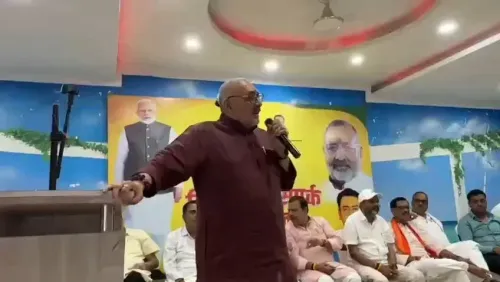
A number that would rewrite any nation's development story — 496 million people lifting themselves out of poverty — has drawn a sharp political salute from Union Textiles Minister Giriraj Singh on Wednesday, 11 November 2026, who called it a 'historic achievement' in India's growth journey under Prime Minister Narendra Modi.
Posting on X in Hindi, the senior BJP leader and Lok Sabha MP from Begusarai, Bihar, wrote: 'माननीय प्रधानमंत्री श्री @narendramodi जी के नेतृत्व में 496 मिलियन लोगों का गरीबी रेखा से बाहर आना भारत के विकास की ऐतिहासिक उपलब्धि है।' — 'Under the leadership of Honourable Prime Minister Shri Narendra Modi, the exit of 496 million people from below the poverty line is a historic achievement in India's development.' Singh added that the figure reflects 'sweeping socio-economic transformation, a better life for crores of families, and the government's commitment to public welfare.'
India's poverty-count debate: from consumption surveys to MPI
The figure, as striking as it is, sits inside a long and contested measurement history. India has tracked poverty through household consumption expenditure surveys for decades. Since 2021, NITI Aayog introduced a Multidimensional Poverty Index aligned with global SDG metrics — measuring deprivation not just by income but across health, education, and living standards. NITI Aayog's MPI reports documented a significant fall in the poverty headcount between 2015-16 and 2019-21. The present figure of 496 million goes beyond those earlier data points and would represent the cumulative arc of that reduction trend extending into the mid-2020s.The welfare architecture behind the claim
The Modi government has consistently anchored its poverty-reduction narrative to a suite of large-scale direct-benefit programmes: subsidised housing under Pradhan Mantri Awas Yojana, free cooking fuel through Ujjwala Yojana, sanitation coverage via Swachh Bharat Mission, and food security through the National Food Security Act. Each scheme, the administration argues, lifts a household not just above an income threshold but across multiple deprivation indicators simultaneously — the logic that makes the MPI framework politically useful for the ruling party. Singh's post is part of a broader BJP communications push that frames development metrics as a referendum on a decade-plus of Modi-led governance. As a cabinet minister from Bihar — one of India's historically poorer states — Singh carries particular political weight when invoking such numbers for his core constituency. The next NITI Aayog MPI update or a fresh large-sample consumption-expenditure survey will be the definitive test: either corroborating this scale of poverty exit or prompting a fresh round of methodological debate. Until then, the 496 million figure stands as the government's boldest headline yet on the promise it has made to India's poorest.Point of View
As the MPI framework can aggregate gains across housing, sanitation, and energy access into a single dramatic headline figure. However, the credibility of the 496 million claim will ultimately rest on independent survey data; until that arrives, it remains a powerful political assertion rather than a fully verified statistic. The next MPI release will either cement this as a governance legacy moment or trigger a sharp methodological counter-narrative.
NationPress
11 Nov 2026
Frequently Asked Questions
What is the 496 million poverty claim Giriraj Singh made?
Union Textiles Minister Giriraj Singh stated that under PM Modi's leadership, 496 million people have exited poverty in India, calling it a historic development achievement rooted in welfare schemes and the government's multidimensional poverty framework.
How does India measure poverty reduction?
India uses both household consumption expenditure surveys and, since 2021 , NITI Aayog's Multidimensional Poverty Index (MPI) , which tracks deprivation across health, education, and living standards aligned with global SDG metrics — not just income alone.
What welfare schemes does the Modi government credit for poverty reduction?
The government points to Pradhan Mantri Awas Yojana (housing), Ujjwala Yojana (cooking fuel), Swachh Bharat Mission (sanitation), and food security entitlements under the National Food Security Act as key drivers of multi-dimensional poverty exit.
Has NITI Aayog confirmed the 496 million poverty exit figure?
NITI Aayog's earlier MPI reports documented a significant fall in poverty between 2015-16 and 2019-21 . The specific figure of 496 million cited by Singh goes beyond those published reports and awaits formal corroboration in the next official MPI update or consumption survey.
Who is Giriraj Singh and why does his statement matter?
Giriraj Singh is a senior BJP leader, Union Minister of Textiles, and Lok Sabha MP from Begusarai, Bihar — one of India's historically poorer states — giving his endorsement of poverty-reduction figures particular political and demographic weight.