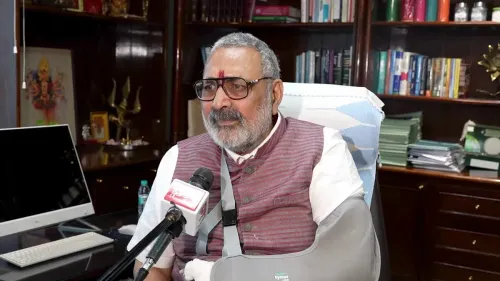
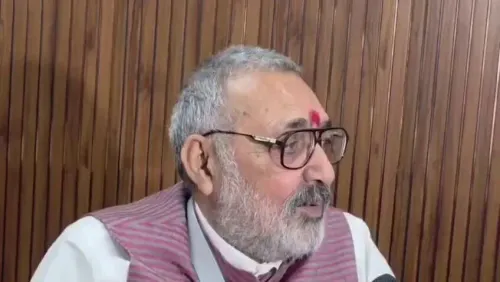
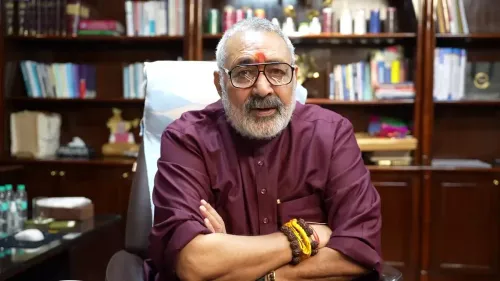
Giriraj Singh: Every plot to seize power through chaos has failed
Synopsis
Union Textiles Minister Giriraj Singh declared on 9 November 2026 that every conspiracy to seize power through anarchy has failed, asserting that BJP holds the people's blessing and that opposition to national achievements betrays anti-national motives.
Key Takeaways
Union Textiles Minister Giriraj Singh posted a sharp political statement on 9 November 2026 .
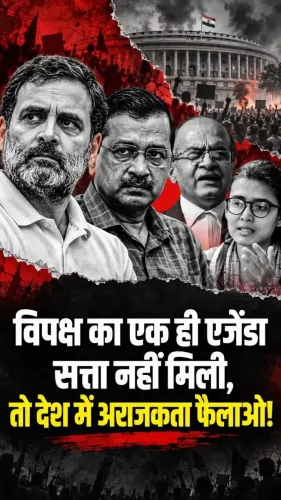
He declared that 'every conspiracy to seize power by spreading anarchy has failed.' Singh attributed the failure of such plots to 'the blessings of the country's people' being with the BJP .
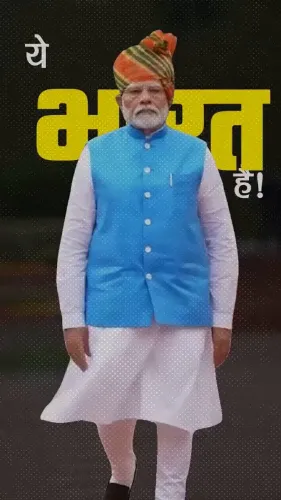
He argued that India's national achievements and decisions in the national interest cause 'pain' to what he called 'anarchic elements.' The rhetorical framing — opposition as destabilisers versus BJP as people's choice — is a consistent BJP communication pattern since 2014 .
Every conspiracy to grab power by spreading anarchy is doomed to fail — that is the blunt message Union Textiles Minister Giriraj Singh delivered on Monday, 9 November 2026, in a sharp post on X that cast the BJP as the sole legitimate custodian of India's public trust.
Writing in Hindi, the senior BJP leader and Lok Sabha MP from Begusarai, Bihar, declared: 'अराजकता फैलाकर सत्ता पाने का हर षड्यंत्र नाकाम है' — 'Every conspiracy to seize power by spreading anarchy has failed' — attributing the failure directly to the people's blessing resting with the BJP. He went further, arguing that it is precisely this track record of national achievement that 'pains these anarchic elements.'
The language of instability — a recurring BJP frame
The vocabulary Singh deploys is not new, but it is deliberate. Since 2014, Bharatiya Janata Party leaders have routinely framed opposition protests, legal challenges, and policy criticism through the lens of manufactured chaos versus stable governance. The rhetorical architecture is consistent: position any criticism as a plot against the nation, then point to public electoral mandates as the rebuttal.
What gives the post its edge is its breadth — Singh does not name an opponent, a protest, or a specific policy dispute. The absence of a named target makes the message a catch-all political statement aimed at any entity the BJP frames as 'anti-national' or destabilising, leaving interpretation wide open for supporters and critics alike.
Asserting public mandate as the ultimate shield
The core argument Singh advances is that popular support — 'देश की जनता का आशीर्वाद', 'the blessings of the country's people' — functions as a standing verdict against those he calls anarchic forces. It is a claim that doubles as both a warning and a mobilisation signal: the party's legitimacy, he implies, is renewed continuously by citizens rather than conferred once at the ballot box.
This framing also serves a secondary purpose — insulating government decisions from criticism by pre-labelling dissent as motivated disruption rather than democratic scrutiny. Whether that line holds up in parliamentary debate or on the street is a question Singh's post conspicuously leaves unanswered.
India's ruling party has the numbers, the mandate, and the minister's confidence. But in a democracy, the loudest assertion of public trust is also the one most constantly tested.
Point of View
Singh maximises the statement's reach — it can be applied retroactively to any protest, legal challenge, or electoral setback. The reference to 'national achievements causing pain' is a rhetorical pre-emption, designed to delegitimise future criticism before it crystallises into a concrete policy debate. It signals that the party is in electoral-positioning mode, reinforcing base messaging rather than engaging substantively with any single issue.
NationPress
9 Nov 2026
Frequently Asked Questions
What did Giriraj Singh say about anarchy and BJP?
On 9 November 2026, Giriraj Singh posted that every conspiracy to seize power by spreading anarchy has failed because the people's blessings are with the BJP, and that India's achievements cause pain to what he called anarchic elements.
Who is Giriraj Singh?
Giriraj Singh is India's Union Minister of Textiles, a senior BJP leader, and a Lok Sabha MP elected from Begusarai constituency in Bihar.
What is the BJP's position on opposition protests and criticism?
Since 2014, BJP leaders including Giriraj Singh have consistently framed opposition criticism and protests as attempts to create instability, countering them by citing electoral mandates as proof of public trust.
Why did Giriraj Singh not name a specific opponent in his post?
Singh's statement was broad and unnamed — a standard political communication strategy that lets a party apply the message to multiple opponents or situations simultaneously, maximising its rhetorical reach.
What does 'people's blessings with BJP' mean in Indian political context?
It is a reference to electoral mandate — the BJP's argument that successive election victories, particularly since 2014, constitute continuous popular endorsement of its governance and decisions.