Giriraj Singh flags $235 bn electrical equipment target by 2035
Synopsis
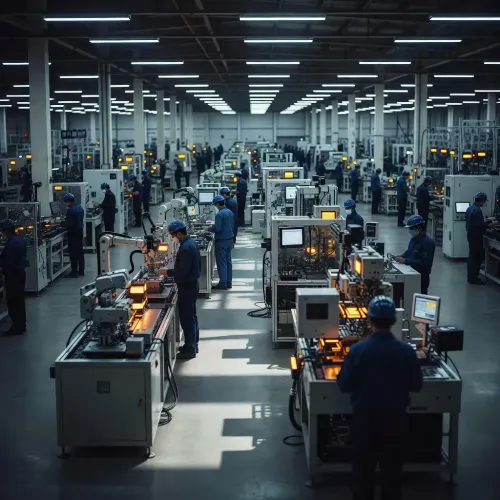
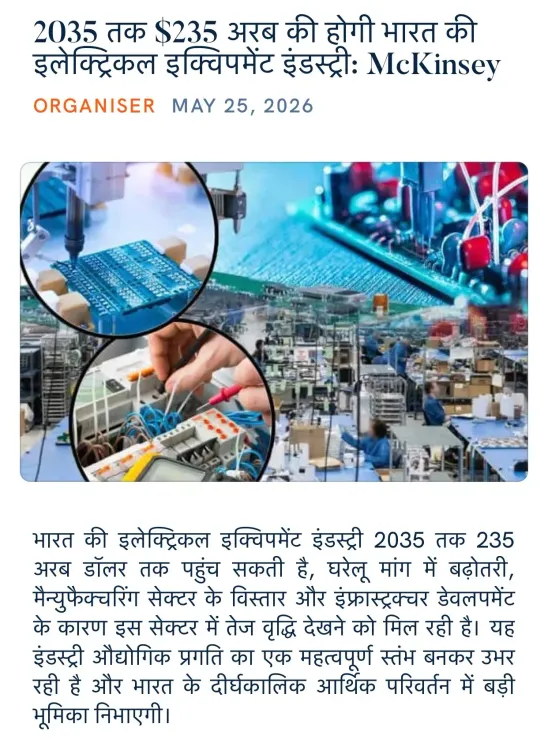
Union Textiles Minister Giriraj Singh has amplified a McKinsey projection forecasting India's electrical equipment industry will hit $235 billion by 2035, spotlighting the sector's role in Make in India and Atmanirbhar Bharat policy goals.
Key Takeaways
Union Textiles Minister Giriraj Singh shared the projection on 25 May 2026 via the NaMo App .
A McKinsey forecast projects India's electrical equipment industry will reach $235 billion by 2035 .
The sector is central to Make in India (launched September 2014 ) and the Atmanirbhar Bharat framework.
PLI schemes introduced from 2020 cover electronics, white goods, and related capital-goods segments that feed this industry.
Key stakeholders include domestic electrical equipment manufacturers , power utilities, and EPC contractors .
Future policy triggers include PLI guideline revisions and power-sector capex in the next Union Budget .
Union Textiles Minister Giriraj Singh on Monday, 25 May 2026 shared a projection that India's electrical equipment industry is set to become a $235 billion sector by 2035, citing a McKinsey forecast, via the NaMo App.
Context
The post, shared on X by the senior BJP leader and Lok Sabha MP from Begusarai, Bihar, highlighted the McKinsey projection with the caption: '2035 tak $235 arab ki hogi Bharat ki electrical equipment industry' — meaning 'India's electrical equipment industry will be worth $235 billion by 2035.' The projection signals a dramatic scale-up from the industry's current size, underscoring the long-term investment thesis for domestic capital-goods manufacturing.
Singh shared the forecast through the NaMo App, a platform routinely used by BJP leaders and Union Ministers to amplify policy-aligned economic narratives to a party-connected audience.
Policy Backdrop
India's electrical equipment sector sits at the crossroads of several flagship government programmes. The Make in India initiative, launched in September 2014, was designed to raise the share of manufacturing in GDP and reduce import dependence in strategic industries — electrical equipment being a core component.
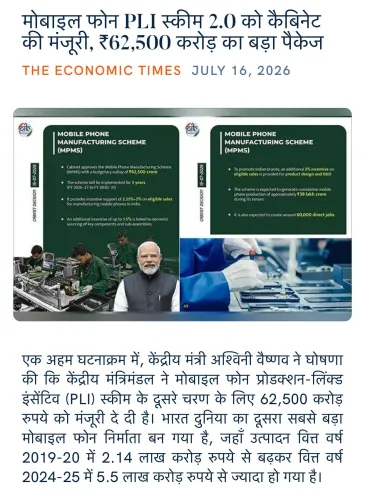
From 2020 onwards, the government rolled out Production Linked Incentive (PLI) schemes covering electronics, white goods, and related capital-goods sectors. These schemes offer financial incentives to manufacturers who achieve incremental production targets, directly supporting the kind of capacity expansion that a $235 billion industry projection would require.
The broader Atmanirbhar Bharat framework has consistently positioned electrical equipment as a strategic priority — linking power-sector expansion, export diversification, and supply-chain resilience into a single industrial policy arc.
Stakeholders and Impact
The primary beneficiaries of a sector reaching this scale would be domestic electrical equipment manufacturers, power utilities, and engineering, procurement and construction (EPC) contractors who source switchgear, transformers, cables, and other components from the domestic supply chain.
A $235 billion industry by 2035 would also have significant employment and export implications, potentially positioning India as a major global supplier of electrical capital goods — reducing dependence on imports from China and other manufacturing hubs. For investors, such projections signal a long runway for capacity additions and greenfield plant investments across the value chain.
Government communications frequently cite third-party projections from firms such as McKinsey to build a credible, data-backed case for continued policy support and private-sector confidence in capital-intensive sectors.
What's Next
Analysts and industry bodies will watch closely for any revision or extension of PLI guidelines specifically targeting the electrical equipment segment, as well as the next round of power-sector capital-expenditure outlays in the Union Budget. Sustained infrastructure spending — particularly in grid modernisation, renewable energy integration, and urban electrification — will be the primary demand driver determining whether the $235 billion milestone is achievable within the projected timeline.
With the Union Budget cycle and energy-transition commitments converging, the electrical equipment sector is likely to remain a focal point for both policy announcements and private investment decisions through the remainder of the decade.
Point of View
Not Power or Heavy Industries — reflects a broader BJP ministerial practice of collectively owning the economic-growth narrative across portfolios. The $235 billion figure serves as a political data point reinforcing the government's decade-long manufacturing push, even as the specific report's methodology remains unverified in public records. By routing the share through the NaMo App rather than a formal press statement, the communication is calibrated for party-base mobilisation rather than institutional policy signalling. The move nonetheless keeps the electrical equipment sector's investment story visible at a moment when PLI scheme reviews and budget deliberations are likely in progress.
NationPress
8 Oct 2026
Frequently Asked Questions
What is the McKinsey projection for India's electrical equipment industry?
McKinsey has projected that India's electrical equipment industry will grow to $235 billion by 2035, a figure highlighted by Union Textiles Minister Giriraj Singh on 25 May 2026.
Why did Giriraj Singh share this electrical equipment forecast?
Giriraj Singh shared the McKinsey projection via the NaMo App to highlight India's long-term manufacturing growth potential, consistent with the government's Make in India and Atmanirbhar Bharat policy goals.
What is India's current policy support for the electrical equipment sector?
India supports the sector through the Make in India programme launched in 2014 and Production Linked Incentive (PLI) schemes introduced from 2020, which cover electronics, white goods, and related capital-goods industries.
Who benefits from India's electrical equipment industry growth?
The primary beneficiaries are domestic electrical equipment manufacturers, power utilities, and EPC contractors, along with workers employed across the value chain and export-oriented businesses.
What will drive India's electrical equipment industry to $235 billion by 2035?
Key drivers include grid modernisation, renewable energy integration, urban electrification, continued PLI scheme support, and rising domestic and export demand for transformers, cables, and switchgear.