Giriraj Singh highlights Bhagalpur powerloom weaver's tech upgrade
Synopsis
Union Textiles Minister Giriraj Singh on 24 July 2026 highlighted Mohammed Shamshad, a Bhagalpur powerloom weaver, as an example of how technology upgrades under schemes like ATUFS and Aatmanirbhar Bharat are improving quality, buyer reach, and incomes for traditional weavers in Bihar.
Key Takeaways
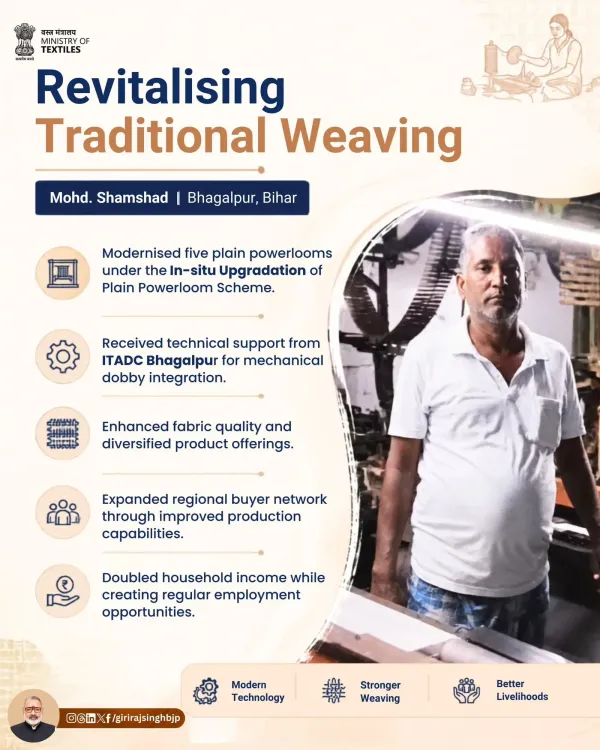
Union Textiles Minister Giriraj Singh shared the success story of Mohammed Shamshad , a powerloom weaver from Bhagalpur, Bihar , on 24 July 2026 .
Shamshad's plain powerloom upgrade reportedly improved product quality, expanded his buyer base, and raised family income.
The post invokes #VocalForLocal and #AatmanirbharBharat , linking the individual case to national self-reliance campaigns.
The Amended Technology Upgradation Fund Scheme (ATUFS) , introduced in 2016 , provides capital investment subsidies for powerloom modernisation in clusters like Bhagalpur.
Bhagalpur is a major silk textile cluster in Bihar, with large numbers of small powerloom and handloom units dependent on government support for upgrades and market access.
Union Textiles Minister Giriraj Singh on Friday, 24 July 2026, spotlighted the success story of Mohammed Shamshad, a powerloom weaver from Bhagalpur, Bihar, citing his experience as proof that blending traditional craft with modern technology opens new economic opportunities.
Posting on X, the minister wrote: 'Bhagalpur ke Shri Mohammad Shamshad ji ne yeh sabit kiya hai ki jab parampara ko aadhunik takneek ka saath milta hai, toh naye avsar ke dwar khulte hain' — 'Mr Mohammed Shamshad of Bhagalpur has proved that when tradition meets modern technology, doors to new opportunities open.' The minister noted that an upgrade of Shamshad's plain powerloom, backed by technical support, improved product quality, helped reach new buyers, and led to a 'notable increase' in the family's income.
Context
Bhagalpur is one of India's most storied textile clusters, historically renowned for Tussar silk — often called 'Bhagalpuri silk' — as well as mulberry silk, with a large base of both handloom and powerloom units. The district's weavers, many of them small and micro entrepreneurs, have long faced challenges around outdated machinery, limited market access, and price competition from larger mills. Shamshad's case, as presented by the minister, illustrates the kind of ground-level transformation the government says its modernisation push is delivering.
Policy Backdrop
The government's effort to modernise decentralised powerloom units has a long lineage. The Technology Upgradation Fund Scheme (TUFS), launched in 1999, introduced subsidised credit for textile machinery upgrades. Its successor, the Amended Technology Upgradation Fund Scheme (ATUFS), rolled out in 2016, shifted to direct capital investment subsidies for powerloom and other textile units. These schemes specifically target clusters like Bhagalpur where millions of workers depend on the decentralised sector.
The Aatmanirbhar Bharat initiative, announced in May 2020, added fresh impetus — packaging self-reliance goals with measures to strengthen domestic textile production and build export competitiveness. The hashtags #VocalForLocal and #AatmanirbharBharat used by the minister in the post explicitly tie Shamshad's individual upgrade to these national campaigns.
Stakeholders and Impact
The powerloom sector is among India's largest employers in manufacturing, with an estimated workforce running into the millions across states including Maharashtra, Gujarat, Tamil Nadu, and Bihar. For weaver communities in Bihar — a state where the textile sector is a significant source of rural non-farm income — access to technology subsidies and market linkages is particularly consequential. Beneficiary-story communications of this kind are aimed at signalling scheme outcomes to prospective applicants and reinforcing uptake in under-penetrated clusters.
The minister's post underscores three specific gains attributed to the upgrade: improved product quality, expanded buyer reach, and higher household income — metrics that align with the stated objectives of both ATUFS and the broader Aatmanirbhar Bharat textile package.
What's Next
Attention will now turn to the pace of ATUFS disbursements in Bihar and whether the upcoming Union Budget or a revised national textile policy will introduce fresh provisions for powerloom modernisation. The ministry's continued highlighting of individual success stories from clusters like Bhagalpur suggests a deliberate outreach strategy to drive scheme awareness and uptake ahead of any policy revision cycle.
Point of View
Tying grassroots economic gains to the broader self-reliance narrative. Whether the ministry follows such messaging with accelerated ATUFS disbursements in Bihar will be the real test of intent.
NationPress
23 Oct 2026
Frequently Asked Questions
Who is Mohammed Shamshad from Bhagalpur?
Mohammed Shamshad is a powerloom weaver from Bhagalpur, Bihar, whose story of upgrading his plain powerloom with modern technology was highlighted by Union Textiles Minister Giriraj Singh on 24 July 2026 as an example of how tradition and technology can together improve incomes and market access.
What is the ATUFS scheme for powerloom weavers?
The Amended Technology Upgradation Fund Scheme (ATUFS), introduced in 2016, offers direct capital investment subsidies to textile units including powerloom operators to help them upgrade machinery, improve product quality, and become more competitive.
Why is Bhagalpur important for India's textile sector?
Bhagalpur in Bihar is one of India's most recognised textile clusters, famous for Tussar silk and mulberry silk fabrics. It has a large base of handloom and powerloom weavers who depend on government schemes for machinery upgrades and market linkages.
What is Aatmanirbhar Bharat's role in textiles?
The Aatmanirbhar Bharat initiative, announced in May 2020, included measures to boost domestic textile production, reduce import dependence, and strengthen export competitiveness, with powerloom modernisation being one of its key components.
What did Giriraj Singh say about Bhagalpur weavers?
Giriraj Singh said that Mohammed Shamshad of Bhagalpur has proved that when tradition meets modern technology, new opportunities open up, citing improvements in product quality, buyer reach, and family income following a powerloom upgrade.