Giriraj Singh hails India-Oman FTA as Modi govt 'masterstroke'
Synopsis
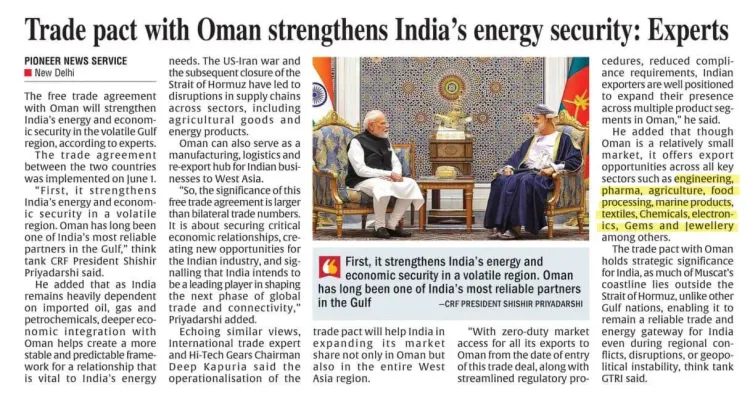
Union Textiles Minister Giriraj Singh has lauded the India-Oman Free Trade Agreement as a 'masterstroke' by the Modi government, highlighting zero-duty market access for textiles, pharmaceuticals and engineering goods, and framing the deal as a boost to India's exports in West Asia and to its energy and economic security.
Key Takeaways
Union Textiles Minister Giriraj Singh has called the India-Oman FTA a 'masterstroke' of the Modi government.
The minister flagged zero-duty market access as a major boost for textiles, pharma and engineering exports.
Singh said the pact would expand Indian exports to West Asia and bolster energy and economic security.
The deal follows the template of the India-UAE CEPA signed in February 2022.
Negotiations with other GCC economies remain on India's trade agenda.
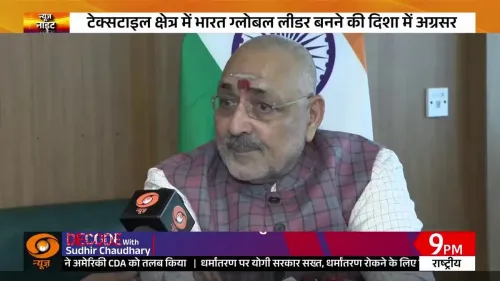
Union Textiles Minister Giriraj Singh on Wednesday, 3 June 2026, described the India-Oman Free Trade Agreement as a 'masterstroke' of the BJP-led government under Prime Minister Narendra Modi, asserting that zero-duty market access would give a major fillip to Indian textiles, pharmaceuticals and engineering exports. The minister, posting on X, framed the pact as both an economic and strategic gain for India in West Asia.
In his post, Singh wrote that the 'India-Oman Free Trade Agreement is a masterstroke of the BJP government under the leadership of Honourable Prime Minister Shri Narendra Modi' and that 'zero-duty market access will provide a huge boost to our key sectors such as textiles, pharma and engineering'. He added that the deal would 'not only expand our exports to West Asia but also strategically strengthen India's energy and economic security'.
Context
Singh's intervention comes from the cabinet member who directly oversees one of the sectors named as a primary beneficiary. India's textile and apparel industry remains among the largest employers in the country and has been seeking preferential access to Gulf markets, where Indian fabrics, made-ups and ready-made garments compete with suppliers from China, Bangladesh and Turkey.
The minister's emphasis on pharmaceuticals and engineering goods mirrors the export basket New Delhi has tried to push into the Gulf Cooperation Council region, where Indian generics and capital goods have a growing footprint but still face tariff and non-tariff barriers in several markets.
Policy backdrop
The India-Oman pact sits within a wider arc of trade diplomacy that gathered pace after the India-UAE Comprehensive Economic Partnership Agreement was signed in February 2022. That deal, India's first major trade agreement with a Gulf economy in over a decade, became the template for negotiations with other GCC states.
Successive rounds of talks with Oman have focused on tariff elimination for labour-intensive Indian exports in exchange for predictable access for Omani petrochemicals and energy products. The push aligns with the production-linked incentive schemes rolled out after 2020, which aim to scale up domestic manufacturing for export.
Stakeholders and impact
For Indian textile exporters, zero-duty entry into Oman would narrow the cost gap with rival suppliers from countries that already enjoy preferential access to several Gulf markets. Industry bodies representing apparel clusters in Tiruppur, Surat, Ludhiana and the National Capital Region have long argued that tariff parity is critical to defending market share.
Pharmaceutical manufacturers stand to gain from smoother registration and lower duties on formulations, while engineering exporters — covering auto components, electrical machinery and fabricated metal products — have flagged the Gulf as a high-growth corridor. On the strategic side, Singh's reference to 'energy security' underscores Oman's role as a crude and LNG supplier and its location at the mouth of the Strait of Hormuz.
What's next
Attention now shifts to the parliamentary and procedural steps that typically follow such agreements, along with the publication of detailed tariff schedules sector by sector. The first full year of bilateral trade data after the pact's operationalisation will be the clearest test of whether zero-duty access translates into measurable export gains for the sectors Singh highlighted.
Parallel negotiations with the remaining GCC economies will also be watched closely. If the Oman template holds, it could accelerate New Delhi's broader effort to lock in preferential access across West Asia — a region that is simultaneously an export market, an energy supplier and home to a large Indian diaspora.
Point of View
Pharma and engineering, the minister is signalling that labour-intensive and value-added sectors — not just commodity flows — are the political prize. The 'energy and economic security' phrasing also reflects how New Delhi increasingly bundles trade pacts with strategic considerations around the Strait of Hormuz. The real test will be whether tariff cuts translate into measurable export gains within the first two years.
NationPress
18 Oct 2026
Frequently Asked Questions
What is the India-Oman Free Trade Agreement?
It is a bilateral trade pact between India and Oman that, as described by Union Textiles Minister Giriraj Singh, offers zero-duty market access for key Indian export sectors including textiles, pharmaceuticals and engineering goods.
Why did Giriraj Singh call the India-Oman FTA a 'masterstroke'?
Singh described it as a 'masterstroke' because zero-duty access is expected to boost Indian exports to West Asia while also strengthening India's energy and economic security through deeper ties with a key Gulf partner.
Which Indian sectors will benefit from the India-Oman FTA?
Textiles, pharmaceuticals and engineering goods are the sectors specifically highlighted by Union Textiles Minister Giriraj Singh as primary beneficiaries of zero-duty market access under the agreement.
How does the India-Oman FTA fit with other Gulf trade deals?
It follows the India-UAE Comprehensive Economic Partnership Agreement signed in February 2022 and is part of a broader push by India to negotiate preferential trade arrangements with GCC economies.
What happens next after the India-Oman FTA announcement?
Attention now turns to procedural steps such as ratification, publication of detailed tariff schedules, and the first full year of bilateral trade data, which will indicate whether the projected export gains materialise.