Giriraj Singh hails Modi's Banarasi silk gift at G7
Synopsis
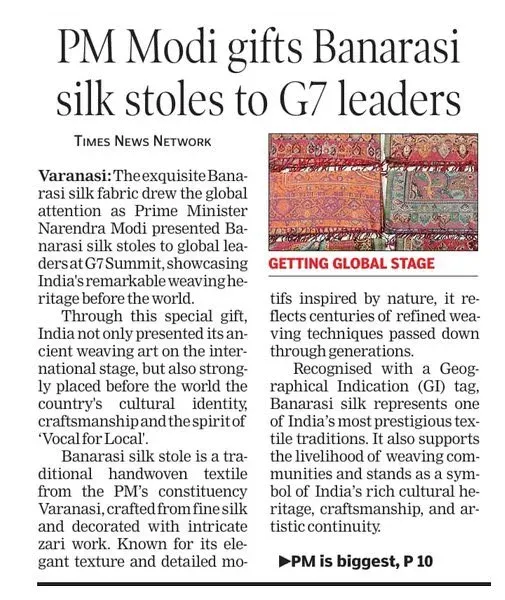
Union Textiles Minister Giriraj Singh lauded PM Modi for presenting Banarasi silk stoles to G7 world leaders, framing the gesture as a landmark moment for India's Vocal for Local campaign and a tribute to Varanasi's handloom weaving heritage.
Key Takeaways
Union Textiles Minister Giriraj Singh praised PM Modi's decision to gift Banarasi silk stoles to world leaders at the G7 Summit .
Singh described Banarasi silk as the identity of India's 'rich culture, craftsmanship, and tradition,' not merely a fabric.
The gesture is framed as advancing the Vocal for Local initiative — part of the Atmanirbhar Bharat package launched in May 2020 — on a global platform.
Banarasi silk has held a Geographical Indication (GI) tag since 2009 , protecting the craft's authenticity and origin in Varanasi, Uttar Pradesh .
India has a broader pattern of deploying GI-tagged textiles in cultural diplomacy at multilateral forums including G7 and G20 .
The move is seen as boosting international visibility for Varanasi's handloom weaver communities whose livelihoods depend on the craft.
Union Textiles Minister Giriraj Singh on Saturday, 20 June 2026 praised Prime Minister Narendra Modi for gifting Banarasi silk stoles to world leaders at the G7 Summit, calling it a powerful assertion of India's 'Vocal for Local' campaign on the global stage.
Context
Posting in Hindi on X, Singh wrote: 'Varanasi ki Banarasi silk kewal ek vastra nahin, balki Bharat ki samridh sanskriti, shilpkala aur parampara ki pehchaan hai' — 'Banarasi silk from Varanasi is not merely a fabric; it is the identity of India's rich culture, craftsmanship, and tradition.' He described the Prime Minister's gesture as a 'strong effort to give Vocal for Local a new identity on a global platform.'
The post carried hashtags #BanarasiSilk, #VocalForLocal, #G7, and #IndiaOnGlobalStage, signalling a coordinated government messaging push around the summit.
Policy Backdrop
The Vocal for Local initiative was launched as part of the Atmanirbhar Bharat package in May 2020, urging citizens and the government alike to prioritise domestically produced goods and crafts. Banarasi silk — woven in the ancient city of Varanasi, Uttar Pradesh — received a Geographical Indication (GI) tag in 2009, legally protecting the craft's origin and supporting its artisan community.
India has increasingly deployed GI-tagged textiles as instruments of cultural diplomacy at multilateral forums. A similar pattern was visible at the G20 Summit, where traditional Indian crafts and fabrics featured prominently in state gifting protocols, connecting economic self-reliance messaging with soft-power outreach.
Stakeholders and Impact
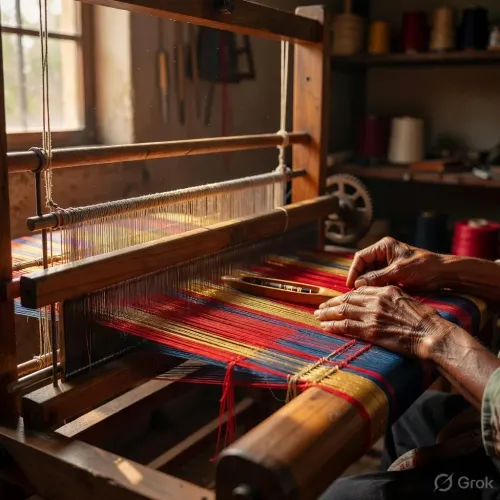
At the heart of this diplomatic gesture are Varanasi's handloom weavers, tens of thousands of artisan families whose livelihoods depend on the demand for authentic Banarasi silk. Singh specifically acknowledged that the Prime Minister's act was bringing 'the hard work and heritage of our weavers to the world with pride.'
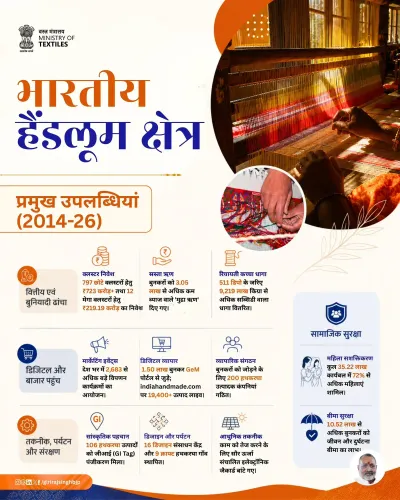
Visibility at a forum like the G7 — attended by leaders of the world's seven largest advanced economies — can translate into heightened international interest in Indian handloom exports, benefiting artisan clusters in Uttar Pradesh and beyond. The Textiles Ministry, which Singh heads, oversees multiple handloom promotion schemes targeting exactly these weaver communities.
What's Next
The government's use of Banarasi silk at the G7 is likely to intensify focus on handloom export promotion and cluster development schemes in the near term. Observers will watch whether the Textiles Ministry follows the diplomatic moment with targeted policy announcements — such as expanded credit support, design modernisation funds, or new international buyer-connect programmes for GI-tagged handloom products.
India's participation in upcoming multilateral summits will also be watched for similar cultural-gifting gestures, as the government consolidates the use of traditional crafts as a pillar of its global identity.
Point of View
As Textiles Minister, amplifying this moment is also a reminder of the ministry's stake in handloom promotion. The move fits a consistent pattern since 2014 of linking artisan heritage with national self-reliance, turning state gifting into a policy signal as much as a diplomatic courtesy. The real test will be whether this visibility translates into concrete export gains or scheme expansions for Varanasi's weaver clusters.
NationPress
19 Sept 2026
Frequently Asked Questions
Why did PM Modi gift Banarasi silk stoles at the G7 Summit?
PM Modi gifted Banarasi silk stoles to G7 world leaders as a cultural diplomacy gesture, showcasing India's traditional handloom heritage and reinforcing the government's Vocal for Local campaign on a global stage.
What is the significance of Banarasi silk?
Banarasi silk, woven in Varanasi, Uttar Pradesh, is one of India's most celebrated handloom traditions and has held a Geographical Indication (GI) tag since 2009, protecting its authenticity and the livelihoods of thousands of artisan weavers.
What is the Vocal for Local initiative?
Vocal for Local is a campaign launched under the Atmanirbhar Bharat package in May 2020, encouraging Indians and the government to prioritise domestically produced goods, including handloom and handicraft products.
What did Giriraj Singh say about Banarasi silk and the G7?
Giriraj Singh said Banarasi silk is not merely a fabric but the identity of India's rich culture, craftsmanship, and tradition, and called PM Modi's G7 gifting gesture a strong effort to give Vocal for Local a new identity on a global platform.
How does India use textiles in cultural diplomacy?
India has consistently used GI-tagged textiles and traditional crafts as diplomatic gifts at multilateral summits such as G7 and G20, linking cultural heritage with economic self-reliance messaging since 2014.