Giriraj Singh Hails Chenab Bridge, World's Highest Rail Bridge
Synopsis
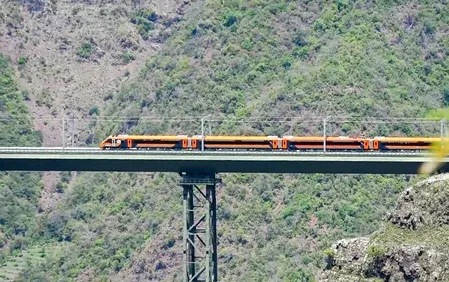
Union Textiles Minister Giriraj Singh on June 5, 2026 highlighted the Chenab Bridge in Jammu and Kashmir — standing 359 metres above the river bed and taller than the Eiffel Tower — as a record-breaking milestone in India's Himalayan railway infrastructure push under the USBRL project.
Key Takeaways
Union Textiles Minister Giriraj Singh shared a post on June 5, 2026 celebrating the Chenab Bridge as the world's highest railway bridge.
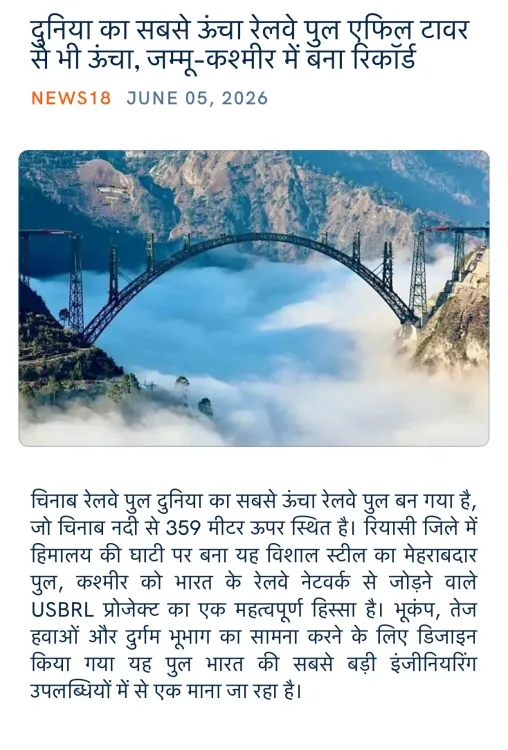
The bridge stands 359 metres above the Chenab river bed in Reasi district, Jammu and Kashmir , surpassing the height of the Eiffel Tower .
It is part of the Udhampur-Srinagar-Baramulla Rail Link (USBRL) , sanctioned in 1994-95 to connect the Kashmir Valley to the national rail network.
Construction of the bridge began in 2004 and faced repeated delays due to difficult Himalayan terrain and seismic requirements.
The bridge is designed to withstand wind speeds of up to 266 km/h and is earthquake-resistant, featuring a steel arch spanning 467 metres .
Full commercial operations on the USBRL corridor to Srinagar remain the next key milestone for the project.
Union Textiles Minister Giriraj Singh on Friday, June 5, 2026, shared a post on X celebrating the Chenab Bridge in Jammu and Kashmir as the world's highest railway bridge — taller than the Eiffel Tower — calling it a record-setting achievement for India's infrastructure ambitions.
Context
The minister's post, shared via the NaMo App, highlighted the Chenab Bridge in Reasi district, Jammu and Kashmir, which stands 359 metres above the Chenab river bed — surpassing the height of the Eiffel Tower (330 metres). The post, written in Hindi, reads: 'दुनिया का सबसे ऊंचा रेलवे पुल एफिल टावर से भी ऊंचा, जम्मू-कश्मीर में बना रिकॉर्ड' — 'The world's highest railway bridge, taller than the Eiffel Tower, sets a record in Jammu and Kashmir.' The bridge is a centrepiece of India's most ambitious Himalayan rail project.
Policy Backdrop
The Chenab Bridge is a critical segment of the Udhampur-Srinagar-Baramulla Rail Link (USBRL), a flagship Indian Railways project sanctioned in 1994-95 to provide all-weather rail connectivity to the Kashmir Valley. Construction of the bridge itself began in 2004 following detailed project reports, with work repeatedly challenged by difficult Himalayan terrain, extreme weather, and seismic considerations. The USBRL represents decades of sustained central government investment in integrating Jammu and Kashmir with the national rail network.
The bridge is engineered to withstand wind speeds of up to 266 kilometres per hour and is designed to be earthquake-resistant. Its steel arch spans 467 metres across the Chenab gorge, making it a feat of modern civil engineering in one of the world's most challenging geographies.
Stakeholders and Impact
For residents of the Kashmir Valley, the USBRL and the Chenab Bridge represent a transformational shift in connectivity. The region has historically depended on the Jammu-Srinagar National Highway, which is frequently disrupted by landslides, snowfall, and security concerns. A functional rail link would offer a more reliable, all-weather alternative for passengers, freight, and essential supplies.
Beyond civilian benefits, the project carries significant strategic weight. Rail connectivity reduces the region's logistical vulnerability and supports faster movement of goods and personnel through difficult terrain. The project has drawn attention from infrastructure planners and policymakers as a model for high-altitude rail engineering across the Himalayas.
What's Next
The completion of the Chenab Bridge brings the full operationalisation of the USBRL line to Srinagar closer to reality. Attention will now focus on the remaining civil and systems work along the corridor, including tunnels and viaducts, before commercial train services can begin on the complete stretch. Any further parliamentary or budgetary announcements on additional Himalayan rail corridors are also being closely watched by infrastructure and policy observers.
Point of View
Years in the making, offers a rare, visually compelling symbol that cuts across political lines — few dispute the engineering achievement. By sharing it via the NaMo App, the minister reinforces the party's strategy of using infrastructure milestones as political communication tools ahead of any electoral cycle. The USBRL's progress also signals that central government focus on difficult-terrain connectivity is shifting from aspiration to delivery.
NationPress
21 Oct 2026
Frequently Asked Questions
How tall is the Chenab Bridge compared to the Eiffel Tower?
The Chenab Bridge stands 359 metres above the Chenab river bed, making it taller than the Eiffel Tower , which is approximately 330 metres high. It is recognised as the world's highest railway bridge.
Where is the Chenab Bridge located?
The Chenab Bridge is located in Reasi district, Jammu and Kashmir , spanning the Chenab river gorge as part of the Udhampur-Srinagar-Baramulla Rail Link (USBRL) .
What is the USBRL project?
The Udhampur-Srinagar-Baramulla Rail Link (USBRL) is an Indian Railways project sanctioned in 1994-95 to provide all-weather rail connectivity between the Kashmir Valley and the rest of India through the Himalayas.
Why is the Chenab Bridge significant for Jammu and Kashmir?
The Chenab Bridge is a critical link in providing reliable, all-weather rail access to the Kashmir Valley , reducing dependence on the Jammu-Srinagar highway , which is frequently disrupted by landslides, snow, and other hazards.
What did Giriraj Singh say about the Chenab Bridge?
Union Textiles Minister Giriraj Singh posted on X on June 5, 2026 calling the Chenab Bridge the world's highest railway bridge and noting that it is taller than the Eiffel Tower, describing it as a record set in Jammu and Kashmir .