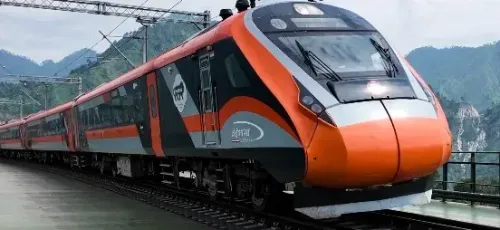
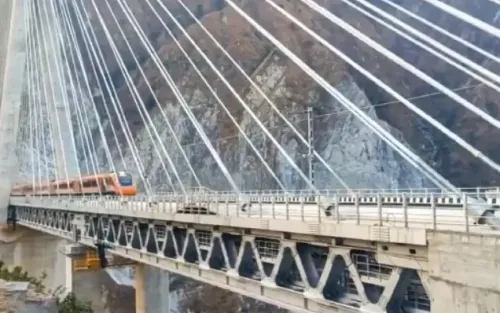
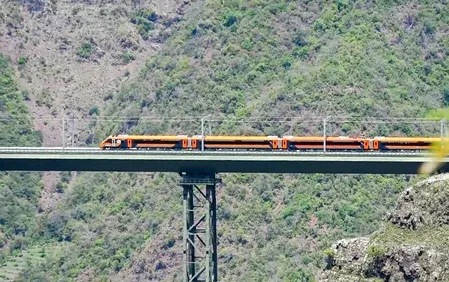
Vande Bharat hits 100 kmph on world's highest railway bridge over Chenab
Synopsis
For the first time, a Vande Bharat train has crossed the Chenab Rail Bridge — 359 metres above the river, taller than the Eiffel Tower — at 100 kmph. The Railway Ministry's speed clearance on the Katra-Banihal section is a tangible operational leap for the USBRL, India's most ambitious mountain rail project, and a signal that the corridor is edging toward full-service readiness.
Key Takeaways
Vande Bharat ran at 100 kmph on the Chenab Rail Bridge for the first time on 20 August .
The Railway Ministry approved the speed increase on the 111-km Katra-Banihal Broad Gauge section after all safety conditions were met.
Previous speed limits were 85 kmph (Katra-Sangaldan) and 75 kmph (Sangaldan-Banihal).
The Chenab Rail Bridge stands 359 metres above the river bed — 35 metres taller than the Eiffel Tower — with a span of 1,315 metres .
The upgrade is expected to cut travel time between Katra and Banihal and boost tourism and trade in the region.
The Vande Bharat train clocked 100 km per hour on the Chenab Rail Bridge — the world's highest railway bridge — for the first time on Thursday, 20 August, following the Railway Ministry's approval to raise the maximum permissible speed on the Katra-Banihal rail section. The milestone was confirmed by Uchit Singhal, Senior Divisional Commercial Manager, Jammu, who said the speed upgrade would cut travel time and deepen connectivity between Jammu and Kashmir.
What Changed on the Katra-Banihal Section
The revised speed limit applies to the 111-kilometre Broad Gauge rail section between Shri Mata Vaishno Devi Katra and Banihal under the Jammu Division of Northern Railway. Previously, trains were permitted to run at 85 kmph on the Katra-Sangaldan stretch and 75 kmph on the Sangaldan-Banihal stretch. The upgrade to 100 kmph across the section was cleared only after all prescribed safety conditions were verified, according to Northern Railway.
About the Chenab Rail Bridge
The Chenab Rail Bridge in Jammu and Kashmir stands 359 metres (1,178 feet) above the Chenab River bed — 35 metres taller than the Eiffel Tower — making it the highest railway bridge in the world. Its total span is 1,315 metres. The structure is a steel and concrete deck arch bridge engineered to withstand high winds and seismic activity, and is widely regarded as a landmark achievement in railway engineering.
Impact on Passengers and the Region
'The move would provide passengers with faster, safer and more comfortable travel while also boosting tourism, trade and economic activities in the region,' Singhal said. With the revised speed ceiling in place, journey time between Katra and Banihal is expected to fall further, strengthening the rail link that connects the Kashmir Valley to the rest of the country.
The Bigger Picture: USBRL Project
The Katra-Banihal section is part of the larger Udhampur-Srinagar-Baramulla Rail Link (USBRL), a strategically significant project whose newly constructed track spans 272 km, with the overall continuous rail corridor from Jammu to Baramulla running roughly 324 to 345 km depending on the junctions measured. This speed enhancement marks a new operational benchmark for the corridor and signals growing confidence in the infrastructure's readiness for higher-capacity service.
Point of View
But the more important question is how quickly the full USBRL corridor can be brought to comparable speed standards end-to-end. Mountain rail projects routinely achieve engineering firsts that take years to translate into reliable passenger timetables. Northern Railway's emphasis on safety compliance before the speed hike is the right signal — but the real test is sustained performance across seasons, including the harsh Himalayan winter. India's strategic interest in all-weather Kashmir connectivity means execution consistency matters far more than headline speed records.
NationPress
5 Oct 2026
Frequently Asked Questions
What is the significance of Vande Bharat running at 100 kmph on the Chenab Bridge?
It is the first time a train has operated at 100 kmph on the Chenab Rail Bridge, the world's highest railway bridge at 359 metres above the Chenab River. The milestone follows the Railway Ministry's approval to raise the maximum permissible speed on the 111-km Katra-Banihal section, cutting travel time between Jammu and Kashmir.
What were the speed limits on the Katra-Banihal section before this upgrade?
Before the upgrade, trains were permitted to run at 85 kmph on the Katra-Sangaldan section and 75 kmph on the Sangaldan-Banihal section. The new approval raises the ceiling to 100 kmph across the entire 111-km Broad Gauge section.
How tall is the Chenab Rail Bridge and why is it significant?
The Chenab Rail Bridge stands 359 metres (1,178 feet) above the Chenab River bed, making it the highest railway bridge in the world — 35 metres taller than the Eiffel Tower. Its 1,315-metre span is built to withstand high winds and earthquakes, and it is a central structure in the USBRL project linking Jammu to the Kashmir Valley.
What is the USBRL project?
The Udhampur-Srinagar-Baramulla Rail Link (USBRL) is a strategically important railway project connecting Jammu to the Kashmir Valley. The newly constructed track spans 272 km, with the overall continuous rail corridor from Jammu to Baramulla running roughly 324 to 345 km depending on the junctions measured.
How will the speed upgrade benefit passengers and the region?
According to Senior Divisional Commercial Manager Uchit Singhal, the higher speed will reduce travel time between Katra and Banihal and provide faster, safer, and more comfortable journeys. It is also expected to boost tourism, trade, and economic activity across the Jammu and Kashmir region.