Giriraj Singh hails Bijnor herbal tea, women's enterprise
Synopsis
Union Textiles Minister Giriraj Singh amplified PM Modi's praise for Bijnor's women-led herbal tea on 27 July 2026, spotlighting the district as a model of grassroots women's enterprise under ODOP and DAY-NRLM frameworks.
Key Takeaways
Giriraj Singh shared PM Modi's praise for Bijnor 's herbal tea on 27 July 2026 , calling it a symbol of women's power.
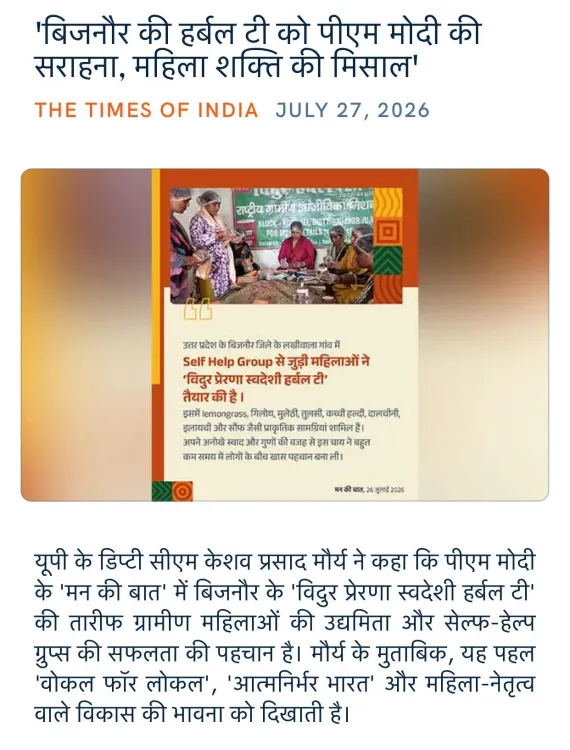
Bijnor district in Uttar Pradesh has women's self-help groups producing and marketing herbal tea as a value-added product.
The One District One Product (ODOP) scheme, launched in 2018 , provides the policy foundation for promoting such district-level goods.
The Deendayal Antyodaya Yojana–National Rural Livelihoods Mission (DAY-NRLM) has supported women's SHGs with credit and market linkages since 2011 .
A Prime Ministerial endorsement can significantly boost consumer interest and open institutional procurement channels for local producers.
The Textiles Ministry 's amplification signals growing central government focus on herbal and natural value chains in Uttar Pradesh .
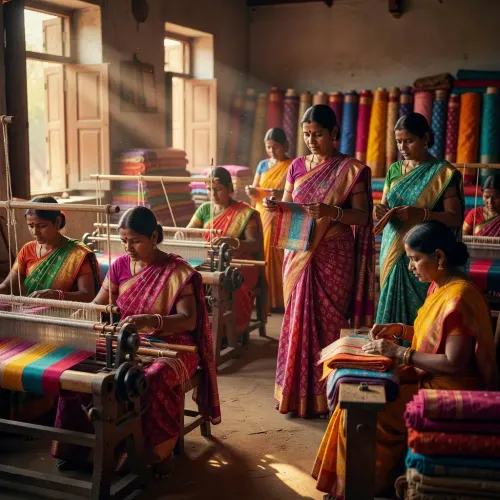
Union Textiles Minister Giriraj Singh on Monday, 27 July 2026, shared a post on X applauding Prime Minister Narendra Modi's praise for Bijnor's herbal tea, calling it a symbol of women's empowerment and an example of grassroots entrepreneurship flourishing under government initiatives.
The minister's post, captioned 'बिजनौर की हर्बल टी को पीएम मोदी की सराहना, महिला शक्ति की मिसाल' ('PM Modi's praise for Bijnor's herbal tea — an example of women's power'), amplified the Prime Minister's recognition of women-led micro-enterprises producing herbal tea in the Bijnor district of Uttar Pradesh.
Context
Bijnor, a district in western Uttar Pradesh, has emerged as a hub for women's self-help group (SHG) activity in the herbal and natural products space. The district's herbal tea, produced and marketed by local women entrepreneurs, has drawn attention as a model of community-led economic participation. Prime Minister Modi's acknowledgement of this product is consistent with his broader 'vocal for local' messaging, which encourages Indians to champion domestically produced goods.
Policy Backdrop
The success of Bijnor's herbal tea sits within a well-established policy framework. The One District One Product (ODOP) scheme, launched in 2018, was designed to identify and promote a distinctive product from each district, channelling government support toward marketing, packaging, and value addition. Herbal and natural items have been a recurring category under the scheme in Uttar Pradesh.
Complementing ODOP is the Deendayal Antyodaya Yojana–National Rural Livelihoods Mission (DAY-NRLM), which has supported women's SHGs since 2011 by providing credit access, skill training, and market linkages for value-added products. Together, these programmes have created an enabling environment for women in districts like Bijnor to move up the value chain from raw agriculture to branded consumer goods.
Stakeholders and Impact
The primary beneficiaries of this recognition are the women self-help groups and herbal product makers of Bijnor. A public endorsement from the Prime Minister, amplified by a senior Union Minister, typically translates into heightened consumer interest and can open doors to larger retail and institutional procurement channels. For the Textiles Ministry, which increasingly intersects with natural fibre and herbal value chains in Uttar Pradesh clusters, such visibility reinforces the ministry's stake in promoting women-led enterprise beyond conventional textile manufacturing.
The broader Atmanirbhar Bharat framework — under which both ODOP and DAY-NRLM operate — positions district-level success stories as proof of concept for self-reliant, women-driven local economies. Giriraj Singh's amplification of this narrative signals the central government's intent to keep such stories in public focus.
What's Next
Observers will watch for any additional ODOP-linked incentives targeting herbal and natural products, particularly in Uttar Pradesh clusters. Parliamentary questions on women enterprise funding within the textiles sector are also likely to reference high-profile examples such as Bijnor's herbal tea as the budget cycle progresses. If the Prime Minister's praise is formalised — through a scheme recognition or a GI tag process — it could significantly scale the product's market reach beyond the district.
Point of View
Converting a local product story into a national narrative about women's economic agency. The move reinforces the 'vocal for local' brand while simultaneously positioning the Textiles Ministry as a stakeholder in agri-herbal value chains — a space traditionally outside its core mandate. By linking Bijnor's herbal tea to women's empowerment, the government signals that ODOP and DAY-NRLM are producing visible, politically useful outcomes ahead of any state or national electoral cycle. Watch for whether this praise triggers formal scheme recognition or GI-tag momentum, which would be the true test of policy follow-through.
NationPress
25 Oct 2026
Frequently Asked Questions
What is Bijnor herbal tea and who makes it?
Bijnor herbal tea is a locally produced herbal beverage from Bijnor district in Uttar Pradesh , made and marketed by women's self-help groups as part of grassroots enterprise initiatives supported by government schemes.
Why did PM Modi praise Bijnor herbal tea?
PM Modi praised Bijnor herbal tea as an example of women-led local enterprise consistent with his 'vocal for local' and Atmanirbhar Bharat messaging, which encourages support for domestically produced goods.
What is the One District One Product scheme?
The One District One Product (ODOP) scheme was launched in 2018 to identify and promote a distinctive product from each district, providing marketing, packaging, and value-addition support to boost local economies.
What did Giriraj Singh say about Bijnor herbal tea?
Union Textiles Minister Giriraj Singh shared a post on 27 July 2026 calling PM Modi's praise for Bijnor's herbal tea a 'symbol of women's power' and an example of grassroots women's empowerment.
How does DAY-NRLM support women making herbal products?
The Deendayal Antyodaya Yojana–National Rural Livelihoods Mission (DAY-NRLM) , operational since 2011 , provides women's self-help groups with credit access, skill training, and market linkages to help them produce and sell value-added goods like herbal tea.