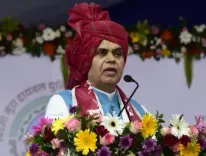
Giriraj Singh hails Mithila Haat bullock-cart tourism push

Synopsis
Union Textiles Minister Giriraj Singh on 22 June 2026 lauded a heritage tourism project at Mithila Haat in Jhanjharpur, Madhubani, where a modernised bullock cart has been turned into a cultural attraction, calling it proof that development and tradition can coexist.
Key Takeaways
Union Textiles Minister Giriraj Singh praised the bullock-cart tourism initiative at Mithila Haat, Jhanjharpur, Madhubani on 22 June 2026 .
The bullock cart — a traditional rural symbol — has been given a modern, aesthetic form to attract tourists to the cultural marketplace.
Giriraj Singh credited Sanjay Jha , a Bihar political figure, for spearheading the effort to preserve Mithila's identity and heritage.
Madhubani paintings from the Mithila region hold a Geographical Indication tag granted in 2007 , underlining the area's established cultural significance.
The initiative aligns with the national Swadesh Darshan scheme (launched 2014-15), which supports heritage and cultural tourist circuits across India.
Local artisans, rural tourism operators, and the broader Mithila community stand to benefit from increased visitor footfall at Mithila Haat.
Union Textiles Minister Giriraj Singh on Monday, 22 June 2026, praised a heritage tourism initiative at Mithila Haat in Jhanjharpur, Madhubani district, Bihar, calling the modernised bullock-cart attraction a model for preserving cultural roots while driving development.
Posting in Hindi on X, the Minister wrote: 'बदलते बिहार की यह सुंदर तस्वीर हमारी सांस्कृतिक विरासत को नए रूप में संजोने की प्रेरणा देती है' — 'This beautiful picture of a changing Bihar inspires us to preserve our cultural heritage in a new form.' He noted that the bullock cart at Mithila Haat had been given an 'attractive and modern form' to make it a tourism centrepiece, adding that this proves 'a new path of development can be forged while staying connected to one's roots.'
The post concluded with a direct commendation of Sanjay Jha, a Bihar political figure associated with local heritage initiatives, tagging him with the words: 'This effort to preserve the identity and heritage of Mithila is truly praiseworthy.'
Context
Mithila Haat is a cultural marketplace in Jhanjharpur, the headquarters of Madhubani district, designed to showcase the traditions, crafts, and folk culture of the Mithila region. Madhubani is globally recognised for its distinctive Mithila paintings, which received a Geographical Indication tag in 2007 — one of the earliest such protections for a folk art form in India.
The bullock cart, a symbol of rural Bihar's agrarian past, has been reimagined at the Haat as a visual and experiential tourism asset. Giriraj Singh framed this as evidence that tradition and modernity are not in conflict, but can be integrated into a coherent development narrative for the state.
Policy Backdrop
The initiative fits within a longer arc of national cultural tourism policy. The Swadesh Darshan scheme, launched by the Ministry of Tourism in 2014-15, specifically targeted the development of heritage and cultural tourist circuits across states, including Bihar. Mithila's folk traditions — paintings, weaves, and rituals — have been a recurring focus of state-level promotion efforts under this framework.
Several Indian states have pursued projects that repurpose traditional rural assets — carts, haats, and folk art — into tourism products. Bihar's emphasis on Mithila-specific heritage places it within a national pattern of using intangible cultural assets alongside physical infrastructure to attract domestic tourists.
Stakeholders and Impact
The primary beneficiaries of such heritage-tourism models are local artisans, weavers, and rural tourism operators in the Mithila belt. By positioning a traditional object like the bullock cart as a tourism draw, the initiative creates footfall at Mithila Haat, which in turn supports the craftspeople and vendors who depend on visitor spending.
For the broader Mithila community, the symbolic value is significant: the region's identity — long tied to its art, language, and customs — gains visibility through state-supported modernisation rather than being sidelined by it. Giriraj Singh's endorsement, as a senior Union Minister from Bihar, also elevates the initiative's national profile.
What's Next
Attention will turn to whether Bihar's state tourism budget and upcoming policy announcements include dedicated funding to scale similar heritage-modernisation models to other districts beyond Madhubani. The success of the Jhanjharpur bullock-cart project could serve as a template for repurposing other rural cultural assets — doli, naav, traditional dwellings — into experiential tourism nodes across the state.
With domestic cultural tourism gaining momentum nationally, Bihar's Mithila-focused initiatives may also attract attention in future rounds of central scheme funding, particularly if state-level tourism data shows measurable visitor upticks at heritage sites like Mithila Haat.
Point of View
Not a relic. The framing of the bullock cart as a 'modern' tourism asset is consistent with the broader BJP narrative of 'vikas' and 'virasat' (development and heritage) as complementary, not competing, forces. By tagging Sanjay Jha directly, Singh also performs a public endorsement that elevates a local actor within the Bihar political ecosystem ahead of what remains a competitive state political landscape. The post reinforces Bihar's positioning as a cultural tourism destination at a moment when domestic travel and intangible heritage preservation are both high on the national policy agenda.
NationPress
20 Sept 2026
Frequently Asked Questions
What is Mithila Haat in Jhanjharpur?
Mithila Haat is a cultural marketplace located in Jhanjharpur, the headquarters of Madhubani district in Bihar. It is designed to showcase the traditions, crafts, and folk culture of the Mithila region, including its world-famous Madhubani paintings.
Why did Giriraj Singh praise the bullock-cart tourism initiative?
Giriraj Singh praised the initiative because a traditional bullock cart at Mithila Haat has been modernised and made visually attractive to serve as a tourism draw. He called it proof that development and cultural tradition can coexist, and commended Sanjay Jha for the effort.
What is the Swadesh Darshan scheme and how does it relate to Bihar?
The Swadesh Darshan scheme was launched by the Ministry of Tourism in 2014-15 to develop heritage and cultural tourist circuits across India, including Bihar. Mithila's folk traditions and cultural assets fall within the kind of heritage tourism this scheme is designed to support.
Who is Sanjay Jha and why was he mentioned by Giriraj Singh?
Sanjay Jha is a Bihar political figure associated with local heritage and tourism initiatives in the Mithila region. Giriraj Singh tagged and praised him on X for his role in preserving Mithila's cultural identity through the Jhanjharpur bullock-cart project at Mithila Haat.
What makes Madhubani district culturally significant in India?
Madhubani district is the heartland of the Mithila region and is globally renowned for Madhubani paintings, a folk art tradition that received a Geographical Indication tag in 2007. The district's art, language, and customs form a distinct cultural identity that heritage tourism initiatives seek to preserve and promote.