Giriraj Singh hails Modi's welfare push, cites poverty reduction
Synopsis
Union Textiles Minister Giriraj Singh on 21 June 2026 praised PM Modi's governance, citing the lifting of over 25 crore people from poverty and farmer self-reliance drives under the Sabka Saath, Sabka Vikas framework.
Key Takeaways
Union Textiles Minister Giriraj Singh posted on X on 21 June 2026 praising PM Narendra Modi's welfare record.
The post credits the government with lifting more than 25 crore people out of poverty under Modi's leadership.
Singh highlighted farmer self-reliance as a key achievement, invoking the annadata (farmer) welfare agenda.
The post invokes Sabka Saath, Sabka Vikas — the BJP's inclusive-development slogan since 2014 .
PM-KISAN , launched in 2019 , provides Rs 6,000 annually to eligible farmers as direct income support.
The next NITI Aayog poverty index update and any PM-KISAN revisions in the 2026-27 budget cycle will be key policy milestones to watch.
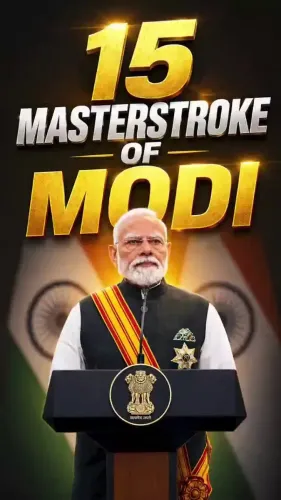
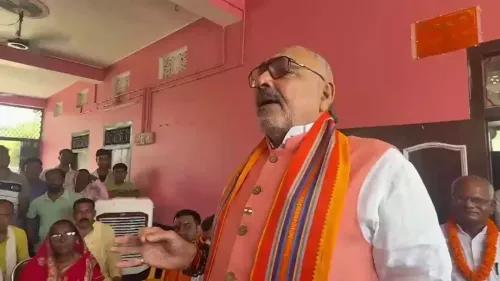
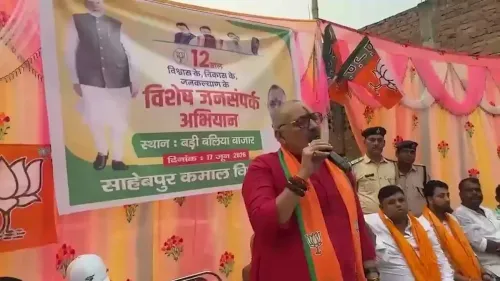
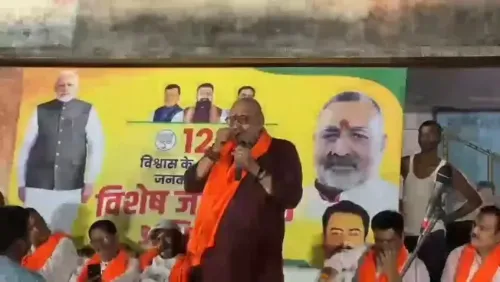
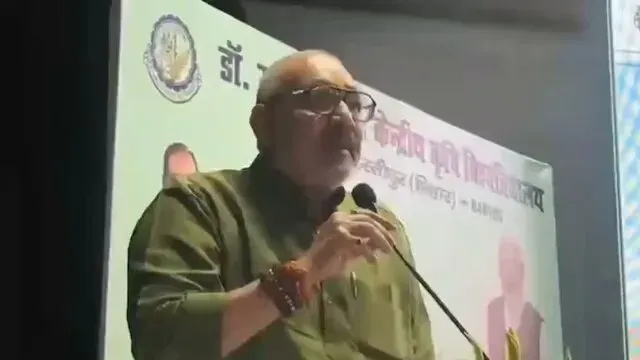
Union Textiles Minister Giriraj Singh on Sunday, 21 June 2026 praised Prime Minister Narendra Modi's governance record, crediting his leadership with lifting more than 25 crore people out of poverty and advancing farmer self-reliance through targeted welfare programmes.
Context
Posting in Hindi on X, Singh wrote: 'माननीय प्रधानमंत्री श्री नरेन्द्र मोदी जी के दूरदर्शी नेतृत्व में आज देश का हर वर्ग सशक्त हो रहा है' — 'Under the visionary leadership of respected Prime Minister Narendra Modi, every section of the country is being empowered today.' He added that efforts to lift more than 25 crore people out of poverty and to make annadata (farmers) self-reliant are 'unparalleled', closing with the government's signature phrase 'Sabka Saath, Sabka Vikas' — 'Together with all, development for all'.
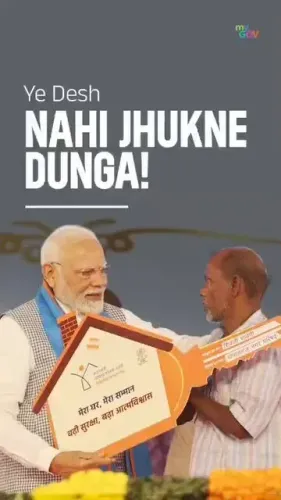
The post was accompanied by a video and tagged with the hashtags #TransformingIndia, #PragatiKaAadhar, and #FarmersFirst, situating it within the ruling party's broader communication framework on inclusive development.
Policy Backdrop
Sabka Saath, Sabka Vikas has been the cornerstone of the BJP's governance messaging since the 2014 general election, framing poverty alleviation and agricultural welfare as interconnected national priorities. The PM-KISAN scheme, introduced in the 2019 Union Budget, provides eligible landholding farmers with annual direct income support of Rs 6,000, and is among the flagship instruments cited when the government speaks of making farmers self-reliant.
The Atmanirbhar Bharat campaign, launched in 2020, extended this self-reliance framework to agriculture and the rural economy, aiming to reduce dependence on external inputs while expanding direct benefit transfers to vulnerable households. NITI Aayog's National Multidimensional Poverty Index reports, the first of which was released in 2021, have been used by the government to document progress on poverty reduction across states.
Stakeholders and Impact
The primary beneficiaries invoked in Singh's post are rural poor households and farmers — two constituencies that have been central to the government's welfare architecture over the past decade. Direct benefit transfer programmes and agricultural income-support schemes have together sought to address both income poverty and agrarian distress simultaneously.
As a senior BJP leader and Lok Sabha MP from Begusarai, Bihar — a state with a large agrarian population — Singh's amplification of this messaging carries particular resonance in the Hindi heartland, where farmer welfare and poverty alleviation remain politically salient issues ahead of any electoral cycle.
What's Next
Policy watchers will look to the next NITI Aayog Multidimensional Poverty Index update for independently tracked data on poverty trends. Any revision to PM-KISAN coverage or outlay — whether during the 2026-27 budget cycle or the monsoon session of Parliament — will be a key indicator of whether the government intends to deepen or expand its farmer-welfare commitments. Singh's post signals continued political investment in framing welfare delivery as a defining achievement of the Modi government, a theme likely to intensify as the administration advances its development narrative.
Point of View
Using verified policy milestones — PM-KISAN, Atmanirbhar Bharat — as anchors for a broader claim of transformational governance. The invocation of 25 crore people lifted from poverty draws on NITI Aayog's MPI framework, lending institutional credibility to what is also a partisan message. As Textiles Minister and a Bihar MP, Singh is simultaneously reinforcing the party's appeal to agrarian and lower-income constituencies in the Hindi heartland. The timing — mid-year, on a Sunday morning — suggests routine political communication rather than a policy announcement, but it reflects a disciplined, coordinated amplification strategy that the party has deployed consistently since 2014.
NationPress
19 Sept 2026
Frequently Asked Questions
What did Giriraj Singh say about PM Modi's welfare schemes?
Giriraj Singh said that under PM Modi's visionary leadership every section of society is being empowered, highlighting the lifting of over 25 crore people from poverty and efforts to make farmers self-reliant.
What is the PM-KISAN scheme and how does it help farmers?
PM-KISAN is a central government scheme introduced in the 2019 Union Budget that provides eligible landholding farmers with Rs 6,000 per year in direct income support to enhance agricultural self-reliance.
What does 'Sabka Saath, Sabka Vikas' mean?
'Sabka Saath, Sabka Vikas' translates to 'Together with all, development for all' and has been the BJP government's core inclusive-development slogan since the 2014 general election.
How does NITI Aayog track poverty reduction in India?
NITI Aayog publishes the National Multidimensional Poverty Index, first released in 2021, which tracks poverty across multiple dimensions including health, education, and living standards across Indian states.
Who is Giriraj Singh and what is his role in the government?
Giriraj Singh is a senior BJP leader, Union Minister of Textiles, and Lok Sabha MP from Begusarai, Bihar, known for his vocal support of the Modi government's welfare and development agenda.