Giriraj Singh Rides Solar EV Prototype for Divyangjan at AMTZ
Synopsis
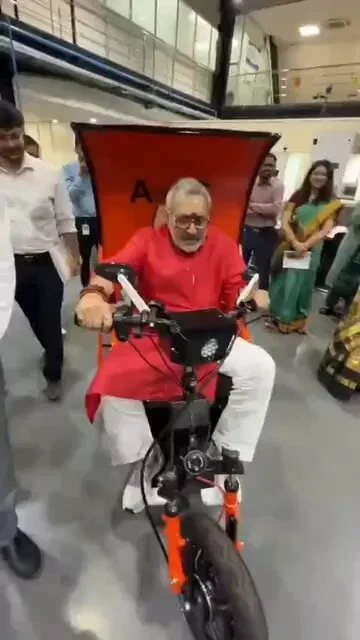
Union Textiles Minister Giriraj Singh rode a solar-powered Made-in-India EV prototype at AMTZ, Visakhapatnam, designed for persons with disabilities. Equipped with lithium battery and solar panels, the vehicle claims a 180 km range and is positioned as an affordable indigenous alternative to foreign mobility solutions under the Atmanirbhar Bharat framework.
Key Takeaways
Union Textiles Minister Giriraj Singh visited AMTZ in Visakhapatnam on 30 May 2026 and rode a solar-powered Made-in-India EV prototype.
The vehicle runs on a lithium battery and solar panels and is claimed to cover 180 km on a single charge.
It is specifically designed for Divyangjan (persons with disabilities) and positioned as far cheaper than imported alternatives.
The prototype was developed by young Indian engineers at AMTZ, Andhra Pradesh's medtech and innovation campus.
Singh linked the innovation to Atmanirbhar Bharat , Make in India , and India's broader green energy goals.
Analysts will watch for the prototype's possible inclusion in future FAME or PLI advanced-chemistry-cell disbursements.
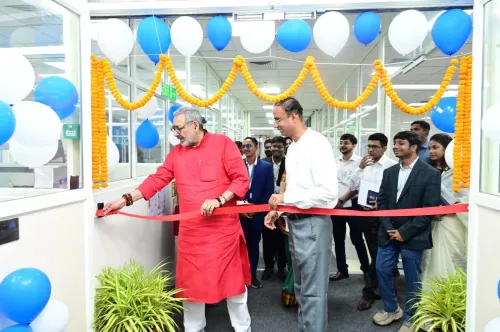
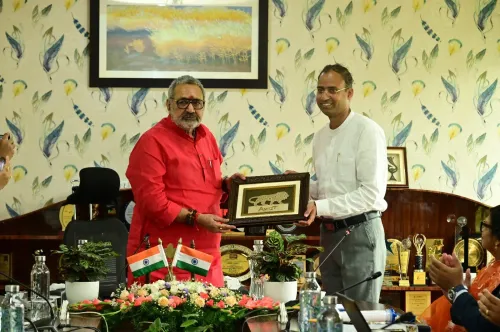
Union Textiles Minister Giriraj Singh on Saturday, 30 May 2026, rode a solar-powered, Made-in-India electric vehicle prototype at the Andhra Pradesh MedTech Zone (AMTZ) in Visakhapatnam, praising it as an affordable indigenous mobility solution designed specifically for persons with disabilities.
What the Minister Said
Posting a video of the ride on X, Singh wrote — 'आज AMTZ में सोलर ऊर्जा से चलने वाली इस शानदार मेड-इन-इंडिया EV की सवारी की' ('Today I rode this magnificent Made-in-India solar-powered EV at AMTZ'). He described the vehicle as equipped with a lithium battery and solar panels, claiming a single-charge range of 180 km. Singh called it 'a brilliant prototype designed especially for our Divyang brothers and sisters — an extremely affordable and excellent indigenous solution compared to foreign alternatives.' He added: 'Our future lies in green energy and such technology. Proud of this invention by the country's young engineers!'
The post carried hashtags including #GreenEnergy, #ElectricVehicle, #MadeInIndia, #AtmanirbharBharat, and #DivyangJan, signalling the minister's intent to connect the prototype to multiple flagship policy narratives simultaneously.
Context: AMTZ and Its Role
AMTZ (Andhra Pradesh MedTech Zone), based in Visakhapatnam, Andhra Pradesh, is a government-backed manufacturing and innovation campus originally established to support medtech and allied technology development. Its expansion into assistive and green mobility devices reflects a broader push to leverage existing innovation infrastructure for social-impact technology. The facility has positioned itself as an incubation ground for young Indian engineers working on niche, high-impact products.
Policy Backdrop
The prototype sits at the intersection of several long-running central government programmes. The FAME India scheme, launched in 2015, has channelled demand incentives and charging-infrastructure investment toward electric and hybrid vehicles. The Make in India programme, announced in 2014, specifically targets domestic design and production in the automobile and green-technology sectors. The National Electric Mobility Mission Plan, framed in 2013, set early targets for EV penetration and indigenous component manufacturing.
Overlaying all of these is the Atmanirbhar Bharat self-reliance initiative launched in 2020, which promotes indigenous manufacturing and reduced dependence on foreign technology imports — the precise framing Singh invoked when comparing the vehicle favourably against 'foreign alternatives.'
Stakeholders and Impact
The vehicle's stated design focus on Divyangjan — persons with disabilities — is significant. Affordable assistive mobility remains a gap in India's EV ecosystem, where most commercially available options are priced beyond the reach of many disability-benefit recipients. A solar-assisted range extender reduces dependence on charging infrastructure, which is still sparse in smaller towns and rural areas where a large share of India's 2.68 crore persons with locomotor disabilities reside, according to census data.
Young engineers and startups operating within AMTZ's ecosystem stand to benefit if the prototype attracts funding through production-linked incentive (PLI) schemes or dedicated assistive-technology procurement by state governments.
What's Next
Ministerial visibility for such prototypes often precedes policy action — observers will watch whether solar-assisted or assistive EVs find explicit mention in the next revision of FAME disbursement guidelines or in PLI advanced-chemistry-cell allocations. Parliamentary questions on the commercialisation timeline and safety certification of the AMTZ prototype are also likely in the coming session. For now, Singh's post plants a public marker: India's green-mobility ambition must extend to its most underserved users.
Point of View
Atmanirbhar Bharat, and Divyangjan welfare — under a single, photogenic moment. As a senior BJP leader from Bihar, Singh's amplification of a technology developed in Andhra Pradesh also signals the party's intent to project inclusive, pan-India innovation credentials ahead of potential state-level political cycles. The prototype itself, while still unvalidated commercially, gives the government a tangible talking point against criticism that India's EV push has largely benefited urban, able-bodied consumers. Whether ministerial attention translates into procurement orders or PLI support will be the real test of political intent.
NationPress
19 Sept 2026
Frequently Asked Questions
What is the AMTZ solar EV that Giriraj Singh rode?
It is a Made-in-India electric vehicle prototype developed at the Andhra Pradesh MedTech Zone (AMTZ) in Visakhapatnam, powered by a lithium battery and solar panels, and designed specifically for persons with disabilities. The vehicle is claimed to travel up to 180 km on a single charge.
Where is AMTZ located and what does it do?
AMTZ, or Andhra Pradesh MedTech Zone, is located in Visakhapatnam, Andhra Pradesh. It is a government-backed manufacturing and innovation campus originally set up for medtech development, now also supporting assistive and green mobility technology.
Why is this EV designed for Divyangjan?
Affordable assistive mobility solutions for persons with disabilities remain scarce in India's EV market. The AMTZ prototype targets this gap by offering a solar-assisted, low-cost alternative to expensive imported mobility devices, reducing dependence on charging infrastructure.
How does this EV relate to Atmanirbhar Bharat?
Atmanirbhar Bharat, launched in 2020, promotes indigenous manufacturing and reduced reliance on foreign imports. Singh explicitly framed the AMTZ prototype as a 'swadeshi solution' cheaper than foreign alternatives, directly invoking this self-reliance framework.
What government schemes support electric vehicles in India?
India's main EV support schemes include FAME India (launched 2015) for demand incentives and charging infrastructure, the Make in India programme (2014) for domestic auto manufacturing, and the National Electric Mobility Mission Plan (2013) for EV penetration targets and indigenous component production.