Giriraj Singh flags AI, IPL, Defence as new wealth creators
Synopsis
Union Textiles Minister Giriraj Singh amplified a report on 25 June 2026 positioning AI, the IPL and defence as India Inc's newest wealth creators, framing the country's $3.4 trillion market story around sectors that have gained policy momentum since 2014.
Key Takeaways
Union Textiles Minister Giriraj Singh shared the report on 25 June 2026 via the NaMo App .
The report frames AI, IPL and defence as the three new pillars of India Inc's wealth creation.
India's Make in India (2014) and Atmanirbhar Bharat (2020) programmes underpin policy support for these sectors.
Defence FDI on the automatic route was raised to 74 percent in 2020 , boosting private-sector participation.
Union Budget 2026-27 allocations for AI and defence capital procurement are the next key policy signal to watch.
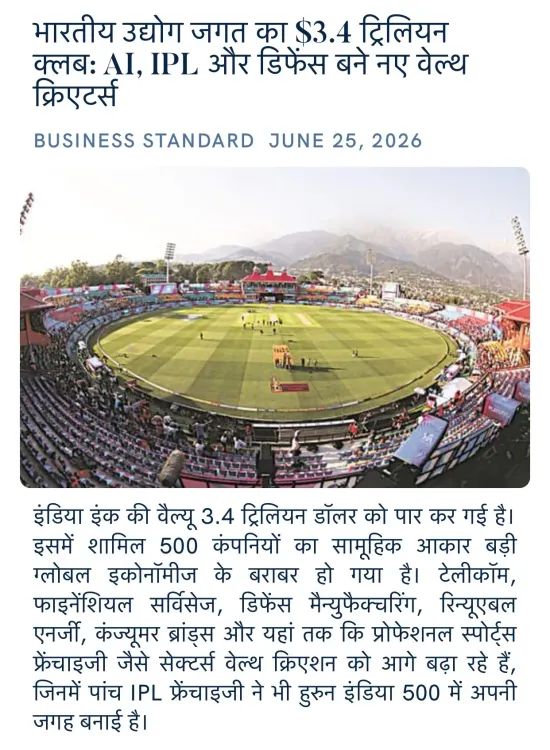
Union Textiles Minister Giriraj Singh on Thursday, 25 June 2026 shared a report highlighting that India Inc has entered what analysts describe as a $3.4 trillion club, with artificial intelligence, the Indian Premier League (IPL), and defence emerging as the country's newest wealth-creation engines. The minister amplified the report via the NaMo App, signalling the ruling establishment's enthusiasm for the narrative of diversified economic growth.
Context
The post, shared in Hindi, translates broadly as: 'Bhartiya udyog jagat ka $3.4 trillion club: AI, IPL aur Defence bane naye wealth creators' ('India Inc's $3.4 trillion club: AI, IPL and Defence become new wealth creators'). The framing positions these three sectors as the latest pillars of India's market capitalisation story, a theme that has gained traction as the country consolidates its position as the world's fifth-largest economy.
Singh's decision to share the content through the NaMo App — the BJP-linked digital platform — rather than a conventional retweet underscores the party's practice of using proprietary channels to circulate economy-positive narratives ahead of the Union Budget 2026-27 cycle.
Policy Backdrop
The three sectors cited in the post each carry distinct policy lineage. Artificial intelligence has been a focal point of India's technology ambitions, with the government pushing for domestic AI research capacity and digital infrastructure investment. The Make in India initiative, launched in 2014, and the Atmanirbhar Bharat programme, announced in 2020, together laid the groundwork for prioritising indigenous capability across technology and strategic manufacturing.
On the defence front, a landmark 2020 liberalisation raised the foreign direct investment ceiling on the automatic route to 74 percent, accelerating private-sector participation in weapons systems, aerospace, and electronics. The result has been a steady rise in domestic defence production and an expanding export order book. The IPL, meanwhile, has matured from a cricket tournament into a multi-billion-dollar media and sponsorship property, contributing meaningfully to corporate revenues and broadcasting income.
Stakeholders and Impact
Indian corporates — from conglomerates with defence subsidiaries to technology startups and sports franchise owners — stand at the centre of this wealth-creation narrative. Investors tracking India's market capitalisation have increasingly looked beyond traditional sectors such as information technology services and fast-moving consumer goods toward these emergent categories.
For ordinary citizens, the broader implication is a more diversified economic base that could, in theory, generate employment and export earnings across a wider range of industries. However, the distribution of wealth within these sectors — particularly AI and defence, which are capital-intensive — remains a subject of ongoing policy debate.
What's Next
All eyes will be on the Union Budget 2026-27 for concrete allocations toward AI research infrastructure and defence capital procurement. Any revision to the Defence Production and Export Promotion Policy would be watched closely by both domestic manufacturers and foreign partners seeking joint-venture opportunities.
As India's market capitalisation story evolves, the government's ability to translate headline wealth figures into broad-based job creation and industrial capacity will determine whether the $3.4 trillion club narrative becomes a durable economic milestone or remains a talking point for the political cycle.
Point of View
Timed as the government builds a pre-Budget narrative around diversified growth engines. By spotlighting AI, IPL and defence together, the BJP frames its post-2014 policy architecture — Make in India, Atmanirbhar Bharat, defence FDI liberalisation — as the structural cause of India Inc's expanding market capitalisation. The move also signals that the ruling establishment wants to own the story of new-economy wealth creation, not just traditional manufacturing. Whether the $3.4 trillion figure translates into a durable policy commitment will depend on what the Union Budget 2026-27 actually allocates to these sectors.
NationPress
24 Sept 2026
Frequently Asked Questions
What is India Inc's $3.4 trillion club?
The '$3.4 trillion club' refers to a reported milestone in India's aggregate market capitalisation, with analysts identifying AI, the IPL and defence as the sectors driving this valuation growth.
Why did Giriraj Singh share this report?
As a senior BJP leader and Union Textiles Minister, Giriraj Singh shared the report via the NaMo App to amplify the government's narrative of broad-based economic growth ahead of the Union Budget 2026-27.
How has India's defence sector become a wealth creator?
A 2020 policy raised the FDI ceiling on the automatic route to 74 percent, accelerating private investment in defence manufacturing and exports under the Atmanirbhar Bharat programme.
What role does the IPL play in India's economy?
The Indian Premier League has grown into a multi-billion-dollar media, sponsorship and franchise property, contributing significantly to corporate revenues and broadcasting income in India.
What should we watch next on India's AI and defence policy?
The Union Budget 2026-27 allocations for AI research infrastructure and defence capital procurement, as well as any updates to the Defence Production and Export Promotion Policy, are the key signals to track.