Giriraj Singh highlights Arunachal weaver's income rise under SCDP scheme
Synopsis
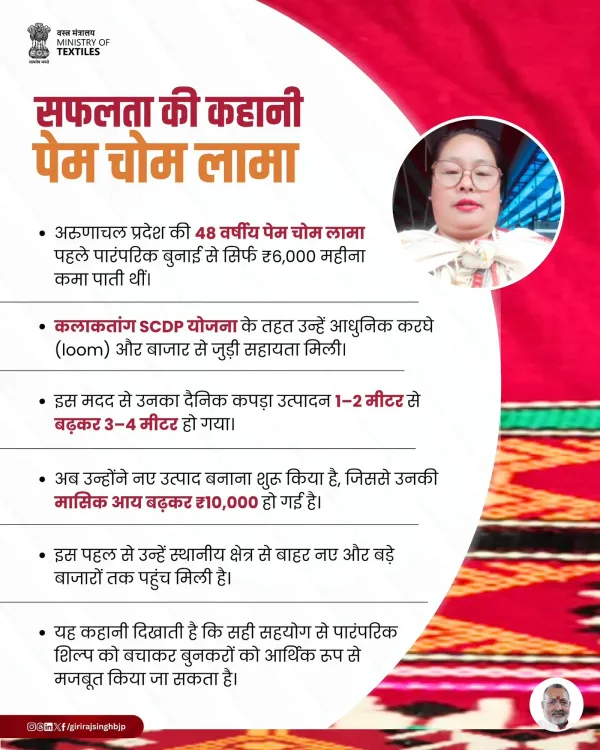
Union Textiles Minister Giriraj Singh has highlighted how Arunachal Pradesh weaver Pem Chom Lama doubled her daily cloth output and raised her monthly income from ₹6,000 to ₹10,000 after receiving modern looms and market support under the Kalaktang SCDP Yojana, framing her story as a model of self-reliance.
Key Takeaways
Union Textiles Minister Giriraj Singh shared the case of Pem Chom Lama , a weaver from Arunachal Pradesh , on 8 June 2026 .
Lama's daily fabric output rose from 1–2 metres to 3–4 metres after receiving modern looms under the Kalaktang SCDP Yojana .
Her monthly income increased from ₹6,000 to ₹10,000 , a rise of approximately 67 percent .
The scheme provides modern equipment and market linkages to weavers, consistent with the National Handloom Development Programme framework launched in 2015 .
The Ministry of Textiles has specifically targeted women-dominated weaving households in northeastern states under successive cluster-based programmes.
Budget allocations for handloom clusters in 2026–27 and parliamentary scrutiny of North East scheme implementation remain key watchpoints.
Union Textiles Minister Giriraj Singh on Monday, 8 June 2026 shared the story of Pem Chom Lama, a weaver from Arunachal Pradesh, whose daily cloth output and monthly earnings have risen significantly after she received modern looms and market support under the Kalaktang SCDP Yojana.
Context
Posting in Hindi, the minister described how Pem Chom Lama's daily fabric production climbed from 1–2 metres to 3–4 metres after she was provided upgraded weaving equipment and market linkages under the scheme. Her monthly income, he stated, rose from ₹6,000 to ₹10,000 as a result. Singh framed her progress with the line 'सशक्त बुनकर, समृद्ध भारत' — 'Empowered weavers, prosperous India' — signalling the broader intent behind the intervention.
The post quoted the minister as saying the scheme has given Pem Chom Lama 'an opportunity to write a new story of self-reliance,' and that her increased production and confidence now provide 'a strong economic support to her entire family.'
Policy Backdrop
The Ministry of Textiles has for over a decade channelled support to handloom clusters across the northeastern states through centrally sponsored programmes. The National Handloom Development Programme, launched in 2015, provides modern equipment, design assistance, and market linkages to weavers, with a dedicated focus on women-dominated households in states such as Arunachal Pradesh where baseline output is typically low.
The Atmanirbhar Bharat package announced in 2020 further earmarked outlays for handloom and handicraft clusters in the Northeast, reinforcing the cluster-based approach that combines loom upgrades with downstream marketing support. The Kalaktang SCDP Yojana cited by the minister appears to operate within this broader policy architecture, though its specific operational details are drawn from the minister's own account.
Stakeholders and Impact
Arunachal Pradesh is home to numerous traditional weaving communities where handloom production is a primary source of household income, particularly for women. A near-doubling of daily output — from 1–2 metres to 3–4 metres — represents a material productivity gain for artisans working on manual looms, and the income increase from ₹6,000 to ₹10,000 per month cited in the post reflects a roughly 67 percent rise in earnings.
North East weavers and women artisans remain a key constituency for the Ministry of Textiles, and case studies such as Pem Chom Lama's are regularly used to illustrate the on-ground reach of centrally funded programmes. The #VocalForLocal and #NorthEastArtisans hashtags used by the minister align the post with the government's broader campaign to build domestic and retail demand for handloom products.
What's Next
Attention will now turn to Union Budget 2026–27 allocations for handloom clusters and whether parliamentary oversight mechanisms surface data on the scale and geographic spread of SCDP-type interventions across the Northeast. A wider rollout of market-linkage support to weavers in states such as Manipur, Nagaland, and Meghalaya — which also have large handloom populations — could follow if the Arunachal model is formally evaluated and validated. The minister's public amplification of individual beneficiary stories suggests the ministry intends to keep the handloom welfare narrative prominent in the run-up to the budget cycle.
Point of View
A recurring motif in BJP-era textile communications. Whether the Kalaktang SCDP model can be replicated at scale across the region will be the harder question policymakers and budget-watchers will eventually need to answer.
NationPress
26 Sept 2026
Frequently Asked Questions
What is the Kalaktang SCDP Yojana?
The Kalaktang SCDP Yojana is a scheme cited by Union Textiles Minister Giriraj Singh that provides modern looms and market support to weavers in Arunachal Pradesh; it appears to operate within the broader framework of centrally sponsored handloom cluster programmes, though full operational details are drawn from the minister's account.
How much did Pem Chom Lama's income increase under the handloom scheme?
According to Minister Giriraj Singh's post, Pem Chom Lama's monthly income rose from ₹6,000 to ₹10,000 — an increase of approximately 67 percent — after she received modern looms and market linkages under the Kalaktang SCDP Yojana.
What is the National Handloom Development Programme?
The National Handloom Development Programme was launched in 2015 by the Ministry of Textiles to provide upgraded equipment, design support, and market linkages to weavers across India, with a particular focus on northeastern states where traditional weaving is a primary livelihood.
Why does the government focus handloom schemes on Northeast India?
Northeastern states such as Arunachal Pradesh have large communities of traditional weavers, many of them women, whose baseline productivity and incomes are low; cluster-based interventions that combine modern looms with marketing support are designed to raise earnings while preserving craft traditions.
What should I watch for next on handloom policy in India?
Key watchpoints include Union Budget 2026–27 allocations for handloom clusters, parliamentary questions on the scale of SCDP-type schemes in the Northeast, and any formal government evaluation of whether the Arunachal Pradesh model is being extended to other weaving states such as Manipur and Nagaland.