Giriraj Singh flags Meditech textiles as healthcare force
Synopsis
Union Textiles Minister Giriraj Singh on 13 June 2026 underlined technical textiles as a key enabler for India's healthcare sector, citing PPE kits, surgical textiles and rehabilitation devices, and linking Meditech growth to the Atmanirbhar Bharat and Viksit Bharat 2047 frameworks.
Key Takeaways
Union Textiles Minister Giriraj Singh posted on 13 June 2026 highlighting technical textiles as a growing force in India's healthcare sector.
Key Meditech applications cited include PPE kits , surgical textiles, rehabilitation devices and other medical uses.
The National Technical Textiles Mission (NTTM) , launched in 2020 with a ₹1,000 crore outlay, is the primary government scheme backing this segment.
The post- COVID-19 PPE production emergency in 2020 catalysed India's indigenous medical textiles manufacturing base under Atmanirbhar Bharat .
The minister linked Meditech expansion to the Viksit Bharat 2047 vision of making India a developed nation by independence centenary.
Fund utilisation under the NTTM and potential new incentives in the next Union Budget remain the key policy milestones to watch.
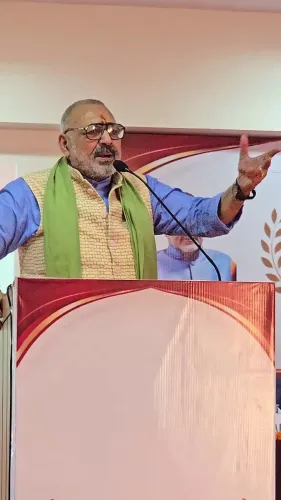
Union Textiles Minister Giriraj Singh on Saturday, 13 June 2026 highlighted the expanding role of technical textiles in India's healthcare sector, pointing to their deployment across PPE kits, surgical textiles, rehabilitation devices and other medical applications as a driver of both service quality and domestic industry growth.
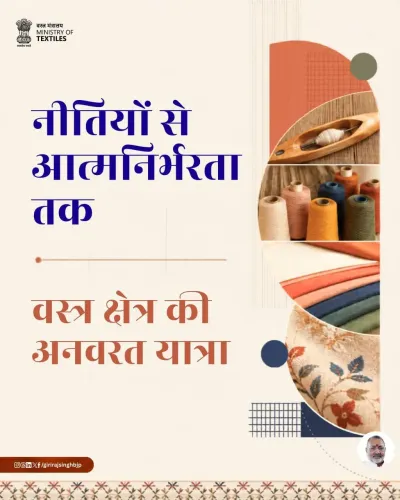
In his post on X, the minister wrote — 'टेक्निकल टेक्सटाइल्स आज स्वास्थ्य क्षेत्र के लिए एक महत्वपूर्ण सहायक शक्ति के रूप में उभर रहे हैं' ['Technical textiles are today emerging as an important enabling force for the healthcare sector'] — and added that their growing use has 'not only strengthened the quality of healthcare services but also given new momentum to the expansion of the Meditech sector in the country.'
Context
The minister's remarks situate the Meditech segment — the medical sub-category of technical textiles — within India's broader push for high-value manufacturing. Technical textiles differ from conventional fabrics in that they are engineered for functional performance rather than aesthetics, and the healthcare sub-segment covers items ranging from surgical drapes and wound-care dressings to prosthetic liners and hospital-grade protective gear.
The COVID-19 pandemic was a watershed moment for this space. India's abrupt dependence on imported PPE kits in early 2020 exposed a structural gap, prompting an emergency scale-up of domestic production that seeded a longer-term industrial base for medical textiles.
Policy Backdrop
The National Technical Textiles Mission (NTTM), approved in 2020 with an outlay of ₹1,000 crore, is the primary policy vehicle underpinning this push. The mission targets research, domestic production capacity and export competitiveness across all technical textile segments, with Meditech among its priority verticals.
The mission sits alongside the Atmanirbhar Bharat self-reliance initiative — launched in May 2020 — which explicitly promoted indigenous manufacturing of medical textiles and PPE as a strategic priority. Giriraj Singh's post invokes both #AtmanirbharBharat and #ViksitBharat2047, the government's long-horizon vision to position India as a developed economy by 2047.
Stakeholders and Impact
The Meditech value chain spans textile manufacturers upgrading to technical-grade production, healthcare providers sourcing domestically made consumables, and specialised Meditech firms developing higher-end products such as implantable meshes and smart wound-care materials. A stronger domestic Meditech industry reduces import bills, creates skilled manufacturing jobs, and can improve supply-chain resilience for hospitals and clinics.
For Bihar and other textile-producing states, the minister's consistent championing of technical textiles also carries a political-economic dimension: it signals potential investment and employment opportunities in a segment that commands higher margins than commodity fabrics.
What's Next
The key indicators to watch are fund utilisation and project completion milestones under the National Technical Textiles Mission, as well as any fresh incentives that may be announced in the next Union Budget or a revised national textiles policy. Industry stakeholders have sought production-linked incentives specifically for the Meditech segment to accelerate scale-up. Whether the government formalises such a framework will determine how quickly India's stated Meditech ambitions translate into verifiable export and production numbers.
Point of View
Reinforcing the government's narrative that pandemic-era disruptions have been converted into long-term industrial opportunity. By anchoring Meditech within both Atmanirbhar Bharat and Viksit Bharat 2047, the minister signals that technical textiles are being positioned as a pillar of India's innovation-led manufacturing story, not merely a niche industrial segment. The messaging also keeps pressure on the bureaucracy to show tangible NTTM outcomes ahead of the next budget cycle, where fresh incentives for Meditech could be on the table. Politically, it reinforces Singh's profile as a minister steering a traditional sector toward high-technology, higher-value production.
NationPress
27 Oct 2026
Frequently Asked Questions
What are technical textiles used for in healthcare?
Technical textiles in healthcare — collectively called Meditech — include PPE kits, surgical drapes, wound-care dressings, implantable meshes, rehabilitation supports and hospital-grade protective gear, all engineered for functional performance rather than aesthetics.
What is the National Technical Textiles Mission?
The National Technical Textiles Mission is a central government scheme approved in 2020 with a ₹1,000 crore outlay to promote research, domestic production and exports across all technical textile segments, including the medical sub-segment known as Meditech.
What is Meditech in the context of Indian textiles policy?
Meditech refers to the medical sub-category of technical textiles, covering products used in healthcare delivery such as PPE kits, surgical textiles and rehabilitation devices; it is one of the priority verticals under India's National Technical Textiles Mission.
How did Atmanirbhar Bharat help India's medical textiles sector?
The Atmanirbhar Bharat initiative launched in May 2020 promoted indigenous manufacturing of PPE kits and medical textiles after COVID-19 exposed India's import dependence, seeding a domestic production base that has since grown into a broader Meditech industry.
What is Viksit Bharat 2047?
Viksit Bharat 2047 is the Indian government's long-term vision to make India a fully developed nation by 2047, the centenary of independence, through sustained economic growth, technological advancement and self-reliant manufacturing.