Giriraj Singh flags medical textiles testing lab at AMTZ Visakhapatnam
Synopsis
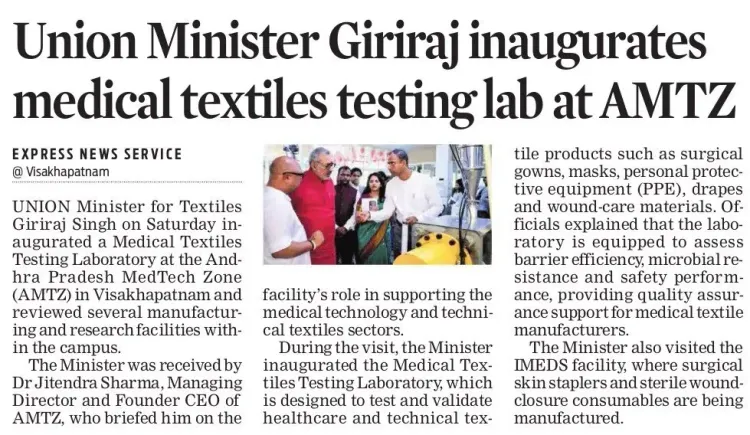
Union Textiles Minister Giriraj Singh on 31 May 2026 spotlighted a new Medical Textiles Testing Laboratory at AMTZ in Visakhapatnam, saying it will test PPE, surgical gowns and masks against global standards and advance India's self-reliance in the MedTech sector.
Key Takeaways
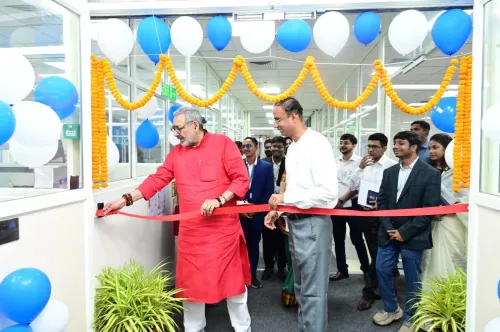
Union Textiles Minister Giriraj Singh announced a Medical Textiles Testing Laboratory established at AMTZ, Visakhapatnam .
The lab will test surgical gowns, masks, PPE kits , drapes, and other medical textile products for quality and global standard compliance.
The initiative is positioned under the Atmanirbhar Bharat framework to reduce India's import dependence in medical textiles.
The National Technical Textiles Mission , approved in 2020 with a Rs 1,480 crore outlay, provides the policy backbone for this testing infrastructure.
Visakhapatnam is being reinforced as a national hub for MedTech and technical textiles manufacturing and testing.
Domestic manufacturers and MedTech exporters are the primary beneficiaries, with improved access to internationally recognised certifications.
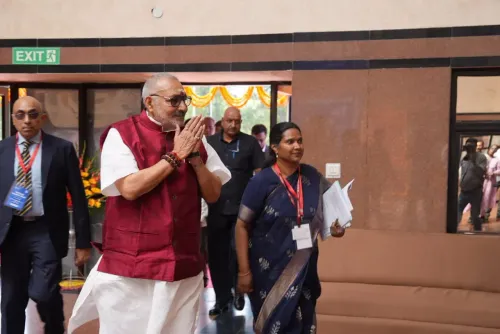
Union Textiles Minister Giriraj Singh on Sunday, 31 May 2026 highlighted the establishment of a Medical Textiles Testing Laboratory at the Andhra Pradesh MedTech Zone (AMTZ) in Visakhapatnam, describing it as a significant step toward making India self-reliant and globally competitive in the medical textiles and MedTech sectors.
Context
In his post, the Minister stated that the newly set-up lab at AMTZ, Visakhapatnam will ensure testing of surgical gowns, masks, PPE kits, drapes, and other medical textile products for quality, safety, and conformance with global standards. He wrote: 'यह पहल भारत को मेडिकल टेक्सटाइल्स और मेडटेक क्षेत्र में आत्मनिर्भर बनाने के साथ-साथ वैश्विक स्तर पर अधिक प्रतिस्पर्धी बनाने की दिशा में एक महत्वपूर्ण कदम है' — ('This initiative is an important step toward making India self-reliant in medical textiles and the MedTech sector, as well as more competitive at the global level.')
AMTZ is an integrated medical technology manufacturing and testing facility in Visakhapatnam, Andhra Pradesh, and has emerged as a key node for health-related industrial infrastructure in India.
Policy Backdrop
The announcement fits within the framework of the National Technical Textiles Mission (NTTM), approved in 2020 with an outlay of Rs 1,480 crore, which specifically earmarked components for research, testing infrastructure, and production of technical textiles including the medical textiles segment. The mission was designed to position India as a global leader in technical textiles — a category that encompasses surgical and protective textile products.
The COVID-19 disruptions of 2020 exposed India's dependence on imported PPE, masks, and surgical textiles, prompting the Ministry of Textiles to introduce production-linked incentives and invest in quality testing infrastructure to reduce that dependence. The AMTZ lab represents a continuation of that policy response. Both initiatives sit under the broader Atmanirbhar Bharat programme, launched in 2020, which seeks to build domestic value chains across sectors including health-related manufacturing.
Stakeholders and Impact
The primary beneficiaries of a dedicated testing laboratory at AMTZ include domestic medical textile manufacturers, MedTech exporters, and healthcare procurement agencies that require certified, globally compliant products. Access to in-country testing reduces turnaround time and cost for manufacturers seeking international certifications, which has historically been a barrier to export competitiveness.
For Andhra Pradesh, the facility reinforces Visakhapatnam's role as a hub for technical textiles and MedTech infrastructure. Manufacturers of surgical gowns, PPE kits, and hospital drapes stand to benefit most directly, as quality certification against global standards is a prerequisite for accessing procurement contracts in regulated markets such as the European Union and the United States.
What's Next
Attention will now turn to the operational status of the lab, the specific testing protocols it will be notified to conduct, and whether its establishment translates into a measurable rise in BIS or internationally recognised certifications for Indian medical textile products. Industry observers will also watch whether the facility is eventually accredited under international frameworks that allow test reports to be accepted directly by foreign regulators.
The Ministry of Textiles is expected to use the AMTZ lab as a model for expanding specialised testing infrastructure to other technical textiles clusters across India, as the government seeks to scale up exports in a segment where global demand — particularly for medical-grade protective textiles — has grown significantly since 2020.
Point of View
Rather than tariff protection alone. Giriraj Singh's decision to amplify this development publicly signals that the ministry is keen to demonstrate tangible Atmanirbhar Bharat deliverables in the health-manufacturing space ahead of the budget cycle. The choice of Visakhapatnam — an Andhra Pradesh facility — also carries political geography: it allows the BJP-led Centre to showcase collaborative federalism with a state that is a key coalition partner. The broader arc here is India's attempt to move up the value chain in technical textiles, where testing and certification infrastructure is as critical as production capacity in winning regulated export markets.
NationPress
14 Oct 2026
Frequently Asked Questions
What is the Medical Textiles Testing Lab at AMTZ Visakhapatnam?
It is a newly established laboratory at the Andhra Pradesh MedTech Zone in Visakhapatnam that tests medical textile products such as surgical gowns, PPE kits, masks, and drapes against quality and global safety standards.
What is AMTZ and where is it located?
AMTZ stands for Andhra Pradesh MedTech Zone. It is an integrated medical technology manufacturing and testing facility located in Visakhapatnam, Andhra Pradesh.
How does the AMTZ lab relate to Atmanirbhar Bharat?
The lab is part of India's Atmanirbhar Bharat initiative, which aims to build domestic manufacturing and testing capacity to reduce dependence on imported medical textiles and health-related products.
What is the National Technical Textiles Mission?
The National Technical Textiles Mission is a Ministry of Textiles programme approved in 2020 with a Rs 1,480 crore outlay to boost research, testing infrastructure, and production of technical textiles including medical textiles.
Who will benefit from the medical textiles testing lab at AMTZ?
Domestic medical textile manufacturers, MedTech exporters, and healthcare procurement agencies will benefit, as the lab provides in-country testing and certification against international standards, reducing cost and time barriers to export markets.