Giriraj Singh credits Modi's governance model for Viksit Bharat push
Synopsis
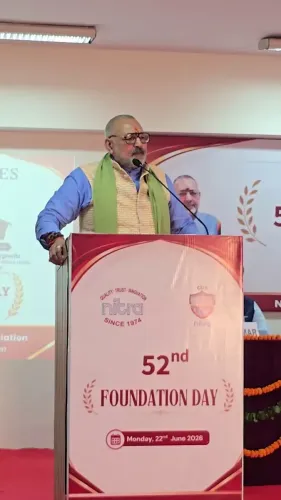
Union Textiles Minister Giriraj Singh on 1 July 2026 praised PM Modi's outcome-focused governance, citing regulatory simplification and inter-ministerial coordination as key drivers of the Viksit Bharat 2047 vision. He argued that real change in citizens' lives — not just scheme creation — is the true benchmark of government success.
Key Takeaways
Giriraj Singh posted on 1 July 2026 praising PM Modi's governance philosophy of measuring success by citizen impact, not scheme count.
He highlighted three pillars: simplification of rules, better inter-ministerial coordination, and people-centric decision-making.
India's World Bank Ease of Doing Business rank improved from 142nd in 2014 to 63rd in 2020 under successive reform rounds.
The Viksit Bharat 2047 goal — developed-economy status by India's centenary — was formally articulated by PM Modi in his 2022 Independence Day address .
Key beneficiaries of these reforms include MSMEs, businesses, and individual citizens seeking faster public-service delivery.
Further steps on single-window systems and compliance reduction are expected in the next Union Budget or monsoon session of Parliament .
Union Textiles Minister Giriraj Singh on Wednesday, 1 July 2026 praised Prime Minister Narendra Modi's governance philosophy, arguing that the true measure of a government's success lies not in the number of schemes it creates but in the tangible change it delivers to ordinary citizens. Singh made the remarks in a post on X, invoking the twin pillars of Ease of Doing Business and Ease of Living as the driving forces behind the Viksit Bharat 2047 vision.
Context
Singh wrote in Hindi: 'सरकार की सफलता का पैमाना केवल बनाई गई योजनाएं नहीं, बल्कि आम नागरिक के जीवन में आया वास्तविक बदलाव है' — translated: 'The measure of a government's success is not merely the schemes it has created, but the real change that has come into the life of the common citizen.' He added that work is continuously being done to simplify rules, improve coordination among ministries, and make the lives and businesses of citizens easier through people-centric decisions.
Policy Backdrop
The framing echoes a decade-long governance arc that began with the launch of Make in India in September 2014, which sought to attract investment through improved business regulations and single-window clearances. India's rank in the World Bank Ease of Doing Business index climbed from 142nd position in 2014 to 63rd in 2020, reflecting successive rounds of central and state-level regulatory reforms.
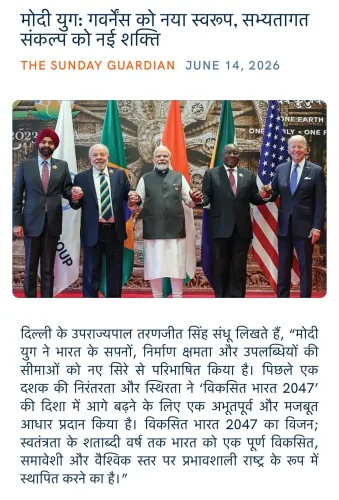
Prime Minister Modi formally articulated the Viksit Bharat goal during the 2022 Independence Day address, linking developed-economy status by 2047 — the centenary of Indian independence — to improvements in ease of living and outcome-oriented governance. Inter-ministerial coordination and reduction of compliance burden have since been repeatedly stressed as core administrative priorities.
Stakeholders and Impact
The reforms Singh referenced have direct implications for businesses, MSMEs, and citizens across India. Reduced compliance requirements and streamlined inter-ministerial processes lower the cost and time burden on small enterprises, which form the backbone of India's manufacturing and services sectors. For individual citizens, people-centric policy delivery translates into faster access to welfare schemes and public services.
As Textiles Minister, Singh oversees a sector that is heavily dependent on ease-of-doing-business conditions, from raw-material procurement to export clearances, making his endorsement of these reforms directly relevant to his own ministry's mandate.
What's Next
Further legislative or executive steps on single-window systems and compliance reduction are anticipated in the forthcoming Union Budget or the monsoon session of Parliament. Singh's post signals that the ruling BJP intends to keep the governance-reform narrative — and its link to the Viksit Bharat 2047 target — prominent in public discourse ahead of those legislative milestones.
Point of View
The messaging pivots from input-based accountability to impact-based accountability, a framing that is harder for the opposition to contest on purely procedural grounds. The specific invocation of ease of doing business and ease of living also signals that these twin indices will remain central to the BJP's electoral and policy pitch as the 2047 target year draws closer. As Textiles Minister, Singh's endorsement carries sectoral weight, implicitly tying his own ministry's reform agenda to the broader national vision.
NationPress
29 Sept 2026
Frequently Asked Questions
What did Giriraj Singh say about PM Modi's governance?
Giriraj Singh said that PM Modi's governance model measures success by real change in citizens' lives rather than by the number of schemes created, and praised ongoing efforts to simplify rules and improve inter-ministerial coordination.
What is Viksit Bharat 2047?
Viksit Bharat 2047 is India's long-term national vision to achieve developed-economy status by 2047, the centenary of Indian independence, as articulated by PM Modi in his 2022 Independence Day address.
How has India's Ease of Doing Business ranking changed under Modi?
India's rank in the World Bank Ease of Doing Business index improved from 142nd in 2014 to 63rd in 2020, driven by multiple rounds of central and state-level regulatory reforms.
Why is Giriraj Singh commenting on ease of doing business?
As Union Textiles Minister, Giriraj Singh oversees a sector that depends heavily on regulatory ease for raw-material procurement and export clearances, making business-environment reforms directly relevant to his ministerial mandate.
What reforms are expected next under the Viksit Bharat agenda?
Further steps on single-window clearance systems and compliance reduction are anticipated in the forthcoming Union Budget or the monsoon session of Parliament.