Giriraj Singh: Bharat Tex 2026 Energises India's 2030 Textile Goal
Synopsis
Union Textiles Minister Giriraj Singh on 18 July 2026 credited Bharat Tex 2026 with giving fresh momentum to India's global textile ambitions, pointing to strong international participation as a sign of the country's progress toward its 2030 export and production goals.
Key Takeaways
Union Textiles Minister Giriraj Singh posted on 18 July 2026 hailing Bharat Tex 2026 as a boost to India's global textile recognition.
Singh said positive global response and active industry participation signal India is on track for its 2030 textile targets .
The event aligns with the Make in India (launched 2014) and Atmanirbhar Bharat (announced May 2020) frameworks.
The PLI scheme for man-made fibre apparel and technical textiles carries an outlay of Rs 10,683 crore , approved in 2021 .
Key beneficiaries include textile exporters and MSME manufacturers seeking global supply-chain integration.
Disbursement under the textiles PLI and updated export targets ahead of the next Union Budget are the next policy markers to watch.
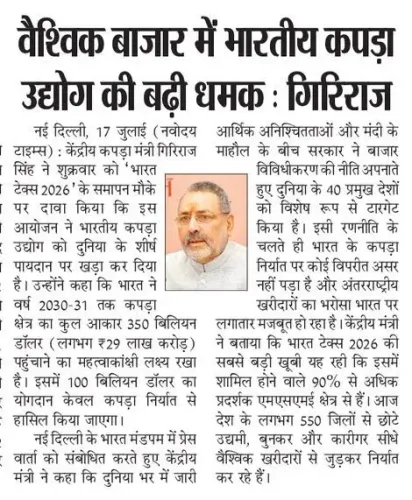
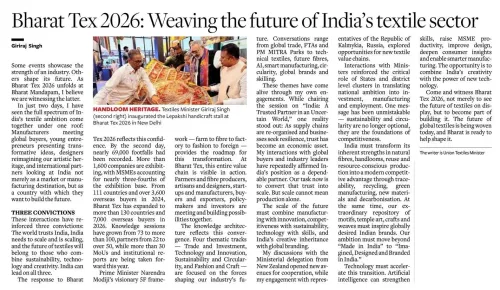
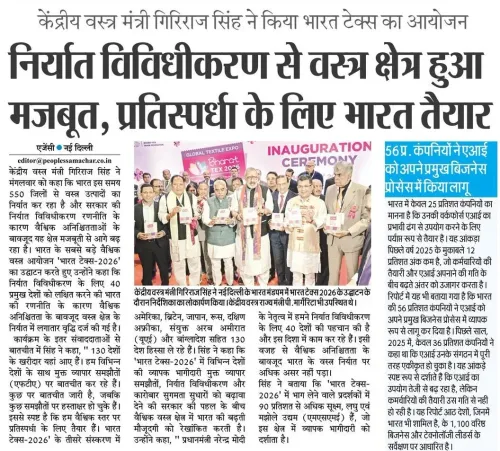
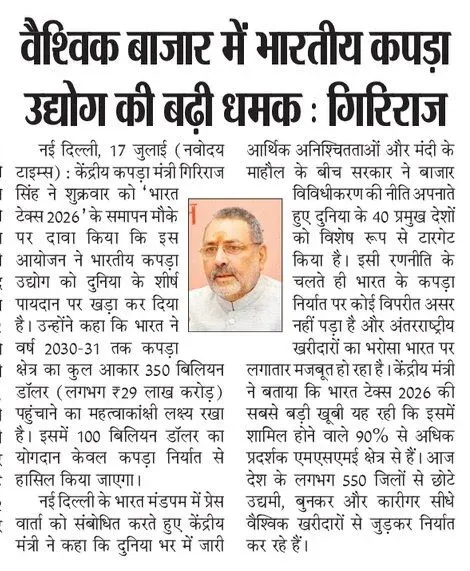
Union Textiles Minister Giriraj Singh on Saturday, 18 July 2026 hailed Bharat Tex 2026 as a catalyst for India's growing global identity in the textile sector, citing strong international response and active industry participation as evidence of the country's accelerating march toward its 2030 textile targets.
Posting on X, Singh wrote: 'Bharat Tex 2026 ne Bharatiya vastra udyog ki badhti vaishvik pahchan ko nayi urja di hai' — 'Bharat Tex 2026 has given fresh energy to the rising global recognition of the Indian textile industry.' He added that the positive response from across the world and active participation of industry stakeholders showed that India is moving rapidly toward its 2030 goal.
Context
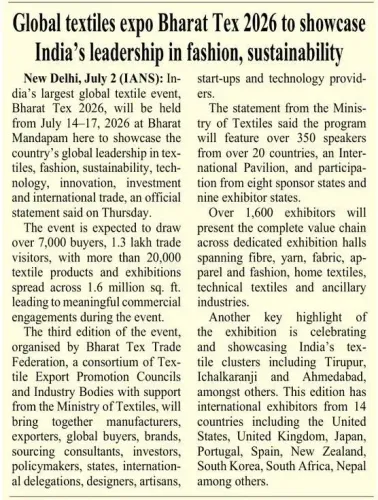
Bharat Tex is India's flagship international textile trade exposition, designed to showcase the country's manufacturing capabilities to global buyers, brands, and investors. The 2026 edition drew participation from domestic producers as well as international delegations, reinforcing its role as a platform for projecting India's competitiveness in global textile supply chains.
Singh's post, tagged with #BharatTex2026, #IndianTextiles, #MakeInIndia, and #AtmanirbharBharat, situates the event squarely within the government's twin flagship frameworks for manufacturing and self-reliance.
Policy Backdrop
India's textile policy since 2014 has been anchored in the Make in India initiative, which identified textiles as a priority sector for export promotion, global branding, and supply-chain integration. The campaign sought to position India as a preferred manufacturing destination and reduce import dependence in key segments.
In 2021, the government approved a Production Linked Incentive (PLI) scheme for man-made fibre apparel and technical textiles with an outlay of Rs 10,683 crore, aiming to build scale in higher-value segments where India has historically lagged behind competitors. The Atmanirbhar Bharat framework, announced in May 2020, added a self-reliance dimension with production and export support measures across manufacturing sectors including textiles.
Together, these schemes have formed the scaffolding for an ambitious push to raise India's share in world textile trade — a goal that events like Bharat Tex are intended to publicly reinforce.
Stakeholders and Impact
The immediate beneficiaries of the momentum generated at Bharat Tex 2026 are textile exporters and MSME manufacturers, who rely on international visibility to attract orders, partnerships, and investment. For smaller units in particular, a high-profile government-backed exposition can open doors to supply-chain relationships that would otherwise be difficult to establish.
Global buyers and brands scouting for alternatives or complements to existing sourcing hubs are also key stakeholders, as India's pitch increasingly emphasises scale, compliance standards, and product diversity spanning traditional handlooms to technical textiles.
What's Next
Attention will now turn to the disbursement progress under the textiles PLI scheme and whether the government releases updated export or production targets ahead of the next Union Budget. The momentum from Bharat Tex 2026 could inform the scale of commitments the ministry signals for the medium term. If the positive international response translates into firm orders and investment commitments, it would materially strengthen India's case for crossing the 2030 milestone — a benchmark that the minister has now publicly tied to the event's success.
Point of View
The minister is stitching together two distinct policy eras into a single, continuous arc of ambition. The emphasis on the 2030 goal is notable: it sets a public benchmark that the ministry will now be held against, raising the stakes for PLI disbursement and export data in the coming budget cycle. For BJP, a strong textile story is also electorally useful in states like Gujarat, Tamil Nadu, and Maharashtra where the industry employs millions.
NationPress
18 Jul 2026
Frequently Asked Questions
What is Bharat Tex 2026?
Bharat Tex 2026 is India's flagship international textile trade exposition, bringing together domestic manufacturers, global buyers, and investors to showcase India's textile capabilities and attract supply-chain partnerships.
What is India's 2030 textile target?
India has set an ambitious goal to significantly expand its share in global textile trade by 2030, backed by schemes like the PLI for man-made fibre apparel and technical textiles and the broader Make in India initiative. Specific verified figures for the 2030 target have not been officially confirmed in publicly available data.
What did Giriraj Singh say about Bharat Tex 2026?
Union Textiles Minister Giriraj Singh said Bharat Tex 2026 has given fresh energy to the rising global recognition of the Indian textile industry and that positive international response shows India is moving rapidly toward its 2030 goal.
What is the PLI scheme for textiles in India?
The Production Linked Incentive scheme for man-made fibre apparel and technical textiles was approved in 2021 with an outlay of Rs 10,683 crore, aimed at building scale in higher-value textile segments and boosting exports.
How does Make in India relate to the textile sector?
Make in India, launched in September 2014, identified textiles as a priority sector for manufacturing promotion, export growth, and foreign investment, forming the policy foundation for subsequent schemes including the textiles PLI.