Giriraj Singh: Bihar to Get 29 Factories, ₹6,000 Cr Investment
Synopsis
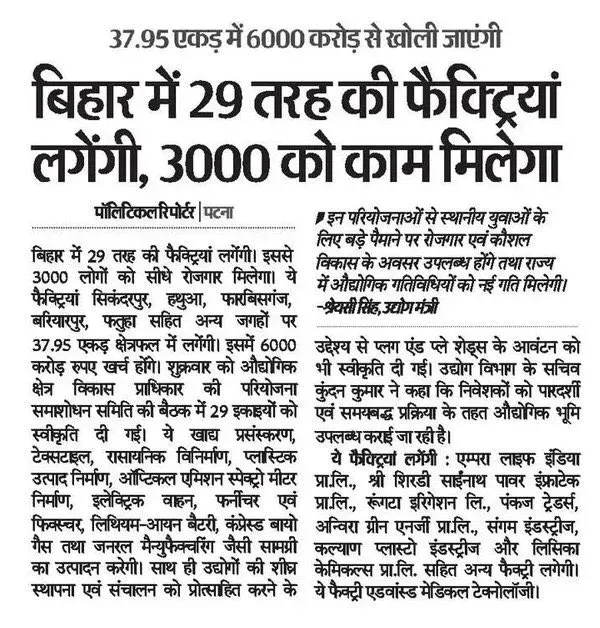
Union Textiles Minister Giriraj Singh announced on 4 July 2026 that Bihar will see 29 new factories built through ₹6,000 crore in investment, framing the move as a step toward self-reliant industrial growth and youth employment under the Viksit Bharat 2047 vision.
Key Takeaways
29 new factories are set to be established in Bihar under a proposed investment of ₹6,000 crore .
Union Textiles Minister Giriraj Singh made the announcement on 4 July 2026 via X.
The initiative is framed as advancing Atmanirbhar Bharat principles — domestic manufacturing and reduced import dependence.
The announcement is linked to the Viksit Bharat 2047 vision for a developed India by the centenary of independence.
Bihar's youth and local economy are identified as the primary beneficiaries, with new employment opportunities as the stated goal.
Sector-level details and employment figures are expected at Bihar's next investment summit or state budget.
Union Textiles Minister Giriraj Singh on Saturday, 4 July 2026, announced that Bihar is set to see 29 new factories established through an investment of ₹6,000 crore, calling the development a decisive step toward an industrially self-reliant state and expanded employment for local youth.
Context
Posting in Hindi on X, the minister framed the investment as more than an industrial milestone. 'यह पहल केवल उद्योगों की स्थापना नहीं, बल्कि आत्मनिर्भर बिहार, सशक्त युवाओं और मजबूत स्थानीय अर्थव्यवस्था की दिशा में एक महत्वपूर्ण कदम है' — ('This initiative is not merely the establishment of industries, but an important step toward a self-reliant Bihar, empowered youth, and a strong local economy'), he wrote. Singh added that a 'changing Bihar is now becoming a new identity of opportunities.'
The announcement aligns with the Viksit Bharat 2047 vision, the central government's long-term framework for transforming India into a developed nation by the centenary of independence, which Singh explicitly tagged in his post.
Policy Backdrop
Bihar has historically carried one of the lowest manufacturing bases among major Indian states, with its economy long dominated by agriculture. Since the mid-2010s, successive state and central government initiatives have sought to reverse this by improving infrastructure, easing land acquisition, and building industrial corridors.
The Atmanirbhar Bharat initiative, launched in 2020, provided a national framework for domestic manufacturing promotion and import substitution — language Singh's post echoes directly. Coordinated investment facilitation between the Bihar state government and central ministries has been a recurring feature of this push, with skill development programmes targeting the state's large young population.
Stakeholders and Impact
The primary beneficiaries identified in Singh's post are Bihar's youth, for whom new factory jobs would represent a significant alternative to migration-driven employment. Bihar has among the highest rates of inter-state labour migration in India, and any sustained industrial expansion in the state is seen as a structural corrective to that trend.
Industrial investors and supply-chain operators stand to gain from the state's improving ease-of-doing-business metrics and its strategic location connecting eastern and northern India. The minister's framing — 'a new identity of opportunities' — signals an effort to shift Bihar's external perception among the investor community.
What's Next
Detailed project-level timelines, the sectors these 29 factories will cover, and phased employment projections are expected to emerge through Bihar's next investment summit or state budget presentation. Employment generation data from the proposed units will be a key metric tracked in subsequent state economic surveys. For Giriraj Singh, whose Lok Sabha constituency of Begusarai sits within Bihar, the industrial push carries both policy and political salience ahead of the state's evolving electoral calendar.
Point of View
Industrial growth in Bihar directly bolsters his own constituency narrative. Whether the ₹6,000 crore figure translates into ground-level job creation will be the real test, and civil society and opposition voices in the state are likely to track implementation closely.
NationPress
4 Jul 2026
Frequently Asked Questions
How many new factories are coming to Bihar and what is the investment amount?
According to Union Textiles Minister Giriraj Singh's post on 4 July 2026, 29 new factories are set to be established in Bihar with an investment of ₹6,000 crore .
What is the Viksit Bharat 2047 vision mentioned in Giriraj Singh's post?
Viksit Bharat 2047 is the central government's long-term vision to transform India into a fully developed nation by 2047, the centenary of independence. It is frequently referenced in economic and infrastructure announcements as the overarching policy goal.
What is Atmanirbhar Bharat and how does it relate to Bihar's industrial push?
Atmanirbhar Bharat ('Self-Reliant India') is an initiative launched in 2020 to promote domestic manufacturing and reduce import dependence. Giriraj Singh's post directly echoes its language by describing the Bihar factory plan as a step toward a 'self-reliant Bihar.'
Who is Giriraj Singh and why is he commenting on Bihar's industrial development?
Giriraj Singh is the Union Minister of Textiles, a senior BJP leader, and the Lok Sabha MP from Begusarai, Bihar . His Bihar roots and ministerial portfolio make him a key voice on industrial and employment developments in the state.
Will the Bihar factories create jobs for local youth?
Minister Giriraj Singh stated that the new factories will 'open new employment opportunities for local youth.' Specific employment generation figures are expected to be detailed at Bihar's next investment summit or state budget presentation.