Giriraj Singh Flags 52% Rise in India's Fertiliser Exports
Synopsis
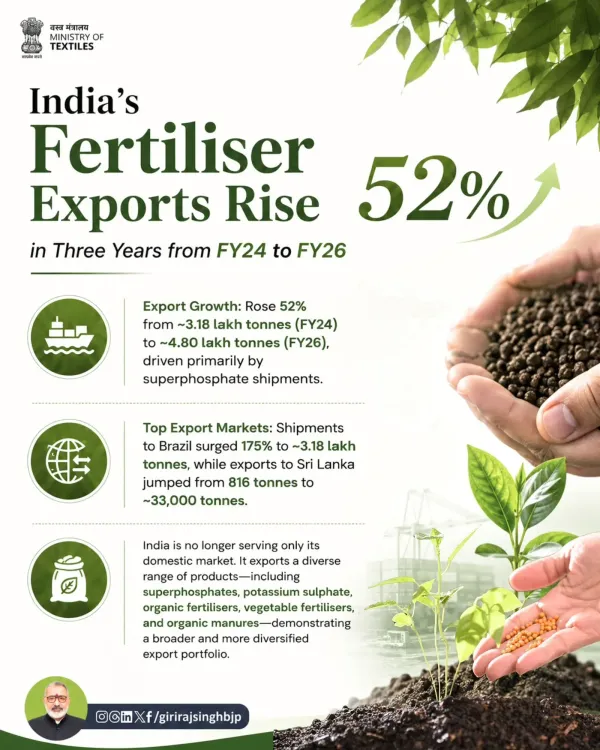
Union Textiles Minister Giriraj Singh on 27 July 2026 cited a 52 per cent rise in India's fertiliser exports over three years, calling it evidence that policy reforms and expanded industrial capacity are delivering results in global markets.
Key Takeaways
Giriraj Singh posted on 27 July 2026 highlighting a 52% increase in India's fertiliser exports over the past three years .
The minister credited policy reforms , growing industrial capacity , and sustained industry efforts for the export rise.
India is the world's second-largest fertiliser consumer and has been actively working to reduce import dependence in the sector.
Key policy enablers include the Nutrient Based Subsidy scheme (2010) and the Make in India initiative (2014) .
Upcoming Ministry of Commerce trade data and the monsoon session of Parliament will be key moments to watch for further policy signals.
Union Textiles Minister Giriraj Singh on Monday, 27 July 2026, highlighted a 52 per cent increase in India's fertiliser exports over the past three years, attributing the growth to policy reforms, expanded industrial capacity, and sustained efforts by domestic manufacturers to strengthen their presence in global markets.
Context
Posting on X, Giriraj Singh wrote: 'नीतिगत सुधार, उद्योग की बढ़ती क्षमता और निरंतर प्रयासों का सकारात्मक परिणाम स्पष्ट दिखाई दे रहा है' — 'The positive results of policy reforms, growing industrial capacity, and sustained efforts are clearly visible.' He added that the 52% rise in fertiliser exports over three years signals that Indian industry is steadily consolidating its competitive identity in the global market.
The post, tagged #Fertiliser and #Exports, comes as the government has been actively pushing domestic chemical and fertiliser manufacturers to reduce import dependence and capture a larger share of global trade flows.
Policy Backdrop
India's fertiliser sector has been shaped by two significant policy interventions in recent decades. The Nutrient Based Subsidy (NBS) scheme, introduced in 2010, rationalised fertiliser pricing and created incentives for more efficient domestic production. The Make in India initiative, launched in 2014, further accelerated capacity building across industrial sectors, including chemicals and fertilisers.
India is the world's second-largest fertiliser consumer, and the push to grow exports represents a significant strategic shift — from a country heavily reliant on imports to one seeking to be a net contributor to global supply chains. This transition gained urgency after global supply disruptions in 2022 exposed vulnerabilities in fertiliser availability and pricing worldwide.
Stakeholders and Impact
The primary beneficiaries of this export expansion are fertiliser exporters and chemical manufacturers who have invested in scaling up production infrastructure. Sustained export growth improves the trade balance in a sector that has historically been a significant drain on foreign exchange due to large-scale imports.
For farmers and the agricultural supply chain, a stronger domestic industry can translate into greater supply-side stability, even as export volumes rise. The broader industrial policy pattern mirrors similar capacity-expansion drives in other process industries aimed at integrating India more deeply into global value chains.
What's Next
Upcoming quarterly trade data releases from the Ministry of Commerce will be closely watched to corroborate the export trajectory that Giriraj Singh has highlighted. Any parliamentary discussion on fertiliser policy during the ongoing monsoon session could further shape the regulatory environment for the sector.
If the export momentum is sustained, it could reinforce the government's broader argument that industrial policy reforms are delivering measurable results — and set the stage for more targeted interventions to deepen India's role as a global fertiliser supplier.
Frequently Asked Questions
What did Giriraj Singh say about India's fertiliser exports?
Giriraj Singh stated on 27 July 2026 that India's fertiliser exports have grown by 52% over the past three years, attributing this to policy reforms, expanded industrial capacity, and sustained efforts by domestic manufacturers.
Why is India's fertiliser export growth significant?
India is the world's second-largest fertiliser consumer and has historically relied on imports. A 52% rise in exports over three years signals a strategic shift toward supply-side strength and global competitiveness in the sector.
Which government schemes support India's fertiliser sector?
The Nutrient Based Subsidy scheme, introduced in 2010, and the Make in India initiative, launched in 2014, are the two major policy frameworks that have shaped capacity building and export competitiveness in India's fertiliser industry.
Is Giriraj Singh the minister in charge of fertilisers?
No. Giriraj Singh is the Union Minister of Textiles. The fertiliser sector falls under the Ministry of Chemicals and Fertilisers, but Singh highlighted the export data as part of the government's broader industrial policy achievements.
Where can I find official data on India's fertiliser exports?
Official fertiliser export data is published by the Ministry of Commerce and Industry through its quarterly and annual trade statistics releases, which are the primary source for verifying sector-level export figures.