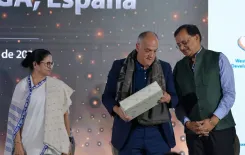
Giriraj Singh shares India's defining tourist destinations
Synopsis
Union Textiles Minister Giriraj Singh amplified a cultural piece on India's defining tourist destinations via the NaMo App on 24 June 2026, signalling continued government emphasis on domestic tourism and heritage promotion.
Key Takeaways
Giriraj Singh , Union Textiles Minister and Lok Sabha MP from Begusarai , shared destination-focused content on 24 June 2026 via his X handle.
The content was distributed through the NaMo App , the Prime Minister's Office's official citizen-outreach platform.
The share aligns with the Swadesh Darshan scheme (launched 2014-15 ) and the Dekho Apna Desh campaign (intensified from 2020 ).
As Textiles Minister, Singh's interest carries significance for handloom and craft-cluster tourism circuits across states.
Stakeholders including domestic tourists , the hospitality industry , and artisan communities stand to benefit from heightened destination visibility.
Observers are watching for Swadesh Darshan 2.0 circuit rollouts and potential textile-tourism budget allocations.
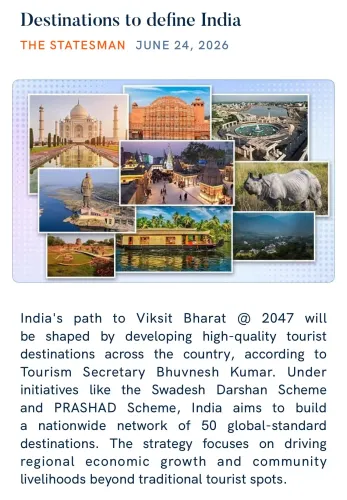
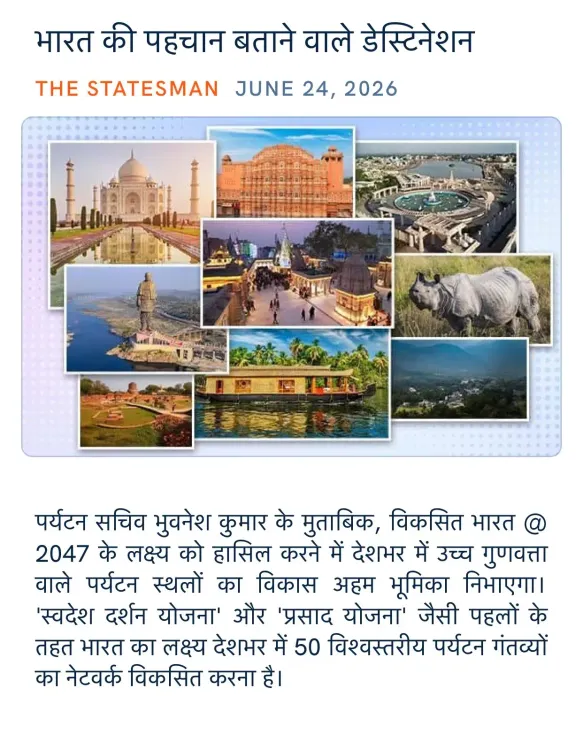
Union Textiles Minister Giriraj Singh on Wednesday, 24 June 2026, shared a curated piece spotlighting destinations that capture India's cultural identity, amplifying the content through the NaMo App on his official X handle.
Context
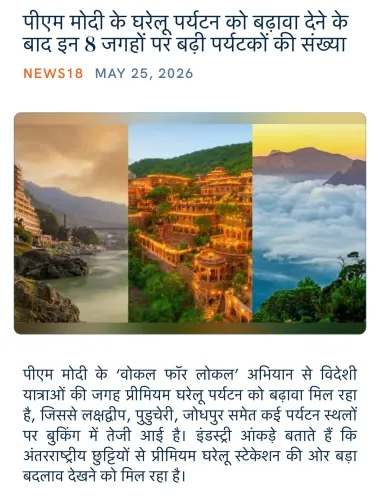
The minister shared an article headlined 'Destinations to define India' ('भारत की पहचान बताने वाले डेस्टिनेशन'), distributing it via the NaMo App — the official mobile platform used by the Prime Minister's Office to disseminate government messaging and curated content to citizens. The act of sharing through this channel signals an alignment with the broader government narrative on domestic tourism.
While the post itself is brief, the choice of subject — destinations that 'define' India — connects to a long-running governmental effort to position the country's heritage, handicrafts, and cultural landscapes as pillars of national identity and economic growth.
Policy Backdrop
The share sits within the arc of two flagship initiatives: the Swadesh Darshan scheme, launched in 2014-15 to develop thematic tourist circuits across states, and the Dekho Apna Desh campaign, intensified from 2020 onwards to promote domestic travel and reduce outbound tourism spending. Both programmes have sought to draw attention to under-visited cultural and heritage destinations across the country.
Successive central governments have positioned tourism as a vehicle for employment generation, foreign-exchange earnings, and soft-power projection. Digital amplification through ministerial handles and official apps has become standard practice to extend the reach of scheme-linked messaging beyond traditional media.
Stakeholders and Impact
The implicit audience for such amplification spans domestic tourists, the wider tourism and hospitality industry, and handloom and handicraft artisans whose livelihoods are often anchored to heritage circuits. As Textiles Minister, Giriraj Singh's interest in tourism destinations carries an added dimension: textile clusters in states such as Varanasi, Patan, Kanchipuram, and Bishnupur are themselves emerging as tourism draws, linking artisanal production with visitor footfall.
When a senior cabinet minister amplifies destination content through a platform with a large citizen subscriber base, it can meaningfully raise awareness of specific circuits and nudge travel planning, particularly among aspirational middle-class domestic travellers.
What's Next
Observers will watch for concrete follow-through in the form of Swadesh Darshan 2.0 circuit announcements and any dedicated budgetary allocation linking textile-tourism corridors. The Ministry of Textiles has previously explored joint programming with the Ministry of Tourism to promote craft-cluster trails, and ministerial social-media activity of this kind often precedes or accompanies formal policy announcements. Whether this share translates into a structured initiative or remains a gesture of cultural promotion will become clearer in the months ahead.
Point of View
Such as a dedicated textile-tourism circuit under Swadesh Darshan 2.0, will be the real test of intent.
NationPress
22 Sept 2026
Frequently Asked Questions
Why did Giriraj Singh share a tourism article on X?
Giriraj Singh shared an article on destinations that define India via the NaMo App, aligning with the government's ongoing push to promote domestic tourism and cultural heritage under initiatives like Swadesh Darshan and Dekho Apna Desh.
What is the NaMo App and why is it used to share such content?
The NaMo App is the official mobile application of the Prime Minister's Office, used to disseminate government messages, scheme updates, and curated content directly to citizens, making it a key digital outreach tool for senior ministers.
What is the Swadesh Darshan scheme?
Swadesh Darshan is a central government scheme launched in 2014-15 to develop thematic tourist circuits across Indian states, with a second phase — Swadesh Darshan 2.0 — focused on sustainable and responsible tourism.
What is the Dekho Apna Desh campaign?
Dekho Apna Desh, meaning 'See Your Own Country', is a campaign intensified from 2020 to encourage Indians to travel domestically, reduce outbound tourism spending, and discover the country's heritage and cultural destinations.
How does the Textiles Ministry connect to tourism promotion in India?
India's major handloom and handicraft clusters — in cities like Varanasi, Kanchipuram, and Patan — are increasingly positioned as tourism destinations, creating a natural overlap between the Textiles Ministry's mandate and domestic tourism promotion.