Giriraj Singh Flags India's Defence Exports at ₹38,424 Cr
Synopsis
Union Textiles Minister Giriraj Singh highlights that India's defence exports have reached ₹38,424 crore, with products reaching over 80 countries — citing the milestone as evidence of the country's self-reliance and manufacturing strength under Make in India and Atmanirbhar Bharat.
Key Takeaways
Union Textiles Minister Giriraj Singh posted on September 27, 2026 citing India's defence exports at ₹38,424 crore .
Indian defence products now reportedly reach over 80 countries , a dramatic expansion from a handful of destinations a decade ago.
Official data had pegged defence exports at approximately ₹15,920 crore in FY 2022-23 , suggesting near-doubling in about three years.
The government had set a target of US $5 billion in defence exports by 2024-25 under its self-reliance policy framework.
Make in India (2014) and Atmanirbhar Bharat (2020) form the twin policy pillars driving indigenisation and export push.
The next key signal to watch is the official release of FY 2025-26 defence export figures and any new manufacturing corridor announcements.
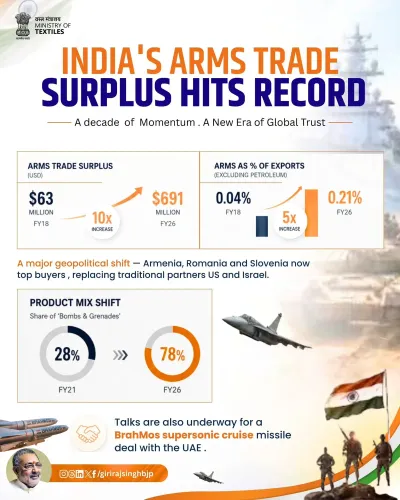
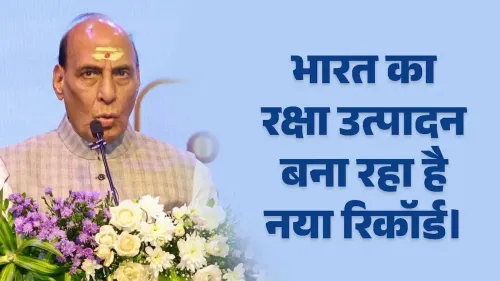
India's defence export story has crossed a threshold that would have seemed implausible a decade ago — Union Textiles Minister Giriraj Singh on Sunday, September 27, 2026, shared that Indian defence products are now reaching over 80 countries, with export values touching ₹38,424 crore, citing the figure as proof of the country's growing strategic manufacturing muscle.
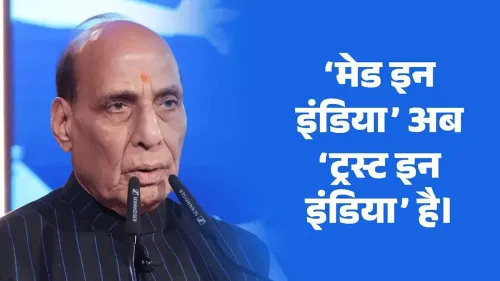
Writing in Hindi, Singh underscored the moment as a marker of national capability: 'नए भारत की सामर्थ्य को दर्शाती है' — 'a reflection of the new India's strength.' The post captures what has become a defining political and economic narrative in New Delhi — the transformation of India from one of the world's largest arms importers into a credible defence exporter.
From ₹15,920 Crore to ₹38,424 Crore: How Fast the Curve Has Climbed
The trajectory is steep. Official government data placed defence exports at approximately ₹15,920 crore in FY 2022-23 — meaning the figure Singh cites, if confirmed, would represent a near-doubling within roughly three years. That is not incremental growth; that is a structural shift. The government had earlier set an ambitious export target of US $5 billion by 2024-25, and the numbers being cited suggest India is tracking at or ahead of that curve.
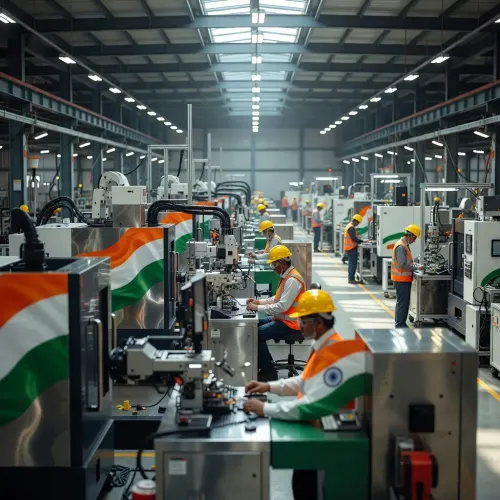
The engine behind this growth is a deliberate policy stack assembled since 2014 — licensing liberalisation, private sector entry into previously state-reserved segments, and foreign direct investment opening. Make in India, launched in 2014, gave domestic manufacturers a formal mandate. Atmanirbhar Bharat, announced in 2020, sharpened the focus: cut imports, build local capacity, then export the surplus capability.
Eighty-Plus Countries: The Geography of India's Defence Reach
Perhaps the more striking number in Singh's post is not the rupee figure but the geographic one — over 80 destination countries. A decade ago, India's defence export footprint was a handful of nations, mostly smaller neighbours and legacy partners. Today, Indian platforms, components, and systems are landing in markets across Southeast Asia, Africa, Latin America, and the Middle East — regions where buyers are looking for cost-competitive, battle-tested alternatives to Western and Russian suppliers.
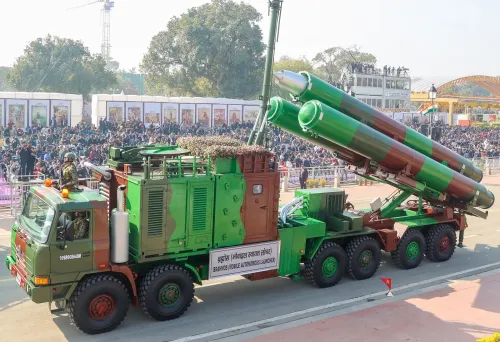
Defence Public Sector Undertakings alongside a growing private manufacturer ecosystem — producing everything from artillery systems and patrol vessels to radar components and small arms — have collectively widened what India can credibly offer. The diversification of buyers is itself a strategic signal: India is not just filling gaps left by sanctions or supply disruptions; it is competing on product merit.
A Textiles Minister Speaking for 'New India' — and Why That Is the Point
It is worth noting that Singh holds the Textiles portfolio, not Defence. His decision to amplify the defence export milestone — as a senior BJP leader and Lok Sabha MP from Begusarai, Bihar — reflects how deeply the self-reliance narrative has become a whole-of-government communication strategy. Manufacturing confidence, whether in looms or in launchers, feeds a single political brand: an India that makes, rather than merely buys.
What to watch next: the release of official FY 2025-26 defence export figures and any announcement of new defence manufacturing corridors or revisions to India's offset policy — signals that will tell us whether the curve keeps climbing or begins to plateau.
Point of View
If the cited figures hold up in official data, would represent a genuine inflection point in India's defence-industrial trajectory — not just a talking point. The shift from import dependence to 80-plus export destinations maps onto a broader strategic repositioning: India is signalling to global buyers, especially in the Global South, that it is an alternative supplier of consequence. Whether private-sector manufacturers can sustain quality and delivery at scale remains the central test of whether this curve is durable.
NationPress
27 Sept 2026
Frequently Asked Questions
What is India's current defence export figure?
Union Minister Giriraj Singh cited India's defence exports at ₹38,424 crore in a post dated September 27, 2026. Official FY 2022-23 figures stood at approximately ₹15,920 crore.
How many countries does India export defence products to?
According to Singh's post, Indian defence products now reach over 80 countries , a major expansion from the handful of destinations that received Indian defence exports a decade ago.
What is India's defence export target?
The Indian government set a target of US $5 billion in defence exports by 2024-25 as part of its Atmanirbhar Bharat and Make in India policy framework.
What is Atmanirbhar Bharat's role in India's defence exports?
Atmanirbhar Bharat , launched in 2020, aims to reduce defence imports and build domestic manufacturing capacity with the goal of eventually exporting the surplus capability to global markets.
Why is the Textiles Minister posting about defence exports?
Giriraj Singh is a senior BJP leader and his amplification of defence milestones reflects a whole-of-government communication approach, where ministers across portfolios promote the broader 'New India' self-reliance narrative.