Giriraj Singh flags India's non-fossil energy capacity at 297 GW
Synopsis
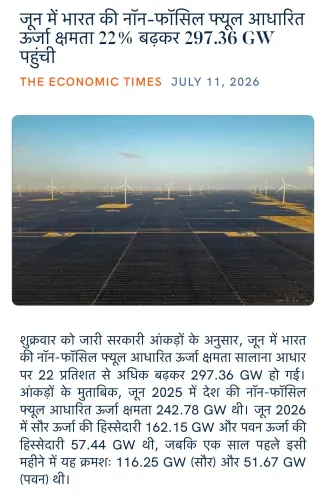
Union Textiles Minister Giriraj Singh highlighted that India's non-fossil fuel-based energy capacity grew 22 percent to 297.36 GW in June 2026, marking steady progress toward the government's Panchamrit target of 500 GW by 2030 pledged at COP26.
Key Takeaways
India's non-fossil fuel-based energy capacity reached 297.36 GW in June 2026 , a 22 percent rise year-on-year.
Union Textiles Minister Giriraj Singh shared the data on 12 July 2026 via the NaMo App.
India's Panchamrit strategy, announced at COP26 in 2021 , targets 500 GW of non-fossil fuel capacity by 2030 .
The Central Electricity Authority is the statutory body that compiles India's monthly power capacity statistics.
The National Green Hydrogen Mission (2023) complements the large-scale renewable capacity expansion drive.
India still needs to more than double current non-fossil capacity to meet its 2030 goal.
Union Textiles Minister Giriraj Singh on Sunday, 12 July 2026 shared data showing India's non-fossil fuel-based energy capacity rose 22 percent to 297.36 GW in June 2026, highlighting the country's accelerating clean energy transition via the NaMo App.
Context
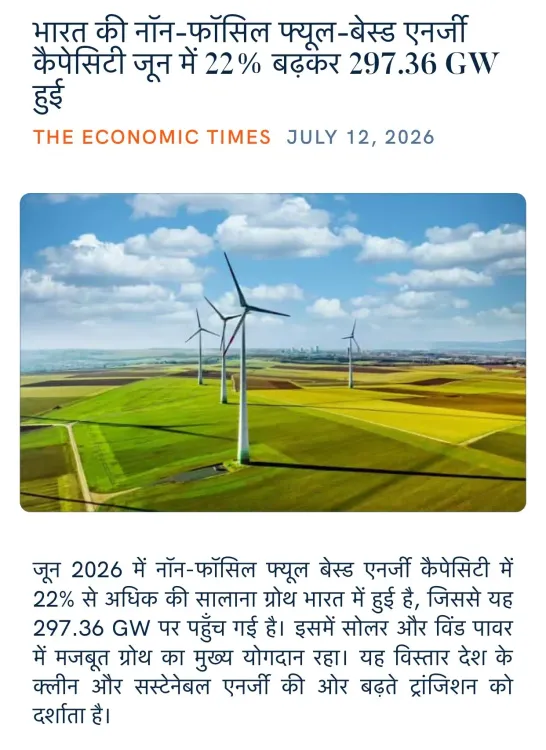
The post, shared in Hindi, references the latest capacity figures compiled by official energy authorities: 'भारत की नॉन-फॉसिल फ्यूल-बेस्ड एनर्जी कैपेसिटी जून में 22% बढ़कर 297.36 GW हुई' ('India's non-fossil fuel-based energy capacity rose 22 percent to 297.36 GW in June'). Singh's decision to amplify the data underscores the ruling BJP's effort to frame India's clean energy growth as a governance achievement ahead of future electoral cycles.
Non-fossil fuel capacity encompasses solar, wind, hydropower, nuclear, and other renewable sources — all counted toward India's international climate commitments. A 22 percent year-on-year rise signals that capacity additions have remained robust even as the broader energy mix continues to be dominated by thermal power.
Policy Backdrop
India's renewable energy ambitions are anchored in two landmark international pledges. At COP21 in 2015, India committed to sourcing 40 percent of cumulative electric power capacity from non-fossil sources by 2030. That target was significantly raised at COP26 in Glasgow in 2021, when Prime Minister Narendra Modi unveiled the Panchamrit strategy, which includes achieving 500 GW of non-fossil fuel energy capacity by 2030 and reaching net-zero emissions by 2070.
The Ministry of New and Renewable Energy has driven this expansion through solar park development, wind energy auctions, and domestic manufacturing incentives aligned with the Atmanirbhar Bharat initiative. The National Green Hydrogen Mission, approved in 2023, further complements the large-scale capacity build-out by targeting clean fuel production. The Central Electricity Authority, the statutory body that tracks monthly generation capacity data, is the primary source for such figures.
Stakeholders and Impact
The expansion directly benefits renewable energy developers, who gain policy certainty and market scale, and state electricity boards, which are progressively integrating higher shares of variable renewable power into their grids. Industrial power consumers stand to gain from competitive green tariffs as capacity scales up, while India's import bill for coal and crude oil faces downward pressure over the medium term.
For India's climate diplomacy, the 297.36 GW milestone represents meaningful progress toward the 500 GW Panchamrit goal, though the country still needs to more than double current non-fossil capacity within the remaining years of this decade. The trajectory also positions India alongside other large emerging economies undertaking rapid decarbonisation of their power sectors.
What's Next
Attention will now turn to the Central Electricity Authority's subsequent quarterly capacity reports, which will indicate whether the pace of additions is sufficient to keep the 500 GW by 2030 target on track. Any mid-term government review of the Panchamrit commitments — particularly ahead of future COP summits — will be closely watched by energy analysts, state utilities, and international climate observers alike.
India's ability to sustain this growth rate while managing grid stability, storage infrastructure, and financing for smaller developers will be a defining test of the country's clean energy policy architecture in the years ahead.
Point of View
A platform closely associated with the BJP's digital outreach — signals a deliberate effort to keep India's clean energy story visible in public discourse, even from a minister whose portfolio is textiles rather than energy. The move reflects a broader BJP communication pattern where multiple senior leaders collectively build a narrative around flagship policy milestones. With India needing to more than double non-fossil capacity before 2030, the government has an incentive to highlight every incremental gain to sustain investor confidence and diplomatic credibility at future climate forums. The real test, however, will be whether grid infrastructure and storage investments keep pace with generation capacity additions.
NationPress
12 Jul 2026
Frequently Asked Questions
What is India's current non-fossil fuel energy capacity?
According to data shared in July 2026, India's non-fossil fuel-based energy capacity stood at 297.36 GW as of June 2026 , reflecting a 22 percent increase.
What is India's renewable energy target for 2030?
India has committed to achieving 500 GW of non-fossil fuel energy capacity by 2030 as part of the Panchamrit strategy announced by Prime Minister Modi at COP26 in 2021 .
What is the Panchamrit strategy?
The Panchamrit is India's five-point climate action plan unveiled at COP26 in Glasgow in 2021 . It includes targets for 500 GW of non-fossil energy capacity, 50 percent of energy from renewables, and net-zero emissions by 2070 .
Who tracks India's power capacity data?
The Central Electricity Authority (CEA) , a statutory body under the central government, compiles and publishes India's official monthly electricity generation capacity statistics, including non-fossil sources.
Why did Giriraj Singh post about energy capacity when his portfolio is textiles?
Giriraj Singh is a senior BJP leader, and senior party ministers routinely share data on cross-sector government achievements as part of the party's coordinated public communication strategy, regardless of their specific ministerial portfolio.