Giriraj Singh Hails 26% Jump in Gems & Jewellery Exports
Synopsis
Union Textiles Minister Giriraj Singh highlighted a 26 per cent jump in India's gems and jewellery exports in June 2026, crediting central government policies on ease of doing business, production incentives, and lab-grown diamonds for the surge, and reaffirming the goal of making India a global Gems and Jewellery hub.
Key Takeaways
Union Textiles Minister Giriraj Singh announced a 26 per cent rise in gems and jewellery exports in June 2026 .
The minister attributed the growth to ease of doing business reforms, export incentives, and support for lab-grown diamonds .
The RoDTEP scheme , introduced in 2021 , is a key policy instrument supporting gems and jewellery exporters by refunding embedded taxes.
The Union Budget 2023 had specifically identified lab-grown diamonds as a priority manufacturing and export segment.
The Gem and Jewellery Export Promotion Council (GJEPC) is the apex body coordinating India's export push in this sector.
Major export clusters are based in Surat , Mumbai , Jaipur , and Hyderabad , employing large numbers of skilled workers.
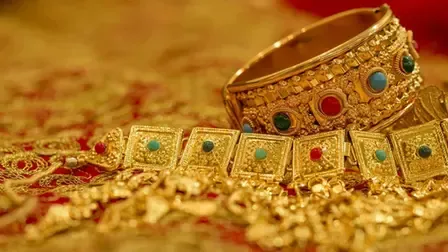
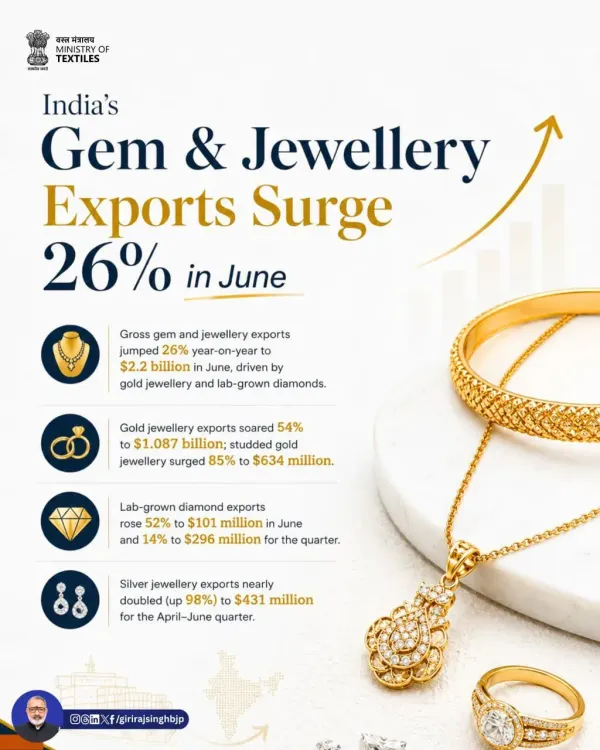
Union Textiles Minister Giriraj Singh on Monday, 27 July 2026, credited central government policies for a 26 per cent rise in India's gems and jewellery exports in June, saying the sector is carving out a growing identity in global markets. The minister pointed to ease of doing business reforms, production and export incentives, support for lab-grown diamonds, and export-friendly policies as the drivers behind the surge.
Context
Posting in Hindi on X, Giriraj Singh wrote that the jump in June exports is 'bharatiya udyog ki gunvatta, navachar aur badhte vaishvik vishwas ka praman hai' — proof of Indian industry's quality, innovation, and rising global trust. He added that these efforts are laying a strong foundation to make India a global Gems and Jewellery hub. The post was accompanied by an image and carried the hashtags #Exports and #RisingIndia.
Policy Backdrop
The gems and jewellery sector falls under the joint ambit of the Ministry of Textiles and the Ministry of Commerce, with the Gem and Jewellery Export Promotion Council (GJEPC) serving as the apex industry body for export promotion. The central government has layered several policy measures to support the sector over recent years. The Remission of Duties and Taxes on Export Products (RoDTEP) scheme, introduced in 2021, replaced earlier incentive structures and extended support to gems and jewellery exporters by refunding embedded taxes that were previously unrecouped.
The Union Budget 2023 specifically highlighted lab-grown diamonds as a priority area, signalling intent to build domestic manufacturing capacity and capture a larger share of a fast-growing global market. Lab-grown diamonds, produced through technological processes rather than mining, carry lower costs and are increasingly preferred by international buyers, giving India — already a dominant diamond-processing nation — a potential edge in value-added exports.
Stakeholders and Impact
The sector is a significant employer of skilled and semi-skilled labour, with clusters concentrated in Surat, Mumbai, Jaipur, and Hyderabad. Diamond manufacturers and gems and jewellery exporters stand to benefit directly from the policy push, particularly smaller units that depend on export incentives to remain competitive against rivals in Belgium, the UAE, and China. A sustained rise in export volumes also supports the government's broader goal of raising India's share in global merchandise trade under the Make in India framework.
The minister's remarks signal continued political attention to the sector at the highest level. With the Ministry of Textiles taking visible ownership of gems and jewellery export performance, industry bodies are likely to push for further budget provisions and trade facilitation measures in upcoming policy cycles.
What's Next
Attention will now turn to subsequent monthly export data from the commerce ministry to confirm whether the June growth trajectory holds through the second half of 2026. Any further policy announcements — including additional RoDTEP rate revisions, dedicated credit lines for lab-grown diamond units, or new bilateral trade agreements covering gems and jewellery — will be closely watched by exporters and industry councils. If the momentum is sustained, it would strengthen the government's case for positioning India as the world's preferred sourcing destination for gems and jewellery ahead of key international trade fairs later this year.
Point of View
Reinforcing a narrative of economic competence ahead of any upcoming electoral or budgetary cycle. By specifically naming lab-grown diamonds and ease of doing business alongside the June export figure, the minister is signalling that the government views the gems and jewellery sector as a showcase for its broader industrial policy. The framing also positions the Ministry of Textiles as an active stakeholder in trade outcomes that formally sit with the Ministry of Commerce, suggesting inter-ministerial coordination on the sector's export story. Sustained follow-through — in the form of verifiable monthly data and further policy measures — will determine whether this narrative holds beyond a single month's performance.
NationPress
27 Jul 2026
Frequently Asked Questions
By how much did India's gems and jewellery exports grow in June 2026?
Union Textiles Minister Giriraj Singh stated that India's gems and jewellery exports rose by 26 per cent in June 2026, attributing the growth to central government policies on ease of doing business, production incentives, and lab-grown diamonds.
What is India's policy on lab-grown diamonds?
The Union Budget 2023 highlighted lab-grown diamonds as a priority area for domestic manufacturing and exports. The government has been promoting this segment to help India capture a larger share of a rapidly growing global market, leveraging the country's existing diamond-processing expertise.
What is the RoDTEP scheme and how does it help jewellery exporters?
The Remission of Duties and Taxes on Export Products (RoDTEP) scheme, introduced in 2021 , refunds embedded taxes and duties that exporters pay but cannot otherwise recover. It replaced earlier incentive mechanisms and extends support to gems and jewellery exporters, improving their cost competitiveness in global markets.
Which ministry oversees India's gems and jewellery exports?
India's gems and jewellery sector is overseen jointly by the Ministry of Textiles and the Ministry of Commerce . The Gem and Jewellery Export Promotion Council (GJEPC) , under the Ministry of Commerce, is the apex body responsible for promoting and developing exports in this sector.
Where are India's major gems and jewellery export hubs located?
India's principal gems and jewellery manufacturing and export clusters are concentrated in Surat (diamonds), Mumbai , Jaipur (coloured gemstones and gold jewellery), and Hyderabad , together employing large numbers of skilled and semi-skilled workers.