Giriraj Singh Hails 6th Defence Indigenisation List, ₹3,070 Cr Push
Synopsis
India's Ministry of Defence has issued its sixth positive indigenisation list, covering 405 parts and equipment worth ₹3,070 crore that must now be manufactured domestically. Union Textiles Minister Giriraj Singh hailed the move as a boost for the Indian defence industry and MSMEs, reinforcing the Atmanirbhar Bharat and Make in India policy drive.
Key Takeaways
The Ministry of Defence released its sixth positive indigenisation list on 19 August 2026 .
The list covers 405 parts and equipment collectively valued at ₹3,070 crore , all of which must now be sourced domestically.
Union Textiles Minister Giriraj Singh highlighted the decision as a catalyst for Indian defence industry and MSMEs .
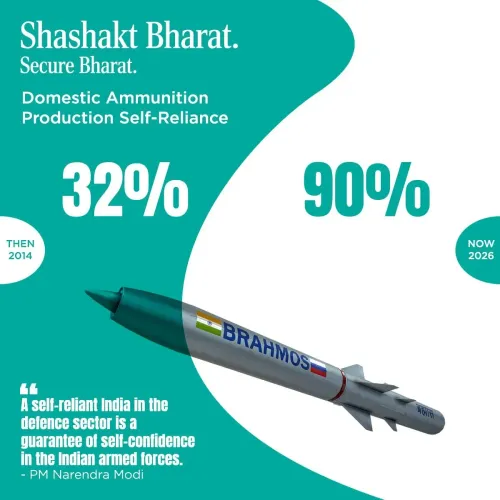
The indigenisation list mechanism has been a cornerstone of Atmanirbhar Bharat 's defence policy since May 2020 .
MSMEs are a primary intended beneficiary, expected to receive large-scale orders for components previously imported.
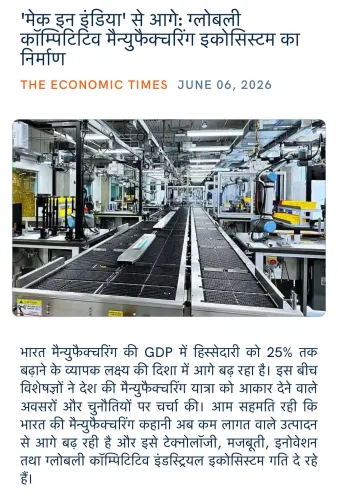
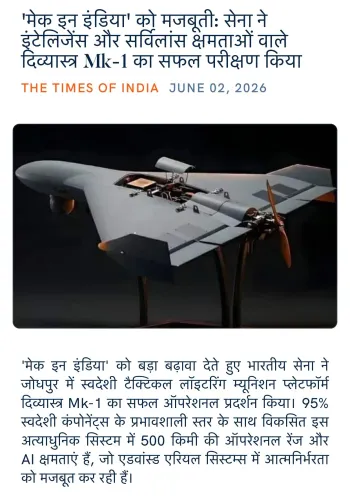
The move aligns with the broader Make in India programme's goal of building domestic defence manufacturing capacity.
India's defence self-reliance drive just hit a new gear. The Ministry of Defence has released its sixth positive indigenisation list — covering 405 parts and equipment worth ₹3,070 crore — barring their import and mandating domestic production, a move Union Textiles Minister Giriraj Singh amplified on Wednesday, 19 August 2026.
Singh, posting in Hindi, framed the decision as a dual win: 'यह फैसला भारतीय रक्षा उद्योग और MSMEs को नई रफ्तार देगा' — 'This decision will give new momentum to the Indian defence industry and MSMEs' — and argued it would make India's security architecture 'far stronger than before.'
Six Lists, One Direction: How the Indigenisation Drive Has Built
The positive indigenisation list mechanism is the backbone of Atmanirbhar Bharat's defence chapter, first announced in May 2020. The logic is blunt: publish a list of items that the armed forces currently import, set a deadline, and tell industry — domestic industry only — to fill the gap. Each successive list has expanded the perimeter of what India refuses to buy from abroad. The sixth list is the latest escalation of that pressure. At ₹3,070 crore, it represents a substantial order pipeline that defence manufacturers and, critically, MSMEs can now chase. Small and medium enterprises have been a deliberate target of this policy — they supply sub-assemblies, precision components, and specialised parts that larger primes cannot always produce economically in-house.Why MSMEs Are the Real Story Here
India's defence MSME ecosystem has grown steadily since 2020, but it still punches below its weight relative to the scale of the armed forces' requirements. A list of this size — 405 line items — is not a symbolic gesture. It is a procurement signal: design your production capacity around these components, because the government will not be ordering them from overseas. The Make in India programme, launched in 2014, set the political ambition. Atmanirbhar Bharat gave it teeth in the defence sector. The indigenisation lists are the mechanism that converts both into actual factory orders. Each list has tended to grow in scope, and the sixth continues that trajectory.A Textiles Minister Cheering a Defence Move — And Why That Matters
Giriraj Singh's portfolio is textiles, not defence — so why is he amplifying this announcement? The answer is the MSME thread. Textile MSMEs and defence MSMEs often share the same policy oxygen: access to government procurement, working-capital support, and technology upgradation schemes. A senior BJP voice championing the defence indigenisation list is a signal that the party sees MSME empowerment as a cross-sectoral political asset, not a siloed ministry talking point. The hashtags #MakeInIndia and #AtmanirbharBharat in Singh's post reinforce the messaging architecture — these are not incidental; they tie a defence procurement decision to the government's broadest economic branding. For Indian industry, the sixth list is an invitation. Whether domestic manufacturers can convert that invitation into delivered hardware — on time, to spec — is the test that every previous list has also posed. The scorecard on the earlier five lists will determine how seriously the armed forces, and the market, take number six.Point of View
Multi-year ratchet — each list expanding the import-exclusion perimeter and signalling to industry that the government's commitment is durable, not cyclical. The ₹3,070 crore figure matters less as a budget line and more as a demand signal: it tells domestic manufacturers what capacity to build. That a Textiles Minister is amplifying a Defence Ministry announcement underscores how the BJP has consciously fused MSME empowerment with national-security messaging, turning procurement policy into political identity. The real test, as with every previous list, is implementation — whether domestic industry can meet the specifications and timelines that the armed forces require, or whether the lists become aspirational catalogues.
NationPress
19 Aug 2026
Frequently Asked Questions
What is India's sixth positive indigenisation list in defence?
It is a list of 405 defence parts and equipment worth ₹3,070 crore that the Ministry of Defence has barred from import, requiring them to be manufactured domestically by Indian companies including MSMEs.
What is a positive indigenisation list in Indian defence policy?
A positive indigenisation list is a catalogue of military items that the government designates for domestic production only, prohibiting their import after a set timeline to encourage local manufacturing under the Atmanirbhar Bharat initiative.
How does the defence indigenisation list benefit MSMEs?
MSMEs are expected to receive large-scale orders for sub-assemblies, precision components, and specialised parts that now cannot be imported, giving smaller domestic firms a direct entry into the defence supply chain.
When did India's Atmanirbhar Bharat defence indigenisation policy begin?
The Atmanirbhar Bharat Abhiyan was announced in May 2020, with defence self-reliance through positive indigenisation lists as a central pillar of the initiative.
Why did Textiles Minister Giriraj Singh comment on a defence ministry announcement?
Singh highlighted the decision because it directly benefits MSMEs — a constituency central to both the Textiles Ministry's mandate and the BJP's broader Make in India and Atmanirbhar Bharat political messaging.