Giriraj Singh Hails India's 7.7% GDP Growth in FY26
Synopsis
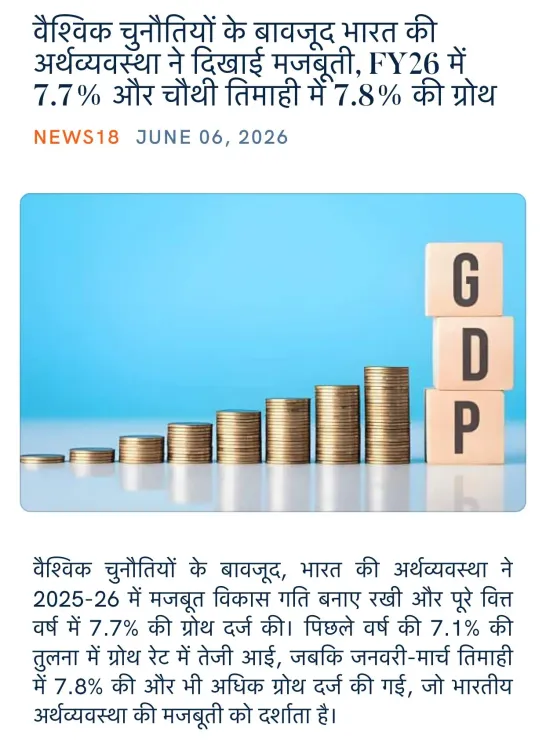
Union Textiles Minister Giriraj Singh on June 6, 2026, shared official data showing India's economy grew 7.7% in FY26 and 7.8% in Q4 FY26, calling it a sign of strength amid global challenges. The figures align with the government's sustained above-7% growth target backed by PLI schemes and capital expenditure.
Key Takeaways
India's GDP grew 7.7% in FY26 , with the fourth quarter clocking 7.8% , according to official data shared by the minister.
Union Textiles Minister Giriraj Singh amplified the data via the NaMo App on June 6, 2026 , framing it as evidence of economic resilience.
The growth print is consistent with government projections of 7%-plus medium-term growth outlined in recent Union Budgets and Economic Surveys.
India's PLI schemes launched in 2020 and the Atmanirbhar Bharat framework have been central to sustaining manufacturing-led growth.
Textile exporters and MSMEs are among the key stakeholders who benefit from a high-growth macro environment.
The NSO is expected to release revised GDP estimates in coming months, which markets and policymakers will watch closely.
Union Textiles Minister Giriraj Singh on Saturday, June 6, 2026, shared official data showing India's economy expanded at 7.7% in FY26 and 7.8% in the fourth quarter, calling it a sign of resilience despite global headwinds.
Context
The minister shared the headline figures via the NaMo App, citing official government data. His post, written in Hindi, noted: 'vashvik chunautiyon ke bavajud Bharat ki arthavyavastha ne dikhai mazbooti' — 'India's economy has shown strength despite global challenges.' The Q4 FY26 print of 7.8% marks an acceleration from the full-year average, signalling momentum heading into the next fiscal year.
The figures come from official national accounts data and place India among the fastest-growing major economies in the world. The full-year FY26 number of 7.7% is consistent with projections made in successive Union Budgets and Economic Surveys, which have repeatedly targeted 7%-plus medium-term growth anchored by capital expenditure and structural reforms.
Policy Backdrop
India's growth recovery has been underpinned by a series of supply-side interventions since FY22, when the economy rebounded at 8.7% after the pandemic contraction of FY21. The government's Production Linked Incentive (PLI) schemes, launched in 2020 across sectors including textiles and electronics, were designed to boost domestic manufacturing and reduce import dependence under the Atmanirbhar Bharat framework.
The textiles sector — a key pillar of employment and merchandise exports — has been a direct beneficiary of PLI support alongside the Remission of Duties and Taxes on Exported Products (RoSCTL) scheme. These interventions have been central to the government's argument that India can sustain above-6% growth even as global trade faces headwinds from geopolitical tensions and energy shocks.
Stakeholders and Impact
Textile exporters and MSMEs stand to gain from a high-growth macro environment, which typically supports domestic consumption, credit offtake, and order books. A strong GDP print also reinforces investor confidence in India's manufacturing transition, which the government has been actively promoting through roadshows and bilateral investment talks.
For workers in labour-intensive sectors such as garments and handlooms — concentrated in states like Gujarat, Tamil Nadu, Maharashtra, and Uttar Pradesh — sustained economic growth translates into more stable employment and wage conditions. The minister's amplification of the data signals that the government intends to use the strong growth narrative to build political and policy momentum ahead of the next Union Budget cycle.
What's Next
The National Statistical Office (NSO) typically releases revised GDP estimates in subsequent months, and any upward or downward revision to the FY26 advance estimates will be closely watched by markets and policymakers. Analysts will also look for whether the strong Q4 print translates into higher capital expenditure allocations for textiles and manufacturing in the next Union Budget.
With India's global positioning as an alternative manufacturing hub gaining traction, a sustained above-7% growth trajectory could strengthen the case for expanded PLI outlays and new export incentive schemes — making the macro data politically and economically significant well beyond the current news cycle.
Point of View
If confirmed by NSO revisions, would cement India's position as the world's fastest-growing major economy and provide strong political capital ahead of state elections and the next budget cycle. Giriraj Singh's use of the NaMo App also underscores the party's continued investment in proprietary digital outreach to bypass traditional media filters. The post fits a well-established pattern where growth data is rapidly converted into political messaging, with the Atmanirbhar Bharat and PLI frameworks serving as the connective tissue between economic performance and electoral narrative.
NationPress
21 Oct 2026
Frequently Asked Questions
What is India's GDP growth rate for FY26?
India's GDP grew at 7.7% for the full financial year FY26, according to official data shared by Union Textiles Minister Giriraj Singh on June 6, 2026.
What was India's GDP growth in Q4 FY26?
India's economy expanded at 7.8% in the fourth quarter of FY26 (January–March 2026), an acceleration from the full-year average.
Why did Giriraj Singh share GDP data?
As a senior cabinet minister and BJP leader, Giriraj Singh shared the official growth figures via the NaMo App to highlight India's economic resilience amid global challenges, aligning with the government's broader Atmanirbhar Bharat narrative.
How does India's FY26 growth compare to recent years?
India recorded 8.7% growth in FY22 after the pandemic contraction. The 7.7% FY26 figure is consistent with the government's medium-term target of sustained above-7% growth backed by PLI schemes and capital expenditure.
What are PLI schemes and how do they relate to India's growth?
Production Linked Incentive (PLI) schemes were launched in 2020 across sectors including textiles and electronics to boost domestic manufacturing and reduce import dependence. They are a key pillar of the Atmanirbhar Bharat framework credited with supporting India's sustained high growth.