Giriraj Singh hails Lal Chowk as symbol of new Kashmir
Synopsis
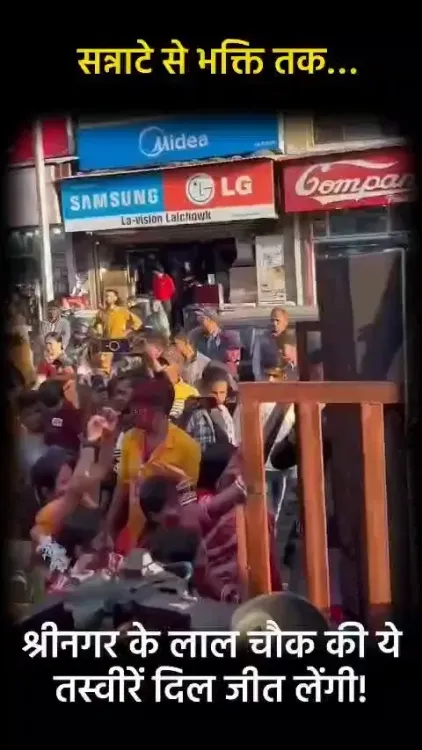
Union Textiles Minister Giriraj Singh shared a video of Srinagar's Lal Chowk on 23 October 2026, describing it as the 'new identity of a changing Kashmir' — continuing the BJP's post-Article 370 normalisation narrative around one of the valley's most historically charged public spaces.
Key Takeaways
Giriraj Singh posted a video of Lal Chowk, Srinagar on 23 October 2026 , framing it as a symbol of Kashmir's transformation.
His Hindi caption translates to: 'From darkness to the light of faith, this image of Srinagar's Lal Chowk is the new identity of a changing Kashmir.' Lal Chowk was for decades a flashpoint for security incidents, protests, and political tension in the Kashmir Valley.
The post extends the BJP's sustained public narrative on normalisation following the August 2019 abrogation of Article 370 .
Official tourism and security data for the valley remain the key metrics that would quantitatively support or challenge the normalisation claim.
A single frame of Srinagar's Lal Chowk is doing what a thousand policy briefings cannot — telling the story of a valley the government says has crossed a threshold. On Friday, 23 October 2026, Union Textiles Minister Giriraj Singh shared a video of the iconic central square and framed it as proof of a transformation that was once considered impossible.
Singh's post, written in Hindi, reads: 'Andhakar se aastha ke ujale tak, Srinagar ke Lal Chowk ki yah tasveer badalte Kashmir ki nayi pahchan hai.' In English: 'From darkness to the light of faith, this image of Srinagar's Lal Chowk is the new identity of a changing Kashmir.' The language is deliberate — 'darkness' and 'light' are not accidental metaphors in a place with Lal Chowk's history.
What Lal Chowk carried for decades
Lal Chowk — literally 'Red Square' — sits at the commercial heart of Srinagar's old city. For most of the 1990s and 2000s, it was shorthand for exactly the kind of tension Singh is now contrasting against: security cordons, shuttered shops, protests, and a clock tower that became one of the most politically charged structures in the subcontinent. Hoisting the national flag there was, for years, an act requiring armed escort and considered a statement in itself.
That history makes any imagery of an open, lit, functioning Lal Chowk politically resonant — which is precisely why the ruling BJP has returned to it repeatedly as a visual argument for its Kashmir policy.
The 2019 pivot and its symbolic afterlife
The inflection point the government points to is August 2019, when Parliament abrogated Article 370, stripped Jammu and Kashmir of its special constitutional status, and reorganised it into two Union Territories under direct central administration. The move was fiercely contested — legally, politically, and on the ground — but the government has since built a sustained communications arc around normalisation: rising tourist footfall, infrastructure investment, and the reappearance of everyday civic life in spaces like Lal Chowk.
Singh's post sits squarely in that arc. As a senior BJP voice and Lok Sabha MP from Begusarai, Bihar, he frequently amplifies themes of national integration. A video of Srinagar's central square — luminous, open, apparently peaceful — is the kind of image the party wants circulating as it continues to defend the 2019 reorganisation in courts and in public opinion.
The metrics that would settle the argument
Symbols are powerful, but they are also selective. The fuller picture of post-2019 Kashmir is one policymakers and residents are still assembling: official tourism data, security incident counts, unemployment figures, the pace of statehood restoration, and the lived experience of Kashmiri residents navigating a new administrative reality. Those numbers — when released — will either reinforce the narrative Singh is advancing or complicate it considerably.
Until then, Lal Chowk's image keeps doing its work — carrying the weight of a before-and-after story that a ruling party wants the country to believe is already written.
Point of View
Symbolically loaded landmark to compress a complex policy argument into a shareable image. Lal Chowk has been a recurring prop in the BJP's post-2019 Kashmir communications precisely because its history is so well-known; any image of normalcy there carries implicit contrast with decades of conflict. The messaging is effective but selective: it foregrounds the visual while sidelining unresolved questions around statehood restoration, civil liberties, and economic recovery that analysts say define whether the 2019 reorganisation has genuinely succeeded. As the government approaches the seventh anniversary of Article 370's abrogation, expect this symbolic register to intensify.
NationPress
23 Oct 2026
Frequently Asked Questions
What did Giriraj Singh say about Lal Chowk in his October 2026 post?
Singh shared a video of Srinagar's Lal Chowk and wrote in Hindi that the image represents the 'new identity of a changing Kashmir', describing the shift as moving 'from darkness to the light of faith'.
Why is Lal Chowk significant in Kashmir's history?
Lal Chowk is the central commercial square of Srinagar and was for decades a site of protests, security incidents, and political tension, making it one of the most symbolically charged public spaces in the Kashmir Valley.
What was Article 370 and when was it abrogated?
Article 370 granted Jammu and Kashmir special constitutional status and autonomy. It was abrogated by the Indian Parliament in August 2019 , after which the region was reorganised into two Union Territories under direct central administration.
What is the BJP's narrative on Kashmir after Article 370?
The BJP has consistently argued that removing Article 370 brought peace, development, and normalisation to the Kashmir Valley, citing improved security conditions, rising tourist footfall, and greater infrastructure investment.
Who is Giriraj Singh and what is his political role?
Giriraj Singh is a senior BJP leader, Union Minister of Textiles, and Lok Sabha MP from Begusarai, Bihar. He is known for frequently commenting on themes of national integration and development.