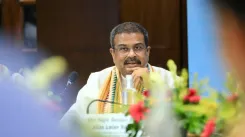
Giriraj Singh Highlights Solar-Powered Weaver from Arunachal
Synopsis
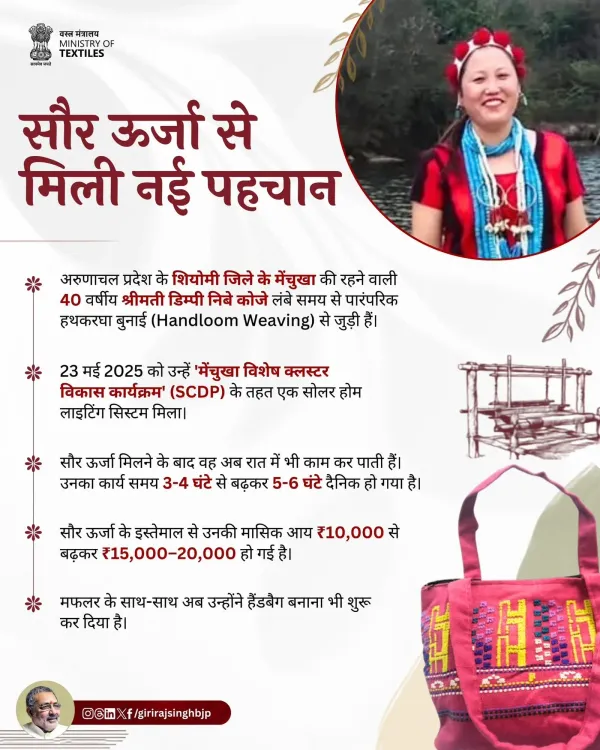
Union Textiles Minister Giriraj Singh has highlighted the story of Dimpi Nibe Koje, a weaver from Shi Yomi district in Arunachal Pradesh, showing how solar energy access extended her work hours, raised her income, and helped her diversify into handbag production — citing it as a model of artisan empowerment.
Key Takeaways
Dimpi Nibe Koje , a handloom weaver from Shi Yomi district, Arunachal Pradesh , was highlighted by Union Textiles Minister Giriraj Singh on 8 July 2026 .
Solar energy access extended her working hours and led to a rise in her income.
She diversified production by adding handbag manufacturing to her handloom work.
The post links to the government's Vocal for Local campaign under Atmanirbhar Bharat Abhiyan , launched in 2020 .
The National Handloom Development Programme and rural solar schemes form the policy backbone enabling such artisan success stories.
Northeast India, with its dense handloom weaving communities, remains a priority focus for the Textiles Ministry's artisan welfare outreach.
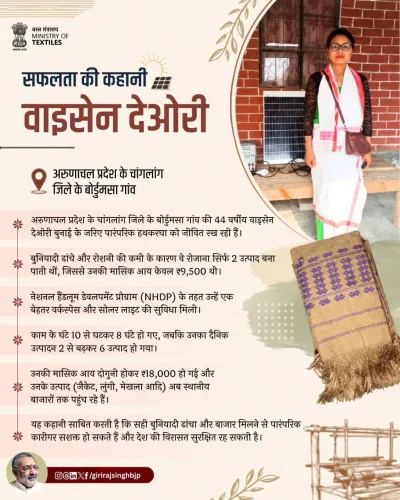
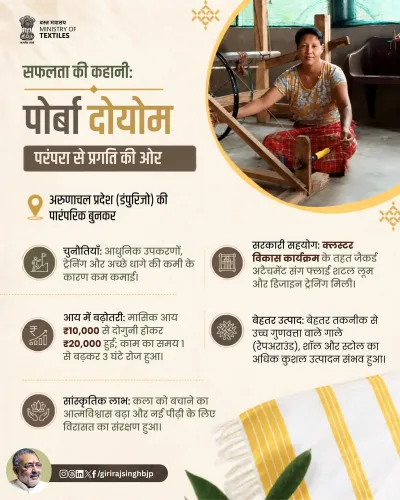
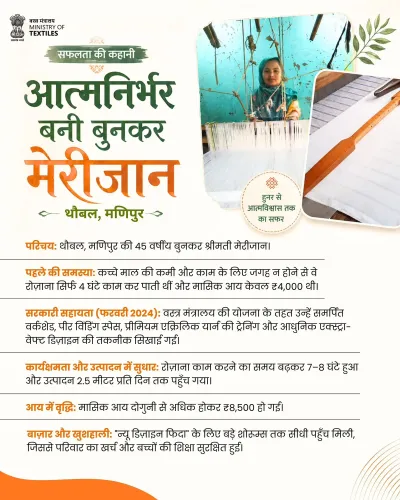
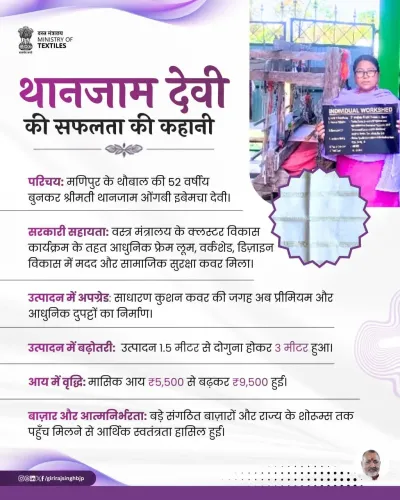
Union Textiles Minister Giriraj Singh on Wednesday, 8 July 2026 spotlighted the story of Dimpi Nibe Koje, a handloom weaver from Shi Yomi district, Arunachal Pradesh, as an example of how targeted infrastructure support can transform artisan livelihoods. Posting on X, the minister highlighted how solar energy access extended her working hours, raised her income, and enabled her to diversify into handbag manufacturing.
Context
In his post, Singh wrote — translated from Hindi — 'Shrimati Dimpi Nibe Koje ji ki kahani bataati hai ki sahi suvidhaen bunkaaron ke jeevan mein bada badlav la sakti hain' ('The story of Mrs Dimpi Nibe Koje tells us that the right facilities can bring a big change in the lives of weavers'). He noted that solar energy increased her productive work time, her income grew, and she began manufacturing handbags alongside her traditional weaving. The minister closed with the call: 'Empowered weavers, prosperous India' — Sashakt bunkar, samridh Bharat — and tagged the post with #VocalForLocal, #SupportArtisans, #Handloom, and #IndiaCrafts.
Shi Yomi is a district in Arunachal Pradesh with tribal communities whose traditional handloom craft forms a significant part of local cultural and economic identity. The region's weaving traditions include distinctive textile patterns tied to indigenous heritage.
Policy Backdrop
The minister's post connects to at least three intersecting policy strands. The Vocal for Local campaign, launched as part of the Atmanirbhar Bharat Abhiyan in 2020, encourages consumers to choose domestically produced goods, with handloom and handicraft products among its primary beneficiaries. The National Handloom Development Programme, operational since the 12th Plan period, provides infrastructure and market-linkage support to weavers across India.
Separately, rural solar access schemes have been extended to households to lengthen productive hours in craft-based livelihoods. The Koje example illustrates a convergence of these programmes: solar infrastructure enabling a weaver to work beyond daylight hours, with the additional productivity translating into product diversification and higher earnings.
Northeast India has been a consistent focus of the Textiles Ministry's outreach, given the density of handloom households and the distinctiveness of regional textile traditions in states such as Arunachal Pradesh, Nagaland, Manipur, and Assam.
Stakeholders and Impact
Women artisans in rural and tribal belts of Northeast India stand at the centre of this policy narrative. Handloom weaving in these regions is predominantly a women-led activity, and income gains for individual weavers carry household-level welfare implications. The addition of handbag manufacturing — a market-facing product — signals a shift from subsistence weaving toward micro-enterprise.
For consumers, the minister's appeal to adopt local products is framed as a direct lever for artisan welfare. The #VocalForLocal hashtag has been used consistently by the government to build a demand-side argument for domestic craft purchases, positioning individual buying choices as acts of economic solidarity with rural producers.
What's Next
Observers will watch for the Textiles Ministry to release updated data on weaver income changes in northeastern states and to announce expansion of solar-enabled handloom clusters in Arunachal Pradesh. The ministry's use of individual success stories as communication tools suggests a broader campaign to build public awareness ahead of potential scheme announcements or budget allocations for the handloom sector. If solar integration with handloom clusters scales across the Northeast, it could reframe rural artisan policy as a convergence point between renewable energy and textile heritage programmes.
Point of View
The Textiles Ministry signals that its Northeast outreach is producing ground-level outcomes — a message with both welfare and electoral resonance in a region where the BJP has invested heavily. The convergence of renewable energy and handloom policy in this narrative is notable, as it allows two separate ministries' programmes to share credit for a single livelihood improvement. If the ministry follows up with cluster-level data, this story could serve as a template for a larger scheme rollout.
NationPress
8 Jul 2026
Frequently Asked Questions
Who is Dimpi Nibe Koje and why is she in the news?
Dimpi Nibe Koje is a handloom weaver from Shi Yomi district in Arunachal Pradesh who gained national attention after Union Textiles Minister Giriraj Singh highlighted her story on 8 July 2026 . Solar energy access allowed her to work longer hours, raise her income, and start producing handbags alongside traditional weaving.
What is the Vocal for Local campaign?
Vocal for Local is a government campaign launched under the Atmanirbhar Bharat Abhiyan in 2020 that encourages Indian consumers to buy domestically made products, particularly from artisans, weavers, and small producers, to strengthen rural livelihoods and reduce import dependence.
How did solar energy help handloom weavers in Arunachal Pradesh?
Solar energy access extended the productive working hours of weavers like Dimpi Nibe Koje beyond daylight, enabling greater output, higher income, and product diversification such as handbag manufacturing — illustrating how renewable energy infrastructure can directly support traditional craft livelihoods.
What is the National Handloom Development Programme?
The National Handloom Development Programme is a central government scheme operational since the 12th Plan period that provides infrastructure, market linkages, and financial support to handloom weavers across India, with a particular focus on preserving regional textile traditions.
What is Shi Yomi district known for?
Shi Yomi is a district in Arunachal Pradesh with tribal communities that maintain traditional handloom weaving practices. The district's weavers produce textiles with distinctive indigenous patterns, and it has become a focus of the central government's artisan welfare and Northeast development outreach.