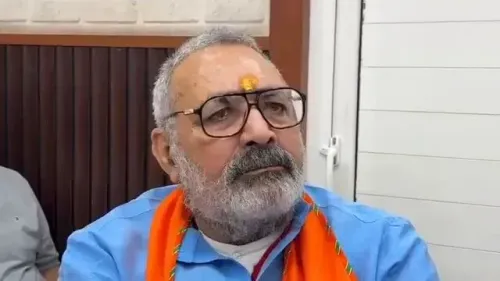
Giriraj Singh hits out at dynastic politics, backs merit

Synopsis
Union Textiles Minister Giriraj Singh lashed out at 'dynastic arrogance' in a Hindi post on 27 September 2026, saying India's days of kings born from queens' wombs are over and the country will now run purely on capability — a clear dig at Congress and the Nehru-Gandhi family.
Key Takeaways
Giriraj Singh posted in Hindi on 27 September 2026 attacking what he called 'dynastic arrogance' in Indian politics.
He declared that 'a poor man's son becoming Prime Minister' — a reference to PM Narendra Modi — is unacceptable to those steeped in hereditary entitlement.
Singh argued that 'the days of being born a king from a queen's womb are gone' and India will now advance purely on merit and work.
The attack is directed at the Indian National Congress and the Nehru-Gandhi family's dynastic hold on the party, a BJP talking point since 2014 .
The messaging is consistent with BJP's long-running electoral strategy of framing the party as merit-based against Congress's perceived family dynasty.
Dynastic entitlement, Union Textiles Minister Giriraj Singh declared on Sunday, 27 September 2026, cannot stomach the rise of a poor man's son to the highest office in the land — and he made clear he believes that discomfort belongs to those who think political power is inherited, not earned.
Posting in Hindi on X, Singh wrote: 'परिवारवाद के अहंकार में डूबे लोगों से एक गरीब के बेटे का प्रधानमंत्री बनना पच नहीं रहा है।' — 'Those drowned in the arrogance of dynastic politics cannot digest the fact that a poor man's son has become Prime Minister.' He added that repeated electoral defeats have still not deflated the 'royal pride,' and drove home his central point: 'The days of being born a king from a queen's womb are gone. This country will now run only on capability and work.'
The 'poor man's son' frame in BJP politics
The reference is unmistakably to Prime Minister Narendra Modi, whose origin as the son of a tea-seller in Gujarat has been a cornerstone of the Bharatiya Janata Party's political identity since the 2014 general election. That campaign built an entire architecture around the contrast: a man who grew up selling tea versus political heirs who grew up in power. Twelve years on, the frame remains potent — and Singh is deploying it with fresh sharpness.
Who the 'royal arrogance' targets
Singh's language — 'dynastic arrogance,' 'losing repeatedly,' 'royal pride' — is standard BJP shorthand for the Indian National Congress and the Nehru-Gandhi family's grip on the party. Congress has faced this critique continuously since 2014, and Singh's post sharpens it by invoking monarchical imagery: queens, kings, inherited thrones. The phrasing 'born a king from a queen's womb' is deliberately medieval — a provocation designed to make dynastic politics sound not just unfair but absurd in a democratic republic.
Rhetoric as electoral groundwork
Posts like this rarely exist in a vacuum. BJP leaders have historically intensified the anti-dynasty drumbeat ahead of state assembly elections and general election cycles, using social media to seed messaging that eventually migrates to campaign rallies. While the specific trigger for Singh's September 2026 post is not confirmed, the language is rally-ready — punchy, emotionally charged, and built for amplification. Opposition responses, if they come, will test whether the dynasty critique still draws the same blood it did in 2014.
For Giriraj Singh — himself a Lok Sabha MP from Begusarai, Bihar, a state that prizes its own narratives of upward mobility — the message carries local resonance too. Bihar's politics have long been shaped by caste and patronage networks; the 'capability over lineage' argument plays differently, and often more powerfully, on that terrain than in any boardroom or television studio.
The era of the hereditary throne, Singh is betting, is one India has moved on from. Whether the opposition agrees — or can make a case to the contrary — is the argument that will define the next electoral cycle.
Point of View
The fact that senior ministers still reach for this frame suggests two things — it continues to resonate with a broad voter base, and the BJP perceives dynastic critique as a live vulnerability for the opposition. The language, however, has hardened; 'royal queen and king' imagery is more medieval and contemptuous than earlier formulations, signalling an escalation in rhetorical temperature. If state elections or a general election cycle is approaching, this post may be the first note of a much louder symphony.
NationPress
27 Sept 2026
Frequently Asked Questions
What did Giriraj Singh say about dynastic politics?
Giriraj Singh posted in Hindi on 27 September 2026 saying that those steeped in dynastic arrogance cannot accept a poor man's son becoming Prime Minister, and declared that 'the days of being born a king from a queen's womb are gone' — the country will now run only on capability and work.
Who is Giriraj Singh referring to as 'poor man's son' becoming PM?
The reference is widely understood to be Prime Minister Narendra Modi, whose background as the son of a tea-seller in Gujarat has been central to the BJP's political narrative since the 2014 general election.
Which party is the target of Giriraj Singh's dynastic politics attack?
Singh's language — invoking 'royal arrogance,' 'losing repeatedly,' and hereditary monarchy — is BJP shorthand directed at the Indian National Congress and the Nehru-Gandhi family, who have led the party across generations.
What is Giriraj Singh's political role and constituency?
Giriraj Singh is the Union Minister of Textiles in the Government of India and a senior BJP leader. He is a Lok Sabha Member of Parliament from Begusarai, Bihar.
Is BJP's anti-dynasty rhetoric a new development in 2026?
No. BJP has deployed the anti-dynasty argument as a core campaign theme since the 2014 general elections, contrasting merit-based leaders like PM Modi with what it frames as hereditary political entitlement in the Congress party. Singh's post continues and intensifies that tradition.