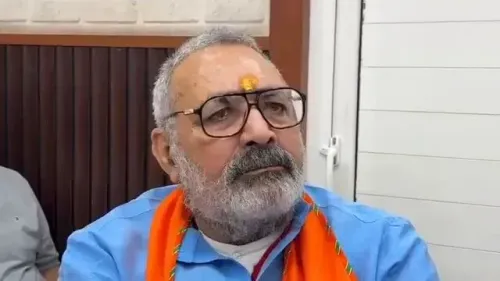
Giriraj Singh targets opposition over Sharia law remarks
Synopsis
Union Textiles Minister Giriraj Singh accused unnamed opposition leaders of pretending to uphold the Constitution while backing Sharia law, framing it as divisive politics that bypasses national law — a fresh salvo in the BJP's sustained push for a Uniform Civil Code.
Key Takeaways
Giriraj Singh posted on 27 September 2026 accusing opposition figures of 'pretending to uphold the Constitution while advocating Sharia law.' He charged that the 'politics of division' by bypassing national law is now 'before the nation.' The post did not name specific individuals or parties; no triggering incident is identified in available information.
BJP has consistently advocated a Uniform Civil Code to replace community-specific personal laws, including aspects of Islamic family law.
The Muslim Women (Protection of Rights on Marriage) Act, 2019 — which criminalised instant triple talaq — is a precedent BJP cites for further personal law reform.
A UCC bill and any Law Commission recommendations on it remain key watch-points in upcoming parliamentary sessions.
A sharp political broadside landed on Sunday, 27 September 2026, when Union Textiles Minister Giriraj Singh accused unnamed opposition figures of staging a facade of constitutional loyalty while privately advocating for Sharia law — a charge that cuts straight to the fault line of India's Uniform Civil Code debate.
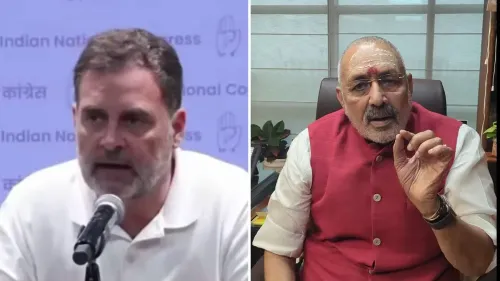
Posting in Hindi on X, Singh wrote: 'Samvidhan ka dhong aur Sharia kanoon ki vakaalat karna hi inka ekmaatra kaam hai' — 'Pretending to uphold the Constitution while advocating Sharia law is the only work they do.' He added that the 'mindset of bypassing the country's laws and practising the politics of division is now before the nation.'
The constitutional uniformity argument Singh is invoking
The accusation is not new in BJP political vocabulary, but it is pointed. Senior BJP leaders — Singh prominently among them — have long argued that community-specific personal laws, including aspects of Islamic family law, create a two-tier legal system that undermines constitutional equality. The party's consistent answer has been a Uniform Civil Code (UCC), which would replace all faith-based family laws with a single statute applicable to every citizen.
India already has one landmark reform on the books: the Muslim Women (Protection of Rights on Marriage) Act, 2019, which criminalised instant triple talaq. BJP leaders regularly cite that legislation as proof that personal law reform is constitutionally sound and democratically legitimate — and as a template for broader UCC action.
Who Singh is targeting — and why the ambiguity matters
Singh's post names no individual, party, or specific incident. The research available does not identify a triggering statement or event that prompted his remarks on this date, and asserting one would go beyond what the post itself says. What is clear is that BJP rhetoric on this issue typically frames opposition resistance to UCC as electoral calculation — defending personal law to secure minority votes rather than on constitutional principle.
The opposition's standard counter-argument holds that personal laws are protected cultural rights and that UCC proposals are majoritarian politics dressed up as legal reform. That debate is now, as Singh puts it, 'before the nation' — and parliamentary pressure for a UCC bill is a live watch-point heading into future Lok Sabha sessions.
Bihar's most combative MP keeps the temperature up
Singh, the Lok Sabha MP from Begusarai, Bihar, has built a political identity around unfiltered statements on cultural and legal fault lines. His interventions rarely go uncontested, and this post — carrying a video — is calibrated to travel. Whether it draws a formal response from any opposition leader will determine whether Sunday's salvo becomes a 24-hour news cycle or a longer flashpoint in the UCC conversation.
The Constitution's promise of equality before the law is not the point of contention — both sides claim it. The real fight is over whose definition of 'equal' wins out.
Point of View
Specific enough in imagery to resonate with the BJP base. With no UCC bill currently on the parliamentary floor, statements like this serve as sustained pressure to ensure the issue does not cool. The deeper question the post implicitly raises — whether constitutional uniformity and religious personal law can coexist — remains formally unresolved, which is precisely why this rhetoric retains its potency.
NationPress
27 Sept 2026
Frequently Asked Questions
What did Giriraj Singh say about Sharia law?
On 27 September 2026, Singh posted that unnamed opponents 'pretend to uphold the Constitution while advocating Sharia law' and that their 'politics of division by bypassing national law is now before the nation.'
Who is Giriraj Singh targeting in his Sharia law post?
Singh did not name any specific individual or party in his post. Based on BJP's consistent political framing, such statements are generally directed at opposition parties perceived to resist Uniform Civil Code legislation.
What is the Uniform Civil Code and why does BJP support it?
The Uniform Civil Code (UCC) would replace community-specific personal laws — including Islamic family law — with a single statute applicable to all citizens. BJP argues this is essential for constitutional equality; the party has consistently advocated for its enactment.
Is Sharia law practised in India?
India's Muslim personal law, governed by statutes such as the Muslim Personal Law (Shariat) Application Act, 1937, regulates family matters like marriage and inheritance for Muslim citizens. The 2019 triple talaq law marked one legislative curtailment of personal law practices.
What is the status of the Uniform Civil Code bill in India?
As of late 2026, a central UCC bill has not been tabled in Parliament. The Law Commission has been tasked with examining UCC proposals, and any formal bill or recommendation remains a key legislative watch-point.