Giriraj Singh Flags India-Japan Summit: $12.5 Billion Pledge
Synopsis
Union Textiles Minister Giriraj Singh shared details of the India-Japan Annual Summit on 3 July 2026, citing backing from over 150 Japanese companies worth $12.5 billion and pledges to deepen bilateral security cooperation, amplifying a key diplomatic milestone via the NaMo App.
Key Takeaways
Union Textiles Minister Giriraj Singh posted about the India-Japan Annual Summit on 3 July 2026 .
Over 150 Japanese companies have backed a $12.5 billion investment commitment to India.
The summit is aimed at fortifying both economic and security ties between India and Japan.
The India-Japan Annual Summit has been held regularly since 2006 , covering trade, defence, and connectivity.
The bilateral relationship is underpinned by the CEPA (2011) and a 2+2 dialogue mechanism (2019) .
Implementation timelines for pledged investments will be the key metric to watch going forward.
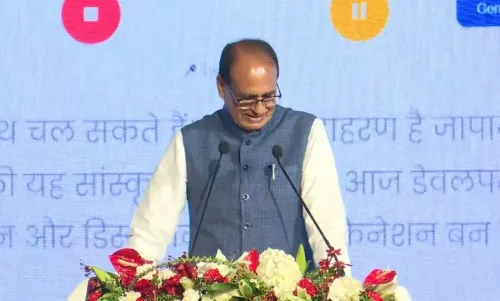
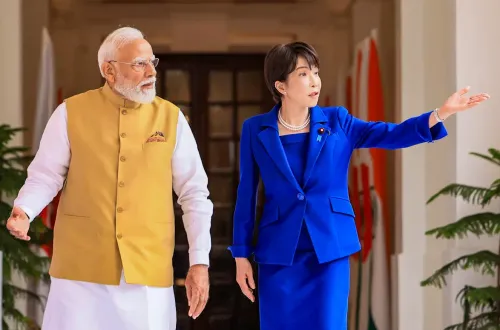
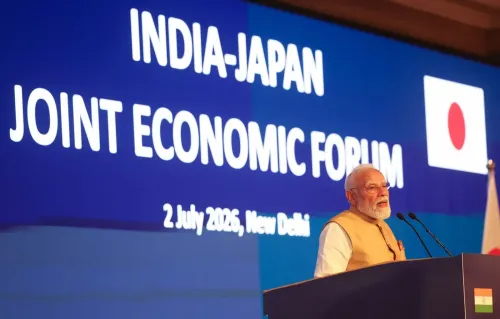
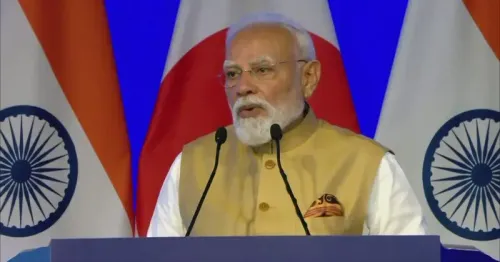
Union Textiles Minister Giriraj Singh on Friday, 3 July 2026 shared details of the India-Japan Annual Summit on X, highlighting that over 150 Japanese companies have backed a $12.5 billion investment leap aimed at fortifying bilateral security and economic ties between the two nations.
Context
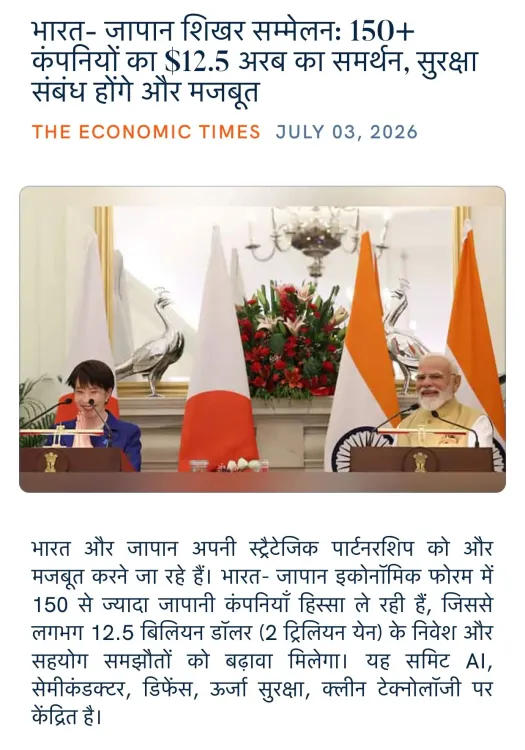
Singh's post, shared in Hindi, reads: 'Bharat-Japan shikhar sammelan: 150+ kampaniyon ka $12.5 arab ka samarthan, suraksha sambandh honge aur majboot' — translated as 'India-Japan Summit: Support of 150+ companies worth $12.5 billion, security ties will be further strengthened.' The post was shared via the NaMo App, the BJP-aligned digital platform, underscoring the ruling party's emphasis on amplifying diplomatic milestones to its base.
The India-Japan Annual Summit is a leaders-level bilateral dialogue held regularly since 2006, reviewing cooperation across economic, defence, and connectivity domains. The latest iteration appears to have produced a significant corporate commitment alongside security-focused outcomes.
Policy Backdrop
India and Japan formalised their economic partnership through the Comprehensive Economic Partnership Agreement (CEPA), which entered into force in 2011, liberalising tariffs on goods and services. That framework has underpinned successive investment announcements, including a $35 billion package pledged by Japan during the 2014 summit.
On the security front, the two countries instituted a 2+2 Foreign and Defence Ministers' dialogue in 2019, deepening strategic coordination. India's Act East Policy and its Indo-Pacific strategy have consistently positioned Japan as a central partner for diversified supply chains, joint infrastructure, and maritime cooperation — areas where both governments have sought alternatives to dependence on a single regional power.
Stakeholders and Impact
Japanese investors and Indian manufacturers stand as the primary stakeholders in any large-scale investment realisation. A commitment of $12.5 billion backed by more than 150 companies would represent a broad-based corporate push rather than a handful of marquee deals, potentially spreading benefits across sectors from electronics and automobiles to textiles and infrastructure.
For India, deepened security ties with Japan carry significance within the Quad framework — the grouping that also includes the United States and Australia — as New Delhi seeks to balance its strategic relationships across the Indo-Pacific. Regular joint naval exercises between the two navies have already institutionalised operational familiarity.
What's Next
The critical question following any summit-level pledge is implementation. Analysts and policymakers will watch for formal project agreements, timelines for capital deployment, and progress on joint defence and technology initiatives in the months ahead. Past India-Japan investment announcements have sometimes seen delayed execution, making follow-through mechanisms a key variable.
As both nations navigate a shifting Indo-Pacific order, the pace at which the $12.5 billion corporate commitment translates into on-ground projects will serve as a practical measure of the summit's lasting impact.
Point of View
Backed by 150-plus companies, signals a shift from government-to-government pledges toward broad corporate buy-in, which is harder to dismiss as symbolic. Framed alongside security deepening, the post ties economic diplomacy to the BJP's broader Indo-Pacific narrative, reinforcing India's positioning as a preferred partner over regional rivals. The real test — as with the $35 billion Japanese pledge of 2014 — will be whether implementation keeps pace with the headline numbers.
NationPress
2 Oct 2026
Frequently Asked Questions
What is the India-Japan Annual Summit?
The India-Japan Annual Summit is a leaders-level bilateral dialogue held regularly since 2006 to review cooperation in economic, defence, and connectivity areas between India and Japan.
What is the $12.5 billion India-Japan investment pledge about?
According to a post by Union Textiles Minister Giriraj Singh, over 150 Japanese companies have backed a $12.5 billion investment commitment to India as part of the latest India-Japan Annual Summit outcomes.
How does the India-Japan CEPA relate to this summit?
The Comprehensive Economic Partnership Agreement (CEPA), in force since 2011, forms the foundational trade framework between India and Japan, enabling the kind of large-scale investment flows announced at successive summits.
What are India-Japan security ties?
India and Japan deepened security cooperation through a 2+2 Foreign and Defence Ministers' dialogue instituted in 2019, and both nations conduct regular joint naval exercises under their broader Indo-Pacific and Quad partnership.
Why did Giriraj Singh post about the India-Japan summit?
As a senior BJP leader and Union Cabinet minister, Giriraj Singh shared the summit highlights via the NaMo App and X to amplify a significant diplomatic and economic milestone for the current government.