Giriraj Singh hails India as world's largest rice producer
Synopsis
Union Textiles Minister Giriraj Singh on 29 May 2026 shared news that India has become the world's largest rice producer, citing a major agricultural milestone. The claim builds on decades of Green Revolution investments, the National Food Security Mission, and PM-KISAN support for farmers.
Key Takeaways
Giriraj Singh shared on 29 May 2026 that India has become the world's largest rice-producing country.
The post was shared via the NaMo App , the official BJP-government digital communication platform.
India's rice output growth is underpinned by the Green Revolution (from 1965 ), the National Food Security Mission ( 2007 ), and the PM-KISAN scheme ( 2019 ).
Key rice-producing states include West Bengal , Uttar Pradesh , Punjab , Andhra Pradesh , and Odisha .
The ranking's confirmation by FAO or USDA global outlooks will be the next critical verification milestone.
The development has implications for Indian agricultural exporters and for domestic rice price-stability policy.
Union Textiles Minister Giriraj Singh on Friday, 29 May 2026, shared a report on his official X account proclaiming that India has become the world's largest rice-producing country, amplifying the news through the NaMo App platform.
Context
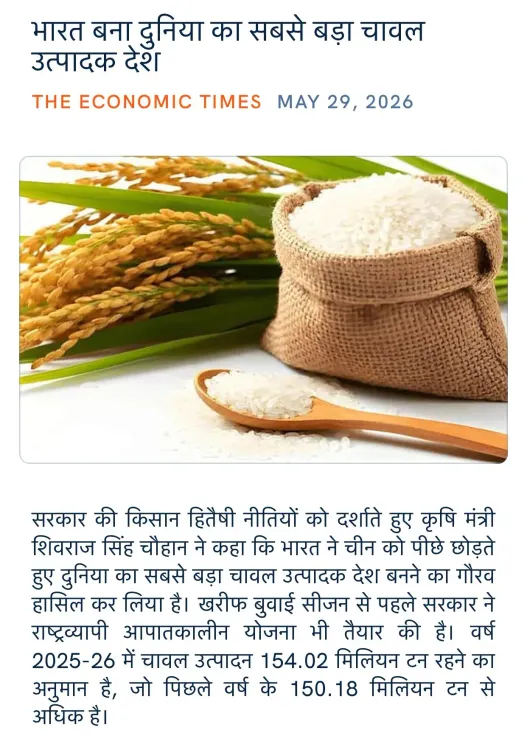
The minister's post, which translates from Hindi as 'Bharat bana duniya ka sabse bada chawal utpadak desh' ('India has become the world's largest rice-producing country'), was shared via the NaMo App, the official digital platform used to disseminate government updates and policy milestones to a wide audience. While Singh heads the Textiles Ministry, senior BJP leaders routinely amplify achievements across sectors as part of the party's broader governance communication strategy.
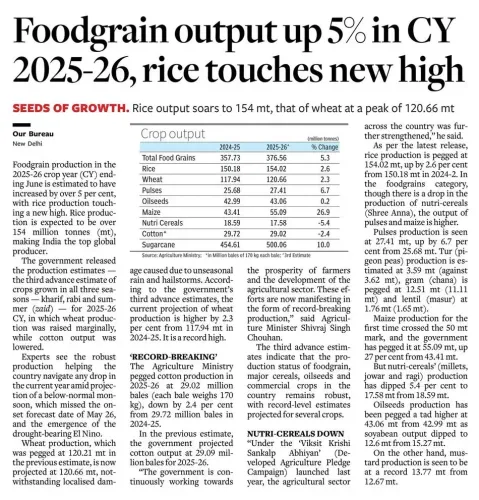
The claim marks a significant milestone in India's decades-long pursuit of agricultural self-sufficiency, positioning the country ahead of traditional rice-powerhouses such as China in terms of total production volume.
Policy Backdrop
India's rise as a dominant rice producer is rooted in structural policy investments stretching back over six decades. The Green Revolution, launched from 1965 onwards, introduced high-yielding seed varieties and expanded canal and tube-well irrigation, dramatically lifting output across the Indo-Gangetic plain.
The National Food Security Mission, launched in 2007, further targeted rice, wheat and pulse production through improved seed distribution and technology transfer to farmers. The National Food Security Act of 2013 reinforced record procurement norms and buffer stock requirements, ensuring that rising production translated into food security for hundreds of millions of citizens.
More recently, the PM-KISAN direct income-support scheme, operational since 2019, has provided financial assistance to landholding farmers cultivating staple crops including rice, sustaining cultivation incentives at the grassroots level.
Stakeholders and Impact
The development holds direct significance for India's estimated 120 million rice-farming households, particularly in states such as West Bengal, Uttar Pradesh, Punjab, Andhra Pradesh, and Odisha, which account for the bulk of national paddy cultivation. A higher production ranking strengthens the bargaining position of Indian exporters in global commodity markets.
Agricultural exporters stand to benefit from the reputational and commercial weight that the 'largest producer' status carries in international trade negotiations. At the same time, policymakers will need to balance export ambitions against domestic price stability, a tension that has historically prompted periodic export restrictions on non-basmati rice.
What's Next
Attention will now turn to forthcoming global crop assessments from bodies such as the Food and Agriculture Organisation (FAO) and the United States Department of Agriculture (USDA), whose official outlooks will either corroborate or contextualise the production ranking. Any announcement from the Ministry of Agriculture on revised minimum support prices, procurement targets, or export policy for the 2026 kharif season will be closely watched by farmers, traders and importing nations alike.
India's emergence as the top rice producer, if confirmed by multilateral data, would mark a structural shift in global food geopolitics and could reinforce calls for a larger Indian role in international food-security governance.
Point of View
Using every ministerial voice to reinforce a broader narrative of governance achievement. The 'largest rice producer' claim, if validated by FAO or USDA data, would represent a genuine structural shift in global food economics — not merely a domestic talking point. It also arrives at a politically sensitive moment: the government must simultaneously manage farmer income expectations, export policy, and inflationary pressures on rice, all of which pull in different directions. The post signals that the ruling party intends to claim this milestone prominently ahead of any official multilateral confirmation.
NationPress
20 Sept 2026
Frequently Asked Questions
Has India become the world's largest rice producer?
Union Textiles Minister Giriraj Singh shared on 29 May 2026 that India has become the world's largest rice-producing country. The claim awaits formal confirmation from multilateral bodies such as the FAO and USDA, whose global crop outlooks serve as the authoritative benchmark.
Which country was previously the largest rice producer in the world?
China has historically been the world's largest rice producer. India surpassing China in total rice output, if confirmed by global agricultural data, would mark a significant shift in the global food production landscape.
What government schemes helped India increase rice production?
Key schemes include the Green Revolution from 1965, which introduced high-yielding varieties and expanded irrigation; the National Food Security Mission launched in 2007; the National Food Security Act of 2013, which strengthened procurement norms; and the PM-KISAN income-support scheme from 2019.
Why is Giriraj Singh, the Textiles Minister, posting about rice production?
Senior BJP leaders routinely share significant national milestones across sectors as part of the party's governance communication strategy, regardless of their specific ministerial portfolio. Giriraj Singh shared the news via the NaMo App platform.
What is the NaMo App?
The NaMo App is an official digital platform associated with the Prime Minister's Office used to share government updates, policy milestones, and news with a wide public audience. Ministers and party leaders frequently use it to amplify national achievements.