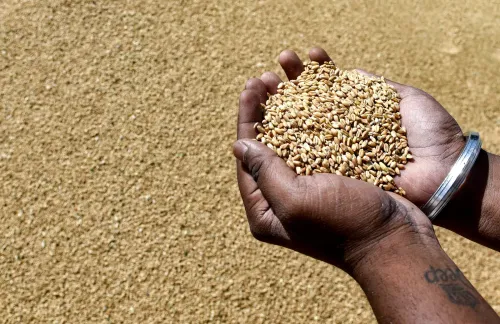
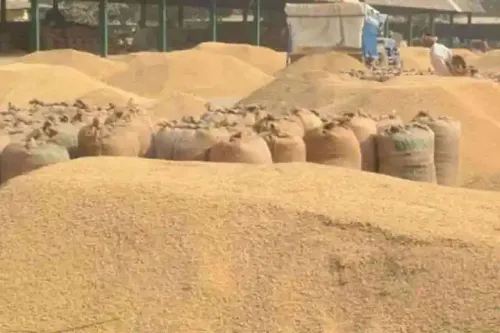
Giriraj Singh Hails Record 376.56 MT Foodgrain Output in 2025-26
Synopsis
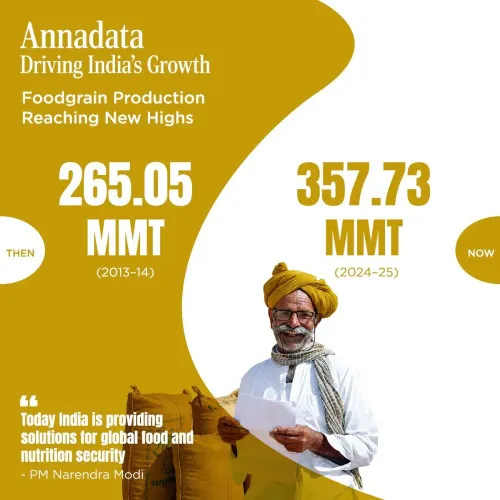
Union Textiles Minister Giriraj Singh has highlighted data showing India's foodgrain production reached a record 376.56 million tonnes in crop year 2025-26, a 5.3% increase, with rice at 154.02 MT and wheat at 120.66 MT — framing the milestone as proof of Atmanirbhar Bharat's success.
Key Takeaways
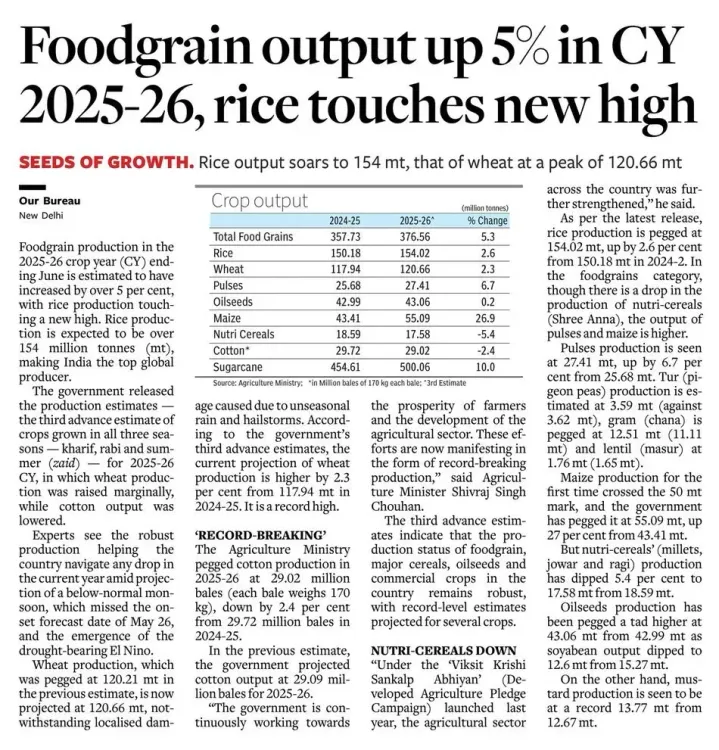
India's total foodgrain production in 2025-26 is claimed to have reached a record 376.56 million tonnes , up 5.3% year-on-year.
Rice output stood at 154.02 million tonnes and wheat output at 120.66 million tonnes , both described as all-time highs.
Union Textiles Minister Giriraj Singh linked the milestone to the Atmanirbhar Bharat framework launched in 2020.
The figures are subject to confirmation via official advance estimates from the Ministry of Agriculture .
Record output could revive policy debate on easing rice and wheat export restrictions to benefit farmers.
Union Textiles Minister Giriraj Singh on Thursday, 28 May 2026 shared data claiming India's total foodgrain production in crop year 2025-26 has reached a record 376.56 million tonnes, marking a 5.3 per cent rise over the previous year, with rice and wheat output touching new highs.
Context
Posting on X, Giriraj Singh highlighted that rice production stood at 154.02 million tonnes and wheat production at 120.66 million tonnes — both described as fresh peaks. In Hindi, he wrote: 'यह ऐतिहासिक सफलता 'आत्मनिर्भर भारत' के संकल्प और ग्रामीण समृद्धि की ओर बढ़ते कदमों को दर्शाती है' ('This historic achievement reflects the resolve of Atmanirbhar Bharat and the steps being taken towards rural prosperity'). The minister framed the output milestone as reinforcing India's food security on a global scale.
Singh, who holds the Textiles portfolio and represents Begusarai, Bihar in the Lok Sabha, is a senior BJP leader who regularly amplifies government achievements across policy domains on social media.
Policy Backdrop
India has recorded successive bumper harvests since at least 2019-20, when total foodgrain output crossed 315 million tonnes, climbing further past that mark in subsequent years. The government has anchored this trajectory to policies of Minimum Support Price (MSP) assurances, expanded irrigation infrastructure, and improved seed technology reaching farmers at the grassroots level.
The Atmanirbhar Bharat framework, launched in 2020, formalised a whole-of-government push for domestic self-sufficiency — agriculture being one of its central pillars. Annual production milestones are routinely cited by the ruling dispensation as evidence that the programme is delivering tangible outcomes for the rural economy.
Stakeholders and Impact
Indian farmers and the broader rural economy are the primary stakeholders in any foodgrain production record. A sustained rise in output — if confirmed by official advance estimates — can ease domestic food inflation, reduce dependence on imports, and potentially open space for calibrated export policy on commodities such as rice and wheat.
Higher production also strengthens the government's negotiating position in global commodity markets and provides buffer stocks that insulate the country against supply shocks triggered by erratic monsoons or geopolitical disruptions to global grain trade.
What's Next
The figures cited in the post are expected to be validated through the Ministry of Agriculture's official advance estimate releases, including the fourth advance estimate for crop year 2025-26. Any revision to these numbers — upward or downward — will be closely watched by commodity markets and food policy analysts.
Separately, a record wheat and rice harvest of this scale is likely to renew debate in policy circles over export restrictions on key cereals, which were tightened in earlier years to protect domestic supply. With buffer stocks potentially at elevated levels, pressure may build on the government to ease those curbs and allow farmers to benefit from international price discovery.
Point of View
Making the post as much a political statement as an agricultural one. If the figures are borne out by official estimates, they would represent a significant acceleration in India's foodgrain growth curve and strengthen the government's food-security narrative globally. The key analytical question is whether the production gains translate into farm-gate income improvements — a metric that has historically lagged behind headline output numbers.
NationPress
11 Oct 2026
Frequently Asked Questions
What is India's total foodgrain production in 2025-26?
According to a post by Union Textiles Minister Giriraj Singh, India's foodgrain production in crop year 2025-26 has reached a record 376.56 million tonnes , a rise of 5.3% over the previous year. These figures are expected to be confirmed by the Ministry of Agriculture's official estimates.
What is India's wheat and rice production in 2025-26?
The post claims rice production reached 154.02 million tonnes and wheat production reached 120.66 million tonnes in 2025-26, both described as all-time highs.
What is Atmanirbhar Bharat and how does it relate to agriculture?
Atmanirbhar Bharat is a self-reliance initiative launched in 2020 by the Indian government to promote domestic production across sectors. In agriculture, it is associated with policies such as MSP assurances, irrigation expansion, and seed technology support aimed at boosting foodgrain output and reducing import dependence.
Why is Giriraj Singh, a Textiles Minister, commenting on agriculture?
Giriraj Singh is a senior BJP leader and frequently uses social media to amplify the government's achievements across policy areas, not limited to his Textiles portfolio. Such cross-portfolio messaging is a common practice among ruling-party ministers to reinforce the government's broader development narrative.
Will India ease wheat and rice export restrictions after this record harvest?
A record harvest of this scale could renew pressure on the government to revisit export curbs on wheat and rice that were tightened in earlier years. Any policy change would depend on confirmed buffer stock levels and domestic price conditions, and would be announced by the relevant ministries.