Shivraj Singh Chouhan Hails Record 3,765.63 LT Foodgrain Output
Synopsis
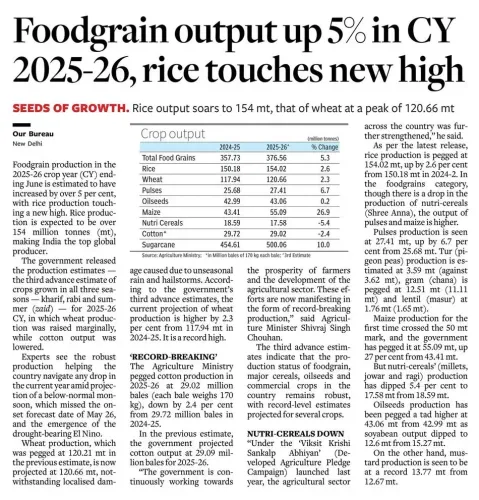
Union Agriculture Minister Shivraj Singh Chouhan cited the government's third advance estimate on 27 May 2026, announcing a record foodgrain production of 3,765.63 lakh tonnes. He credited PM Modi's leadership, ICAR scientists, Krishi Vigyan Kendras, and Indian farmers for the milestone spanning rice, wheat, maize, oilseeds, and sugarcane.
Key Takeaways
The government's third advance agricultural estimate projects India's total foodgrain production at a record 3,765.63 lakh tonnes .
Record output has been reported across rice, wheat, maize, groundnut, mustard, and sugarcane , indicating broad-based crop diversification.
Minister Chouhan credited ICAR scientists, Krishi Vigyan Kendras , and agriculture ministry officials alongside farmers for the achievement.
The announcement aligns with a long-running government practice of publicising advance estimates to highlight policy outcomes since 2014–15 .
Chouhan reaffirmed the government's commitment to farmer self-reliance and income growth beyond production targets.
Final production figures and kharif-season performance will determine whether the record is confirmed.
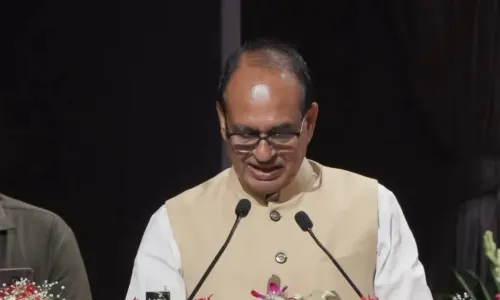
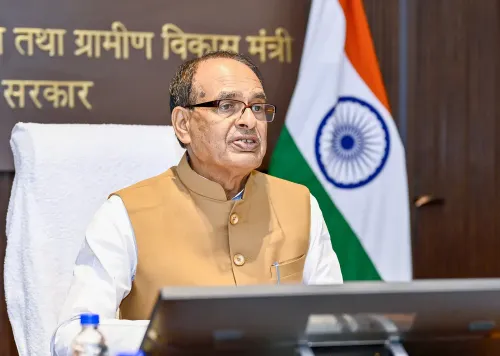
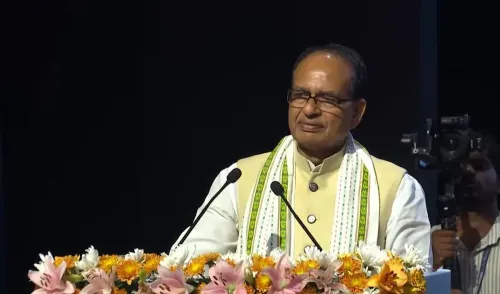
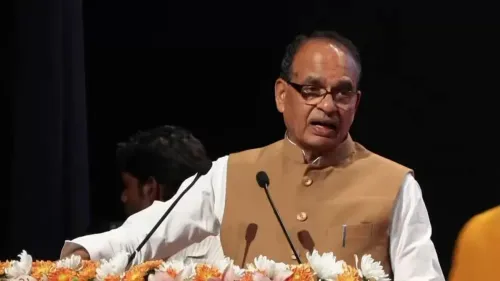
Union Agriculture Minister Shivraj Singh Chouhan on Wednesday, 27 May 2026 credited Prime Minister Narendra Modi's leadership and the hard work of Indian farmers for what the government's third advance agricultural estimate describes as a historic foodgrain production of 3,765.63 lakh tonnes — a record high for the country.
Context
Chouhan shared the figures on X, writing: 'आज जारी तीसरे अग्रिम कृषि अनुमान ने एक बार फिर यह सुनिश्चित किया है कि भारतीय कृषि निरंतर विकास की ओर अग्रसर है' ['Today's third advance agricultural estimate has once again confirmed that Indian agriculture is steadily progressing']. He attributed the milestone to modern farming techniques, research, and innovation pursued under the current government.
The minister specifically cited record output in rice, wheat, maize, groundnut, mustard, and sugarcane as evidence that farmers are embracing crop diversification alongside scientific cultivation methods. He congratulated farmers, scientists at the Indian Council of Agricultural Research (ICAR), officials of the Ministry of Agriculture, and staff at Krishi Vigyan Kendras across the country.
Policy Backdrop
The government has released advance estimates of foodgrain production annually, with figures showing a progressive upward trend since 2014–15. These estimates, issued in multiple rounds, are used by policymakers to plan procurement, storage, and distribution ahead of final harvest data.
Successive central governments have prioritised output growth through expanded irrigation, improved seed varieties, and stronger research-extension linkages. The PM-KISAN direct income-support scheme, launched in 2019, supplements farmer earnings alongside production-focused programmes. Chouhan's post fits a well-established ministerial practice of publicly amplifying advance estimates to underscore policy outcomes.
ICAR, as the apex national body for agricultural research and education, and the district-level Krishi Vigyan Kendras have been central to disseminating new crop varieties and precision-farming practices to cultivators at the grassroots level.
Stakeholders and Impact
If the advance estimate is borne out by final figures, a total foodgrain output of 3,765.63 lakh tonnes would represent a significant addition to national food reserves and export potential. Diversification across oilseeds such as mustard and groundnut, and cash crops such as sugarcane, signals a shift beyond the traditional rice-wheat belt that policymakers have long sought.
Farmers, the primary stakeholders, stand to benefit from better market prices driven by diverse produce. Agricultural scientists and extension workers at Krishi Vigyan Kendras, specifically acknowledged by the minister, have played a direct role in technology transfer at the field level. The minister reaffirmed the government's commitment: 'हमारे किसान आत्मनिर्भर बनें, उनकी आय बढ़े, इसके लिए हम प्रतिबद्ध हैं' ['We are committed to making our farmers self-reliant and increasing their income'].
What's Next
The third advance estimate will be followed by final production figures later in the agricultural year, which will confirm or revise the record claim. Analysts and farm-sector observers will watch whether state governments align procurement and storage infrastructure to absorb the higher output without depressing farm-gate prices.
Any supplementary allocations for agricultural research in the next Union Budget, and the pace of adoption of new crop varieties in the upcoming kharif season, will indicate whether the production momentum is sustained. The minister's emphasis on farmer income — not just output — also signals that policy attention may increasingly shift toward price realisation and value-chain development.
Point of View
Timed to the release of the third advance estimate and designed to frame record production as a vindication of the Modi government's decade-long agricultural modernisation agenda. By naming ICAR and Krishi Vigyan Kendras alongside farmers, the minister broadens the credit beyond political actors, lending the claim institutional credibility. The pivot in the closing lines toward farmer income — not just output — is notable: it pre-empts the standard opposition critique that bumper harvests do not automatically translate into rural prosperity. Whether the final estimates confirm the advance figures, and whether farm-gate prices hold, will be the real test of the narrative being constructed here.
NationPress
11 Oct 2026
Frequently Asked Questions
What is India's foodgrain production record in 2026?
According to the government's third advance agricultural estimate released on 27 May 2026, India's total foodgrain production has reached 3,765.63 lakh tonnes , described as a historic high.
Which crops have shown record production in India in 2026?
Agriculture Minister Shivraj Singh Chouhan cited record output in rice, wheat, maize, groundnut, mustard, and sugarcane , pointing to broad crop diversification across the country.
What is the third advance agricultural estimate in India?
The government releases multiple rounds of advance estimates for foodgrain production before final harvest data is available. The third advance estimate is typically the most refined pre-final projection, used for procurement and food-security planning.
What is ICAR's role in India's agricultural growth?
ICAR (Indian Council of Agricultural Research) is India's apex body for agricultural research, education, and extension. It develops improved seed varieties and technologies that are disseminated to farmers through district-level Krishi Vigyan Kendras.
What is PM-KISAN and how does it support farmers?
PM-KISAN , launched in 2019 , is a direct income-support scheme that provides financial assistance to eligible farmer families, supplementing earnings alongside production-focused agricultural programmes.